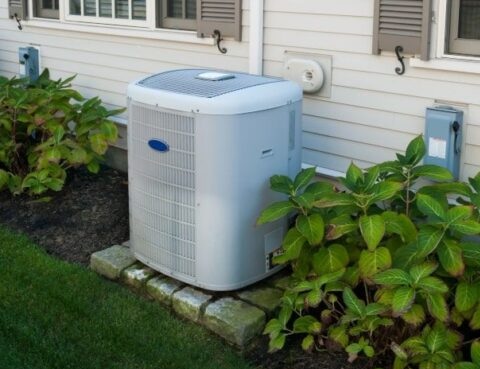
The big number on a new air conditioner is its SEER2 rating. Higher is better. That’s the pitch.
But here’s what most buyers never hear. A big part of that rating comes from a lab test run at 82 degrees outside.
Dallas-Fort Worth’s normal July high is 95.6 degrees, according to the National Weather Service. And in 2026, DFW logged at least 52 days at 100 or hotter.
So is a high-SEER2 unit worth the extra money in North Texas? Sometimes. Not always. If you’re pricing out AC installation and replacement in Frisco or anywhere else in DFW, here’s the math, and who high efficiency actually works for.
What SEER2 measures: a milder summer than yours
SEER2 stands for Seasonal Energy Efficiency Ratio 2. It replaced the old SEER rating on Jan. 1, 2023, after the Department of Energy updated the test.
The new test pushes air through the system at higher pressure, closer to what real ductwork does. That’s why SEER2 numbers look lower than old SEER numbers. A 14.3 SEER2 unit is roughly equal to the old 15 SEER.
What didn’t change is where the testing happens. The seasonal rating is built from lab points at 82 and 95 degrees outdoors. For variable-speed systems, some test points are even cooler than that.
Nothing in the rating requires testing above 95 degrees. Not 100. Not 105. Not the 109 degrees DFW hit this August.
That doesn’t make SEER2 useless. It’s still the best way to compare two units side by side. It just tells you how efficient a system is on a typical day, not on a North Texas July afternoon.
The number that matters more here: EER2
There’s a second rating most homeowners skip. It’s called EER2.
EER2 is tested at one fixed point: 95 degrees outside, 80 degrees inside. That’s a lot closer to a DFW summer day.
Here’s why it matters. Two units can have similar SEER2 ratings and very different EER2 ratings. A high-SEER2 unit that gets most of its score from mild-weather performance can lose efficiency fast when the heat climbs.
Federal rules even recognize this. In the Southwest region (Arizona, California, Nevada and New Mexico), new air conditioners have to meet EER2 minimums too. Texas is in the Southeast region, where only the SEER2 minimum applies. That’s 14.3 SEER2 for most home-size split systems.
So in Texas, nobody makes you check EER2. You should anyway.
The audit: savings calculators assume you run your AC more than you do
Most online SEER calculators ask for one key input: how many hours a year your AC runs at full power. A common default is 2,100 hours.
That number drives everything. Double the hours, double the savings.
The trouble is that real homes don’t run like the formula assumes. A 2016 study presented at ACEEE compared published full-load cooling hours with what systems actually logged in the field. Measured hours averaged 60% to 70% of the published values.
Why the gap? People adjust the thermostat. Houses sit empty. And a lot of systems are oversized, so they cool the house faster and shut off sooner.
That means a lot of “you’ll save $500 a year” promises are built on hours your system may never run.
The bill math: a 3-ton system in North Texas
Here’s what a typical 3-ton system (36,000 Btu per hour) costs to run each year at different efficiency levels. The math uses 17 cents per kilowatt-hour. That’s close to Texas’ highest monthly average residential rate this year, 16.99 cents in April, according to the U.S. Energy Information Administration. July averaged 15.88 cents, so if your rate is lower, your savings will be a little smaller.
Since nobody knows your exact run time, here are three scenarios:
- Light use: 1,400 hours. About two-thirds of the calculator default, in line with the ACEEE field findings.
- Calculator default: 2,100 hours.
- Heavy use: 2,800 hours. A long, brutal summer in a house that’s kept cool all day.
Annual cooling cost by efficiency (light / default / heavy use)
- Older 13 SEER unit (about 12.4 SEER2): $691 / $1,036 / $1,382
- 14.3 SEER2 (federal minimum): $599 / $899 / $1,198
- 16 SEER2: $536 / $803 / $1,071
- 18 SEER2: $476 / $714 / $952
- 20 SEER2: $428 / $643 / $857
Formula: annual kWh = Btu per hour × hours ÷ SEER2 ÷ 1,000. The older unit’s SEER2 figure is an estimate based on the roughly 5% gap between the two ratings.
How much you save each year over a 14.3 SEER2 unit (light / default / heavy use)
- 16 SEER2: $64 / $95 / $127
- 18 SEER2: $123 / $185 / $246
- 20 SEER2: $171 / $256 / $342
Two things jump out.
First, the biggest win is getting rid of an old system. Going from an aging 13 SEER unit to even the federal minimum saves $92 to $184 a year in these scenarios. Going to 18 SEER2 saves $215 to $430.
Second, each step up above the minimum saves less than the one before it. The jump from 14.3 to 16 is worth about $95 a year at the default hours. Not nothing. Not life-changing either.
The payback problem
Higher efficiency costs more up front. HomeGuide’s 2026 pricing puts a 3-ton system at:
- Standard efficiency (13–14 SEER): $5,300 to $7,900 installed
- High efficiency (15–16 SEER): $6,700 to $9,300
- Very high efficiency (19–21 SEER): $9,100 to $12,200
Using the middle of each range, stepping up to a high-efficiency unit costs about $1,400 more. Very high efficiency costs about $4,000 more.
Now compare that to the savings:
- 16 SEER2 at default hours: about 15 years to pay back $1,400. About 11 years with heavy use.
- 20 SEER2 at default hours: about 16 years to pay back $4,000. About 12 years with heavy use.
Most central air conditioners last 10 to 15 years. So on electric bills alone, the top-tier units often don’t pay for themselves.
But bills aren’t the whole story.
Why some North Texans still win with high efficiency
The best high-efficiency units are usually two-stage or variable-speed. They don’t just slam on and off. They run longer at lower speed.
That changes how the house feels:
- Better humidity control. Longer, slower cycles pull more moisture out of the air.
- More even temperatures. Fewer hot upstairs bedrooms.
- Quieter operation. Low speed is a lot quieter than full blast.
For a two-story house in Prosper or McKinney with a bonus room that never cools down, that comfort may be worth more than the bill savings.
The exception: homes with electric resistance heat
There’s one group where the math changes completely.
More than 25% of Texas households pair central AC with electric resistance heat, according to a 2024 ACEEE report. That’s the old-style heat strip setup. It’s simple. It’s also expensive to run in winter.
Swapping that setup for a heat pump saved about 2,535 kWh per home per year in ACEEE’s analysis. Most of that, about 2,300 kWh, came from heating. The report found space heating costs dropped about 50%.
At 17 cents per kWh, that’s roughly $430 a year. That beats every step up over the federal minimum in the lists above. And since a heat pump handles both heating and cooling, you’re replacing one system, not two.
If your home has electric heat strips, ask about a heat pump before you compare SEER2 numbers.
So who should care? Three kinds of North Texas homeowners
1. Your AC just died and you’re on a budget.
A properly sized 14.3 to 16 SEER2 system is a reasonable choice. You’ll still save real money over a unit from the early 2000s. Ask for the EER2 rating and pick the better one between two similar quotes.
2. You’re staying 10+ years and your house runs hot or humid.
Look at two-stage or variable-speed systems in the 16 to 18 SEER2 range. The bill savings alone may not pay it off, but the comfort and humidity control often do. Make sure the contractor does a real load calculation so the system isn’t oversized.
3. You have electric resistance heat.
Start with a heat pump. In North Texas, the winter savings can beat anything you’ll get from a higher SEER2 number.
In every case, installation matters as much as the rating. A high-efficiency unit installed on leaky, undersized ducts won’t hit its numbers. If you’re comparing quotes, ask the installer to size the system to your house and check the ductwork before you buy.
The bottom line
SEER2 is a useful number. It’s just not a North Texas number.
It’s tested in conditions milder than a DFW summer. Savings calculators often assume more run time than real homes log. And the top tiers rarely pay for themselves on bills alone.
What works here is simpler. Replace old systems before they fail. Check EER2, not just SEER2. Size the unit right. And if you have heat strips, look hard at a heat pump.