
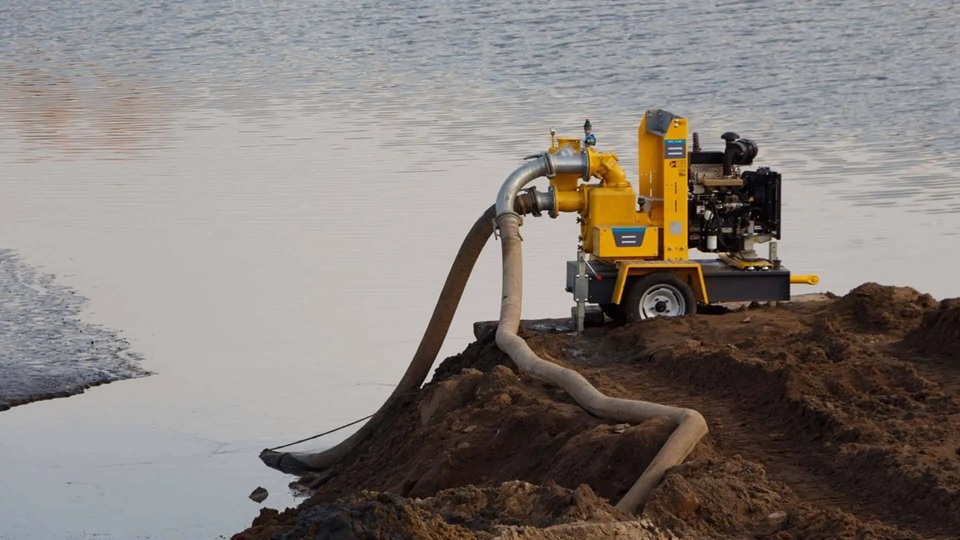
Water arrives on a construction site whether the programme allows for it or not. Rain fills excavations, groundwater seeps into trenches, and a basement dig can turn into a pond overnight. Keeping work moving means pumping that water out quickly, often with equipment that is moved from pit to pit, started and stopped many times a day, and left running unattended. For most of that work, site teams reach for a self priming pump.
This article explains why self-priming designs suit construction dewatering, what limits their suction lift, how solids handling and impeller type interact, and what to check before hiring or buying a unit. General pump theory comes from the Wikipedia entry on centrifugal pumps. Series ranges and test details come from BBP, a pump manufacturer that publishes its self-priming range by application.
Why ordinary centrifugal pumps struggle on site
Every centrifugal pump needs liquid in its casing before it can pump. If the casing fills with air, the impeller becomes gas-bound and cannot move water at all. Under normal conditions, a standard centrifugal pump cannot evacuate air from a suction line that rises to it from a lower water level, which is exactly the situation in a pit or trench where the pump sits on the edge.
The traditional fix is a foot valve at the bottom of the suction hose to hold water in the line between runs. On a construction site that valve sits in mud, gravel and debris. Once it leaks or jams, the line drains, the pump loses prime and someone has to refill the casing by hand.
Limit: a foot valve is cheap. Depending on one is not, especially on a night shift when nobody is standing next to the pump and the only sign of trouble is a flooded trench at dawn.
How a self priming pump solves the restart problem
A self priming pump keeps a reserve of liquid inside its own casing. On start-up, that retained liquid is used to create the vacuum needed to draw water up from below the pump, while air is separated and pushed out through the discharge. Once the casing has been filled on the first installation, the pump can reprime itself even after the suction line has run completely dry. BBP gives a reprime time of 30 to 120 seconds, depending on pipe length and lift height.
There is a price for that convenience. The Wikipedia entry notes that the separation chamber needed for self-priming has an adverse effect on pump efficiency and makes the casing relatively large. For dewatering, where reliable restarts matter more than a few points of efficiency, that is usually an acceptable trade.
Trade-off: on long-running clean-water transfer at a fixed location, a flooded-suction centrifugal pump may cost less to run.
Suction lift: the limit no brochure can beat
Self-priming pumps still pull water up by creating a vacuum, so atmospheric pressure sets the ceiling. BBP quotes a suction lift of up to 25 ft (7.6 m) and is explicit that this is not a product feature: it is a physical limit set by atmospheric pressure at sea level for water at ambient temperature. Any claim of more lift for ordinary water should be treated with suspicion.
In practice the usable lift is lower. Friction in long or small-diameter suction hose, higher altitude and warm water all eat into the margin. Site crews get better results by keeping the pump as close to the water as access allows, using the shortest suction hose that reaches, and lowering the pump on a ramp or bench as an excavation deepens.
Risk: a pump installed near its lift limit may run well on a cool morning and lose prime in the afternoon sun.
Solids, impellers and avoiding clogging
Site water is rarely clean. It carries sand, stones, leaves and the occasional glove, and clogging is the most common reason a dewatering pump stops on a working day. Impeller choice decides what the pump can swallow. BBP’s guidance is that closed impellers give the highest hydraulic efficiency but clog on anything larger than about 6 mm, while semi-open impellers pass 2-inch spherical solids without stalling.
That is why dewatering contractors tend to keep two kinds of unit. The same manufacturer’s range shows the split:
- Clean-water series: 40 – 250 GPM at 30 – 120 ft head, closed impeller, for general transfer and settled water.
- Trash series: 100 – 500 GPM at 20 – 80 ft head, semi-open or open impeller, for water carrying solids up to 2 inches.
- Diesel series: 30 – 300 GPM at 30 – 90 ft head, for off-grid dewatering where there is no site power yet.
Strainers still matter. Even with a trash pump, a strainer on the suction end keeps out objects larger than the impeller passage and protects the wear plate.
Planning a dewatering setup for excavations
Excavations differ. A shallow trench may need one small pump for a few hours, while a deep basement below the water table can need several units running day and night for weeks. Start with the volume. Estimate inflow from rainfall on the excavation area and groundwater seepage, then add a margin for storms. Next, establish the total head: suction lift plus discharge height plus friction in the hose run to the settlement tank or drain. Pick a pump whose curve covers that head at the required flow, not just its maximum flow at zero head.
Discharge planning is part of construction compliance. Silty water usually has to pass through a settlement tank or filter bag before it reaches a drain or watercourse, and that adds head as well as space on site. Finally, decide on power. Diesel units start anywhere but need refuelling and noise control; electric units are quieter but depend on site supply.
Testing, lead time and what to ask a supplier
A pump that arrives untested is a gamble on a deadline-driven site. BBP states that every pump it ships is tested at 1.5× working pressure and sampled at three duty points, with a performance curve tied to the serial number. For standard series variants, it quotes lead times of typically 4–8 weeks, which matters when dewatering has to be in place before excavation starts.
When comparing units, ask for the actual curve, the maximum solids size, the reprime time at your expected lift, and the seal arrangement for gritty water. Contractors who want to compare published series ranges against their own site conditions can review a self priming pump range before ordering. Matching impeller to water, lift to atmosphere and flow to the real inflow keeps pits dry and crews working.






