
Every infrastructure maintenance budget carries the same line item: repainting, re-galvanising and eventually replacing steel that was never wrong in strength terms — it simply corroded. In chloride-laden coastal air, in chemical plants and water treatment works, and on structures that are expensive to access, the cost of keeping steel serviceable often exceeds its purchase price within a decade.
Pultruded FRP profiles are the material answer that has moved from pilot projects to standard specification over the past two decades. This article sets out where they earn their place, and — more usefully — the specification points that determine whether a profile survives its design life or disappoints in year three.
What “pultruded FRP” actually means
FRP (fiber-reinforced polymer, also fiber-reinforced plastic) is a composite of reinforcing fibers and a polymer resin matrix. When the reinforcement is glass, the same family is called GFRP or, in UK and European supplier literature, GRP. Carbon-reinforced FRP is CFRP and belongs to a different cost bracket.
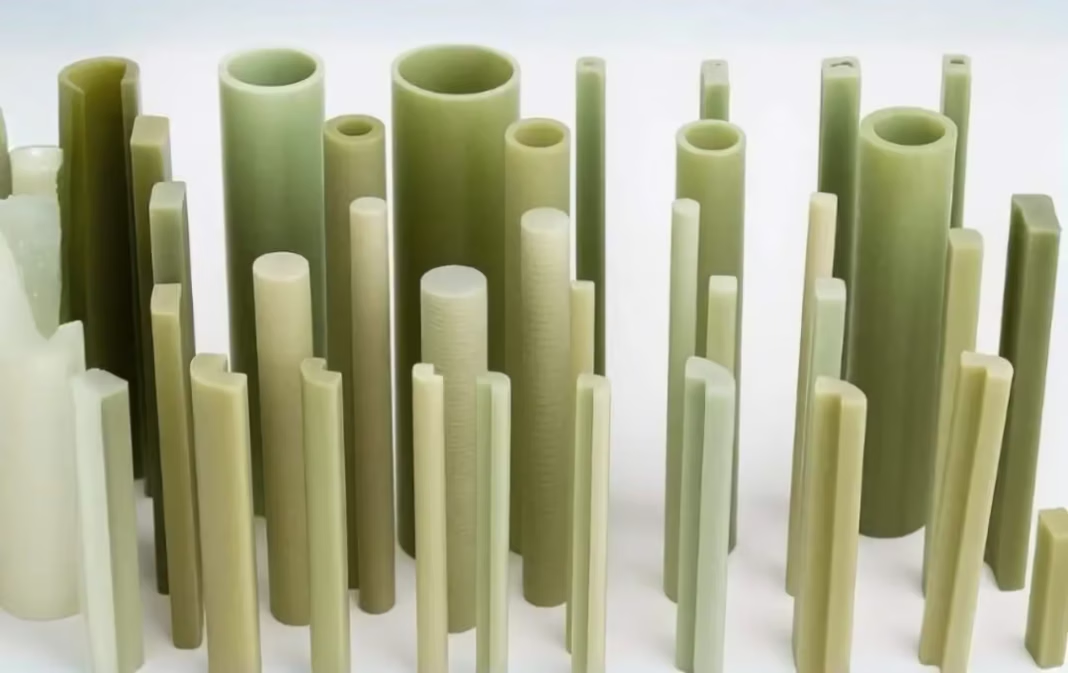
Pultrusion is the manufacturing route: continuous E-glass roving is pulled through a resin bath or injection chamber, compacted by a pre-former, cured inside a heated die at roughly 120–180 °C, drawn at 0.3–1.5 m/min and cut to length. The result is a constant-cross-section profile — I-beams, channels, angles, tubes, rods, flat bars, custom shapes — with glass content of 60–70% by weight, and unidirectional fibers aligned exactly where the axial load goes.
The property set that matters to a structural engineer: density 1.8–2.1 g/cm³ — about 75% lighter than steel; tensile strength 240–400 MPa; tensile modulus 17–28 GPa depending on the system; thermal conductivity 0.3 W/m·K, roughly one-seventeenth that of steel; and zero rust, zero galvanic corrosion and no chloride pitting. The full range of sections and their design data is catalogued by manufacturers such as F1 Composite, whose pultruded FRP profiles cover structural shapes, gratings, window and door systems and finished assemblies.
Five infrastructure applications where the case is settled
1. Walkways, platforms and handrails. A pultruded walkway system can be installed by two people without a crane, in a live chemical or water treatment plant, without hot work permits. Grating and handrail arrive ready to bolt. This is where most FRP conversions start, and where payback is shortest.
2. Cable trays, ladder racks and pipe supports. In substations, tunnels and process plants, FRP cable management brings dielectric strength of 10–14 kV/mm — no separate earthing, no risk of a steel support becoming the fault path. The same non-conductivity suits rail and metro environments.
3. Coastal and marine structures. Jetty access platforms, desalination plant internals, sea-water intake structures, walkways above tidal splash zones. Here the resin choice — not the profile shape — decides performance: vinyl ester systems resist chloride and hydrolysis far better than general-purpose polyester.
4. Solar mounting and substation frames. Where humidity and salt fog attack galvanised steel within a few years; FRP frames combine corrosion immunity with thermal insulation.
5. Building fabric: windows, doors and facade supports. With conductivity of 0.3 W/m·K, glass-FRP window profiles support passive-house-grade thermal performance while remaining free of the thermal bridges that metal frames require engineers to mitigate.
The specification points that decide survival
Most FRP disappointments trace back to a specification written as if the profile were steel.
Resin system. Isophthalic polyester is the cost/performance default for general structural work. Vinyl ester is the right call for chemical, chloride and hydrolysis exposure — say so explicitly, and name the exposure in the specification. Polyurethane brings 3–5× the flexural toughness of polyester for impact-prone parts such as rail interiors and battery trays. Phenolic is specified where low smoke and toxicity govern, in rail (EN 45545-2) and building fire classes, and needs a test report for the actual formulation.
Stiffness governs, not strength. With a tensile modulus of 17–28 GPa against steel’s ~200 GPa, an FRP section that matches a steel section in strength will deflect far more than the steel one did. The practical rule: size for deflection and you will rarely need to check strength. Engineers who copy a steel section across and only compare allowable stresses are the ones who end up with a bouncing walkway.
Surfacing and UV. Specify a resin-rich surface veil (typically 0.2–0.4 mm) and UV stabilisers. Unprotected laminate that looked perfect at handover greys and exposes fiber within a couple of seasons of direct sun.
Fire performance. Fire class is a project requirement, not a supplier default — state the class, the standard and the test report you expect, and ask for it with the quotation.
Standards and tolerances. Ask for EN 13706 or ASTM D3917 dimensional tolerance (±0.25 mm typical) and test data to ASTM D638 (tension), D790 (flexure), D695 (compression) and D2344 (interlaminar shear). A supplier who cannot produce test data per profile family is a supplier to walk away from.
Standard shapes or a custom die?
For beams, channels, angles, tubes and rods, standard tooling means short lead times and no tooling cost — the sane first choice, since even a large catalogue of standard shapes covers most process plant, walkway and support work. Where the geometry is project-specific — a bespoke panel edge, a hybrid profile that carries services inside the section, a frame sized to a client’s glazing system — a custom pultrusion becomes economic. Budget the full path: cross-section design and approval, steel die manufacture, trial run and sample approval, then first production. Total custom die lead time is typically 6–10 weeks, with die manufacture the dominant item. Get the cross-section right at the drawing stage, because the die is the expensive milestone.
Handling, fabrication and installation
Pultruded profiles behave like hardwood in the workshop and nothing like steel on site. Cut and drill with carbide or diamond tooling and normal dust extraction; never weld. Bolted connections with galvanised or stainless hardware are standard, with washer plates sized for the bearing stress of the laminate. Because the coefficient of thermal expansion is around 8 × 10⁻⁶/°C — close to concrete and aluminium — long runs need expansion provision in the same way aluminium curtain walling does. Store flat and supported; a 6 m or 12 m profile left on two blocks in the sun will take a set.
The life-cycle case
On purchase price alone, FRP loses to painted steel and often to galvanised steel. On total cost it wins in aggressive service because the maintenance line goes to zero: no repainting cycles, no rust-driven replacement of handrails, no hot work, and installation by smaller crews with lighter plant. When you present the option internally, price it over 20 years of maintenance, not over the first invoice.
What to send a pultruder for a firm quote
A usable enquiry contains six things: the cross-section or dimensions; the quantity and whether it is a one-off or repeat; the service environment (chemicals, chloride, UV, temperature, fire class); the mechanical or deflection requirement; the standards and test data you expect; and the destination. With those, a manufacturer can either quote from standard tooling or tell you honestly that the job needs a custom die. Send a defined requirement to F1 Composite and the response will come back as a scoped quotation rather than an invitation to negotiate.
Conclusion. Pultruded FRP is not a substitute for steel everywhere — it is the correct answer wherever corrosion, conductivity, weight or thermal bridging is the governing problem. Specify the resin for the exposure, size for deflection, insist on test data with the quotation, and the maintenance line on your asset register stops growing pultruded-frp-profiles.






