Construction companies can survive a lot. Delayed permits, labor shortages, material cost spikes, and brutal weather all come with the territory. What many firms do not survive, however, is growth without financial discipline. A company can land bigger contracts, hire more crews, and expand into multiple markets while the back office quietly falls apart behind the scenes. By the time leadership realizes the numbers are wrong, profit fade has already started eating the business alive.
This problem shows up constantly in construction accounting. Revenue may look healthy on paper while margins shrink project after project. Executives often assume the issue lies in operations or estimating, but the real problem is usually hidden deeper inside disconnected accounting systems, inconsistent reporting, poor controls, and overwhelmed finance teams.
That is why more firms are paying attention to modern construction-focused accounting strategies and remote financial talent models like the ones offered by TGG Accounting. As construction grows more complex, the companies that scale successfully are often the ones that treat financial infrastructure as seriously as field operations.
Growth Exposes Weaknesses
Many construction businesses operate successfully for years with lean accounting departments. A controller wearing five hats may be enough when the company handles a manageable number of jobs. The trouble starts when growth accelerates faster than internal systems can keep up.
Suddenly, payroll complexity increases. Job costing becomes harder to track accurately. WIP reporting starts lagging behind reality. Change orders pile up faster than they are documented. Vendors get paid late because approvals sit in email chains nobody can find.
None of this feels catastrophic at first. In fact, many firms still believe they are doing well because top-line revenue keeps climbing. Then one quarter closes with margins far below expectations, and leadership realizes they cannot fully explain where the money went.
Construction accounting is highly specialized. Generic bookkeeping processes rarely work in this environment because contractors deal with retainage, progress billing, union labor, equipment allocation, and constantly shifting project timelines. If financial controls are weak, small errors compound fast.
The Controls Problem
One of the biggest hidden threats in construction accounting is the lack of standardized internal controls. Many growing firms rely too heavily on institutional knowledge rather than documented systems. When one experienced employee leaves, entire reporting processes suddenly break.
This is one reason businesses increasingly turn toward outsourced accounting for construction companies instead of trying to build oversized in-house departments from scratch. Firms that specialize in construction finance already understand the workflows, reporting requirements, and operational pain points unique to the industry.
Companies like TGG Accounting Construction Services focus on helping contractors create scalable financial systems that continue functioning even during periods of rapid growth. Remote accounting models also widen the talent pool significantly. Construction companies are no longer restricted to whoever happens to live nearby.
The labor challenge is real. Experienced construction accountants are difficult to find, and even harder to retain. Remote opportunities have changed expectations across the workforce, especially among high-level accounting professionals who want flexibility without sacrificing career growth.
That shift matters because modern construction firms need finance teams capable of handling:
- Detailed job costing
- Cash flow forecasting
- WIP schedule analysis
- Project profitability tracking
- Multi-entity reporting
- Compliance and audit preparation
- Real-time operational reporting
These are not secondary tasks. They directly impact whether a contractor stays profitable as projects scale.
For leaders evaluating modern accounting support structures, for a good idea of how this works, visit TGG-Accounting.com to learn more and explore how remote accounting teams integrate directly into construction operations without disrupting field productivity.
<iframe width=”560″ height=”315″ src=”https://www.youtube.com/embed/QHX4nCX9Z7o?si=PWygcfZT_jkAfPgI” title=”YouTube video player” frameborder=”0″ allow=”accelerometer; autoplay; clipboard-write; encrypted-media; gyroscope; picture-in-picture; web-share” referrerpolicy=”strict-origin-when-cross-origin” allowfullscreen></iframe>
Profit Fade Starts Small
Profit fade rarely arrives all at once. It usually begins with small reporting inconsistencies that leadership overlooks because projects still appear active and revenue still looks strong.
Maybe labor costs were coded incorrectly for two months. Maybe a project manager delayed entering change orders. Maybe subcontractor expenses were recognized late. One issue by itself may not destroy margins, but several combined across multiple projects create a dangerous financial blind spot.
Construction companies depend heavily on timing accuracy. If financial reporting trails reality by even a few weeks, leadership starts making decisions based on outdated numbers. Hiring, equipment purchases, expansion planning, and bidding strategy all become riskier when the financial picture is incomplete.
This becomes especially dangerous during rapid growth periods. Many contractors expand aggressively after landing larger commercial projects or government contracts, but growth increases operational complexity immediately. Without disciplined accounting controls, the business starts scaling confusion instead of scaling profitability.
Remote Talent Advantage
The accounting workforce changed dramatically over the last several years. Top financial professionals increasingly want remote flexibility, and construction firms that resist this reality often struggle to compete for talent.
The companies adapting fastest are gaining an advantage. Instead of searching locally for one overworked controller, they now build distributed accounting teams with specialized expertise. That creates better continuity, stronger reporting systems, and deeper operational support.
Remote accounting models also help reduce burnout. Construction accounting can become intense during month-end close cycles, major project transitions, and year-end reporting. Firms with stronger staffing support structures generally produce more accurate financial reporting because workloads stay manageable.
This matters because construction finance is not just about compliance. It directly shapes operational strategy. Accurate reporting helps contractors bid more effectively, manage labor allocation better, and identify underperforming projects before they spiral out of control.
That is where improving profit margins through better financial management becomes less of a slogan and more of a survival strategy. The contractors that consistently outperform competitors are usually the ones with stronger visibility into project-level financial performance.
Why Systems Matter
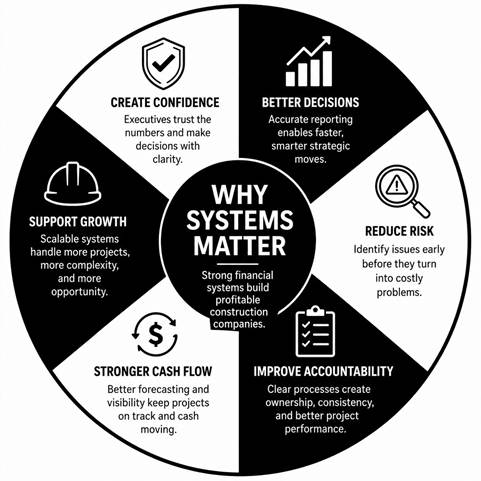
A construction company does not need the biggest accounting department to succeed. It needs repeatable systems, reliable reporting, and financial leadership that understands construction operations at a deep level.
Strong financial controls create confidence. Executives can make faster decisions because they trust the numbers in front of them. Project managers understand accountability expectations clearly. Cash flow forecasting improves. Risk exposure becomes easier to identify before it creates damage.
The opposite is also true. Weak controls create hesitation and confusion. Leadership spends more time chasing missing information than planning strategically. Eventually, the business becomes reactive instead of proactive.
Construction remains one of the toughest industries to scale profitably because margins are often tight even during strong market conditions. That reality makes operational discipline essential, especially inside the back office where financial visibility either strengthens decision-making or quietly undermines it.
Construction companies do not usually fail because of one disastrous project. More often, they struggle because financial controls fail to evolve alongside growth. Profit fade, reporting gaps, and overwhelmed accounting teams slowly chip away at stability until leadership realizes the business expanded faster than its systems could support. Firms that invest early in scalable accounting infrastructure place themselves in a much stronger position to grow without losing control of profitability along the way.