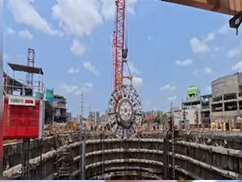
The National High Speed Rail Corporation Limited (NHSRCL) announced on Sunday that the initial Tunnel Boring Machine (TBM) cutterhead has been lowered at Vikhroli, located in the eastern suburbs of Mumbai, for the purpose of constructing a tunnel as part of the Mumbai-Ahmedabad bullet train initiative.
The cutterhead, which has a diameter of 13.6 meters and weighs 350 tonnes, was lowered on Sunday, signifying the completion of the primary assembly phase of the TBM’s main shield for the high-speed rail corridor project, according to an NHSRCL release.
Two TBMs, each exceeding 3,000 tonnes in weight, are currently being assembled for the development of a 16-km segment of the 21-km-long Mumbai tunnel. This section includes a 7-km undersea tunnel beneath Thane Creek, which will represent India’s first undersea rail tunnel, as stated in the release. “The TBMs are the largest machines utilized to date for rail tunnel construction within the country.
The cutterhead has been engineered to excavate a single tunnel sufficiently large to accommodate both the up and down lines of the bullet train corridor. The 350-tonne component was delivered to the site in five separate shipments and was assembled using approximately 1,600 kg of high-precision welding,” the NHSRCL noted.
The unit is equipped with 84 cutter discs designed to penetrate the rock face, 124 scrapers intended to remove debris at the tunnel face, and 16 bucket lips for gathering and directing the excavated material into the pipeline system for removal from the tunnel, as informed by the release.
The TBM will excavate an estimated 6-km stretch from Vikhroli to Bandra Kurla Complex (BKC), traversing beneath densely populated urban areas and the Mithi river before arriving at the under-construction Mumbai bullet train station at BKC, as highlighted in the release. “A variety of monitoring instruments are being implemented to ensure safe tunneling and safeguard nearby structures during the excavation process.
These instruments include Surface Settlement Points (SSP), Optical Displacement Sensors (ODS), strain gauges, and seismographs for monitoring vibrations and seismic waves,” it further added.