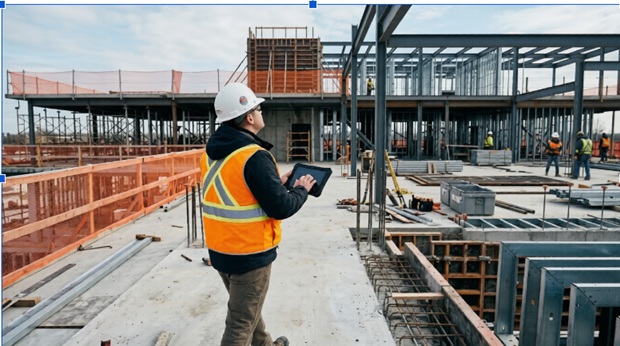
Construction safety audits keep failing for the same handful of reasons, year after year. The cost shows up in citations, repeat violations, project delays, and injuries that were preventable from the start. A construction safety audit reviews how a site controls its known hazards, documents its programs, and trains its workforce against recognized standards.
Most sites fail not because the standards are unclear, but because the gap between policy and practice never closes before the inspector arrives. The same five or six failure patterns surface across project types, project sizes, and regions.
This article walks through the recurring failure modes auditors see on construction sites and the practical fixes that keep findings off the report.
The Real Reasons Audits Fail
Five patterns account for most failed audits on active construction sites. None of them are new, and all of them are preventable.
- Fall protection gaps. Unguarded edges, missing anchor points, and personal fall arrest systems that workers either don’t use or don’t know how to inspect.
- Hazard communication failures. Missing safety data sheets, unlabeled secondary containers, and written programs that haven’t been updated since the site mobilized.
- Documentation that exists in pieces. Training records on one supervisor’s phone, inspection logs in a truck, corrective actions tracked nowhere.
- Multi-employer coordination breakdowns. Subcontractors operating under their own rules, with no shared hazard awareness or written agreement on who controls what.
- Training that looks good on paper. Sign-in sheets without comprehension checks, refresher cycles that lapsed months ago, and language barriers no one accounted for.
OSHA’s preliminary Top 10 most-cited standards for fiscal year 2025 reflect these patterns directly.
Fall Protection led the list for the fifteenth consecutive year with 5,914 citations. Hazard Communication followed at 2,546, Ladders at 2,405, Control of Hazardous Energy at 2,177, and Respiratory Protection at 1,953. Scaffolding, eye and face protection, and machine guarding round out the construction-relevant entries.
The order shifts slightly year to year, but the categories don’t. Sites that fail audits are usually failing inside one or more of these same boxes, which means the citation risk is predictable long before an inspector shows up.
Documentation Gaps That Sink Inspections
Most audit failures live in the paperwork, not the field conditions. Auditors check a familiar set of documents, and any of them missing or out of date will surface as a finding.
- Written safety program. A site-specific plan covering known hazards, control measures, and roles. Generic templates pulled from a binder rarely survive review.
- Hazard assessments. A documented evaluation for each major task, dated, signed, and tied to the specific scope of work.
- Training records. Proof that each worker received the training their job requires, in a language they understand, with the date and the trainer named.
- Equipment inspection logs. Daily or pre-shift checks on ladders, scaffolding, lifts, harnesses, and powered tools. Gaps here become a fast citation.
- Corrective action records. Evidence that previous findings, near misses, and reported hazards were actually closed out, not just logged.
Documentation gaps consistently surface in OSHA enforcement summaries and third-party audit findings as a contributing factor across multiple citation categories, from HazCom to fall protection to lockout/tagout.
Missing or outdated programs, incomplete training records, and unverifiable corrective actions consistently appear among the top citation drivers across the construction sector.
The pattern holds across project sizes, from residential remodelers to large infrastructure contractors. What separates audit-ready sites from the rest is not better paperwork in volume, but a tighter loop between what happens on the ground and what gets recorded the same day.
Hazard Communication and SDS Access
Hazard Communication has held the number-two spot on OSHA’s most-cited list for years. The reasons are consistent: missing or outdated safety data sheets, secondary containers without proper labels, written HazCom programs that don’t reflect the chemicals actually on site, and training workers can’t recall or apply when asked.
On a construction site, the problem is amplified by mobility. Chemicals arrive with the day’s deliveries, get used across multiple work zones, and leave with the crew that brought them. A binder of SDSs in the site trailer is a starting point, not a compliance answer. Workers in a parking deck three floors above the trailer cannot reach a paper binder during an exposure event, which is exactly when an SDS matters most.
Many contractors have moved toward digital safety data sheet management to keep records accessible across trailers, mobile devices, and shared subcontractor folders. This addresses one of the most common HazCom citations: SDSs that exist somewhere but cannot be reached from where the work is happening.
Between 2021 and 2025, OSHA recorded roughly 37,000 hazard communication violations nationwide, with construction and manufacturing together accounting for more than half of all citations.
The most frequently cited specific failures involve missing or outdated SDSs, inadequate written programs, and insufficient worker training on chemical hazards. The downstream effect runs wider than the HazCom citation itself.
Without a current SDS, the respirator selection, glove choice, and emergency response plan all lose their foundation, and the related standards become citable in their own right.
Multi-Employer Worksites: Where Audits Break Down
Construction sites rarely have one employer. They have a general contractor, several subcontractors, specialty trades, and sometimes a separate construction manager. OSHA’s Multi-Employer Citation Policy assigns responsibility across four roles, and audits regularly catch the gaps between them.
| Employer role | Primary responsibility | Where audits catch gaps |
| Controlling | Has overall authority over the worksite, typically the general contractor | Failure to detect, correct, or stop subcontractor hazards in plain view |
| Creating | Causes the hazardous condition through their own work | Subcontractors leaving hazards in place after their task ends |
| Exposing | Has employees exposed to a hazard, even one they didn’t create | No documented request for correction from the creating employer |
| Correcting | Tasked with fixing a specific hazard, such as installing fall protection | Incomplete or untracked corrections, with no closeout record |
General contractors are regularly cited as controlling employers under OSHA’s multi-employer policy when subcontractor hazards are visible and uncorrected.
The standard the GC violates is often a basic one, fall protection or scaffolding, but the citation lands because the GC had authority to act and didn’t.
The fix is rarely more inspections. It’s a written coordination agreement that names who controls what, a shared hazard register accessible to every employer on site, and a daily verification routine that survives schedule pressure.
Training That Looks Good on Paper
Auditors don’t trust sign-in sheets on their own. They interview workers. A signed roster means nothing if the worker can’t describe the hazards they were trained on, the controls they’re supposed to use, or where to find their respirator fit-test record.
Four checks separate real training from documented training:
- Comprehension: Can the worker explain the hazard in their own words?
- Language access: Was the training delivered in a language the worker understands fluently?
- Role-specific content: Did the training match the work the person actually does, not a generic orientation?
- Refresher cadence: Is the training current under the standard, with documented refreshers when the work scope changes?
Sites that pass training-related audit checks tend to share one habit: they treat training as ongoing, tied to the work, and verified through conversation. Sites that fail tend to treat it as a one-time event recorded once and assumed permanent.
Building Audit-Ready Sites
Closing the gap between policy and practice is mostly procedural. Contractors who pass audits consistently run a tight version of the same five-step routine.
- Reconcile the chemical inventory against SDS holdings weekly. Any product on site without a current SDS gets flagged the same day.
- Review the written HazCom program quarterly. Update it whenever a new chemical, process, or subcontractor enters the site.
- Write multi-employer coordination into contracts. Each subcontract should name the shared hazard register, the SDS access method, and the toolbox-talk schedule.
- Document toolbox talks weekly with topic, attendees, and a comprehension check. A photo of the sign-in sheet is not enough. Include what was discussed and what workers were asked to demonstrate.
- Track corrective actions to closure. Every reported hazard, near miss, or inspection finding gets a named owner, a deadline, and a verified closeout. Open items longer than 30 days get escalated.
None of these steps require new technology. What they require is the discipline to run them when the schedule gets tight, which is exactly when they get skipped on sites that later fail audits.
Why Audit Outcomes Matter
A failed safety audit is rarely the worst outcome of a weak safety program. The worst outcome is the incident the audit would have prevented. Citations carry financial penalties, but the operational damage from a serious injury, a fatality, or a stop-work order is substantially larger, and the reputational damage lasts longer than the project.
Audit-ready sites share a basic discipline. They treat safety documentation, hazard communication, multi-employer coordination, and training as continuous work, not a binder to dust off before an inspection.
For site managers and contractors, the most useful next step is a walkthrough audit against the current OSHA Top 10, run by someone outside the project team, with every finding tracked to closure. The findings will be uncomfortable. The alternative, finding them through an inspector or an incident, is far more expensive.