
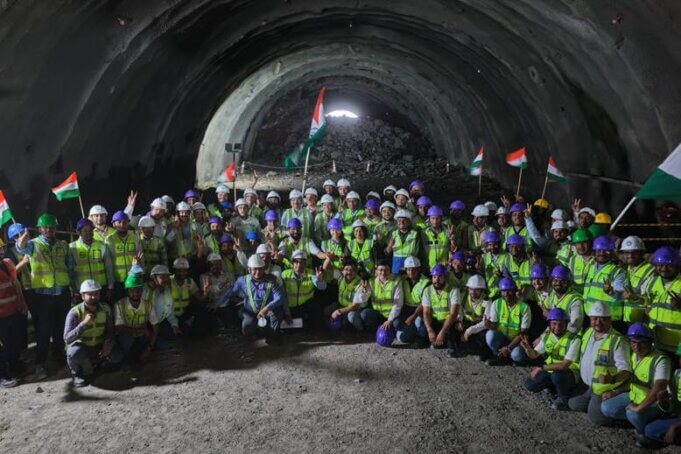
A key breakthrough has been achieved in India’s first high-speed rail corridor, the Mumbai–Ahmedabad Bullet Train Project, with the completion of the third mountain tunnel (MT-07) at Ambesari village in Dahanu Taluka, Palghar district, Maharashtra. This progress shows steady and rapid work in one of the most challenging parts of the project, which runs through difficult mountain terrain in western India.
The MT-07 tunnel measures 417 metres in length and 14.4 metres in width, and is designed to accommodate both up and down tracks of the high-speed rail corridor. Excavation was carried out using controlled drilling and blasting from both ends, supported by advanced tunnelling methods and strict engineering supervision. The execution required high precision to ensure minimal impact on surrounding rock structures, groundwater conditions, and nearby settlements, making it one of the more sensitive construction zones in the corridor.
Advanced Engineering and Safety Systems
During the excavation process, engineers deployed a wide range of real-time monitoring and safety technologies to ensure structural stability and worker protection.
Key monitoring systems included:
- Surface Settlement Points (SSP) for tracking ground movement
- 3D target systems to detect structural deformation
- Strain gauges for measuring stress distribution in rock layers
- Seismographs to monitor vibration levels caused by blasting
These instruments were continuously monitored to ensure that tunnelling operations remained within safe geological limits. The Western Ghats region, particularly in Palghar district, consists of variable basalt rock formations, making constant geotechnical assessment essential to prevent instability.
Worker safety was given high priority throughout construction. Ventilation systems ensured continuous airflow inside the tunnel, while fire safety arrangements, emergency access routes, and controlled entry protocols helped maintain safe working conditions. Continuous supervision by engineering and safety teams further reduced operational risks during blasting and excavation cycles.
Earlier Tunnel Breakthroughs in Maharashtra
The MT-07 breakthrough builds upon a series of earlier tunnelling milestones achieved in the Maharashtra section of the project.
- The first breakthrough, MT-05 (1.5 km), was completed near Saphale on 2 January 2026, marking the first mountain tunnel completion in the state for the bullet train corridor.
- The second breakthrough, MT-06 (454 m), followed on 3 February 2026 and was excavated using the New Austrian Tunnelling Method (NATM), which is widely used in complex geological conditions.
With the completion of MT-07, three mountain tunnel breakthroughs have been achieved within a span of five months, indicating a strong pace of execution and improved tunnelling efficiency in the region.
Overall Tunnel Development Progress
The tunnelling network in Maharashtra forms a critical structural component of the high-speed rail alignment.
- Out of seven mountain tunnels in Maharashtra, three (MT-05, MT-06, MT-07) have already achieved breakthroughs
- MT-08 (350 metres) was completed earlier in October 2023
- MT-03 has crossed approximately 80% excavation progress
- MT-04 is nearing 60% completion
- MT-01 and MT-02 are under active excavation and progressing steadily
In total, the Mumbai–Ahmedabad corridor includes eight mountain tunnels, of which seven are located in Maharashtra and one in Gujarat’s Valsad district. This distribution reflects the challenging topography of the Western Ghats, where tunnelling is essential to maintain alignment and operational speed for the high-speed rail system.
The tunnelling activity is concentrated in the industrial and transport corridor between Boisar in Maharashtra and Vapi in Gujarat. This section is critical because it lies along a densely populated and geologically complex stretch of the Western Ghats.
Key Highlights of the Corridor
The Boisar–Vapi section of the Mumbai–Ahmedabad Bullet Train Project is one of the most technically challenging stretches due to hard rock conditions and complex terrain. It includes important mountain tunnels such as MT-06, MT-07, and MT-08, which are essential for maintaining straight alignment and ensuring smooth high-speed rail operations. The completion of these tunnels between Boisar and Vapi stations marks a major engineering achievement in this difficult region.
This section requires advanced blasting techniques, continuous geotechnical monitoring, and strong structural support systems because of difficult geological conditions and the environmental sensitivity of the Western Ghats. Maintaining alignment accuracy and tunnel stability is critical for safe and efficient high-speed rail movement. Overall, this stretch is considered one of the most challenging parts of the entire Mumbai–Ahmedabad Bullet Train Project due to terrain variability, rock formations, and ecological constraints.
The ongoing tunnelling work reflects India’s growing capability in executing large-scale infrastructure projects with precision. The Mumbai–Ahmedabad Bullet Train Project is introducing global-standard tunnelling methods such as NATM, along with advanced monitoring systems and modern construction practices. With multiple tunnels already completed and others nearing completion, the project is steadily moving toward key construction targets. Once completed, the high-speed rail corridor is expected to significantly reduce travel time between Mumbai and Ahmedabad while setting new benchmarks in speed, safety, and engineering excellence in India’s rail infrastructure sector.






