
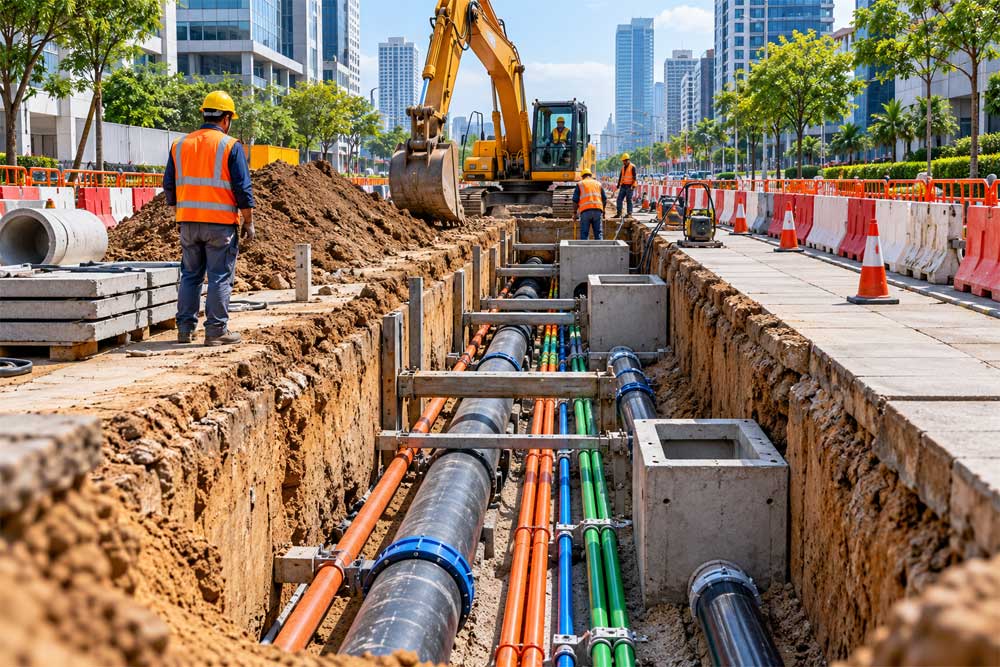
Utility trenching is an important construction method in urban infrastructure projects, where underground networks have to be installed beneath roads, footpaths, public spaces and developed areas. Water supply pipelines, sewerage systems, stormwater drains, electrical cables, telecommunications ducts, gas pipelines and other services often require excavation and underground installation.
Urban utility trenching is more complex than trenching in open areas because construction teams have to work around existing buildings, roads, traffic, pedestrians and previously installed underground services. Limited working space, varying soil conditions, groundwater and the presence of multiple utilities can further affect excavation and installation.
The selection of a trenching method depends on the utility being installed, trench depth and width, soil conditions, groundwater, road conditions, available equipment and the level of disruption that can be accepted at the site. Conventional open-cut excavation remains widely used, while narrow trenching, microtrenching and trenchless technologies provide alternatives for locations where surface disruption needs to be reduced.
Conventional Open-Cut Trenching
Open-cut trenching is one of the most commonly used methods for underground utility installation. The method involves excavating a continuous trench along the planned alignment, preparing the trench bottom, installing the utility and backfilling the excavation after installation.
Excavation is generally carried out using excavators, backhoe loaders or compact machinery depending on the size of the trench and available working space. The excavated material may be temporarily stored beside the trench where space permits or transported away from the site.
For pipeline installations, the trench bottom is normally prepared with a suitable bedding layer. The pipe is then positioned and aligned before the trench is backfilled in controlled layers.
Open-cut trenching provides direct access to the utility and allows construction teams to inspect the installation during different stages. It is suitable for many water, sewerage, drainage and electrical utility projects. However, excavation across existing roads can affect traffic movement and may require temporary diversions, barricading and phased construction.
Trench Shoring and Excavation Support
Deep or unstable trenches require appropriate excavation support to protect workers and maintain the stability of surrounding ground. Unsupported excavation can be affected by soil collapse, groundwater or loads from nearby traffic and structures.
Different trench support systems can be used depending on site conditions. These include hydraulic shoring, sheet piling, trench boxes, soldier piles with lagging and other engineered support arrangements.
Trench boxes provide a protected working area within the excavation and can be moved progressively as installation advances. Shoring systems may also be required where utility trenches are located close to buildings, existing roads or other structures.
The selection of an excavation support system should consider trench depth, soil characteristics, groundwater, nearby loads and the expected duration of excavation.
Narrow-Trench Construction
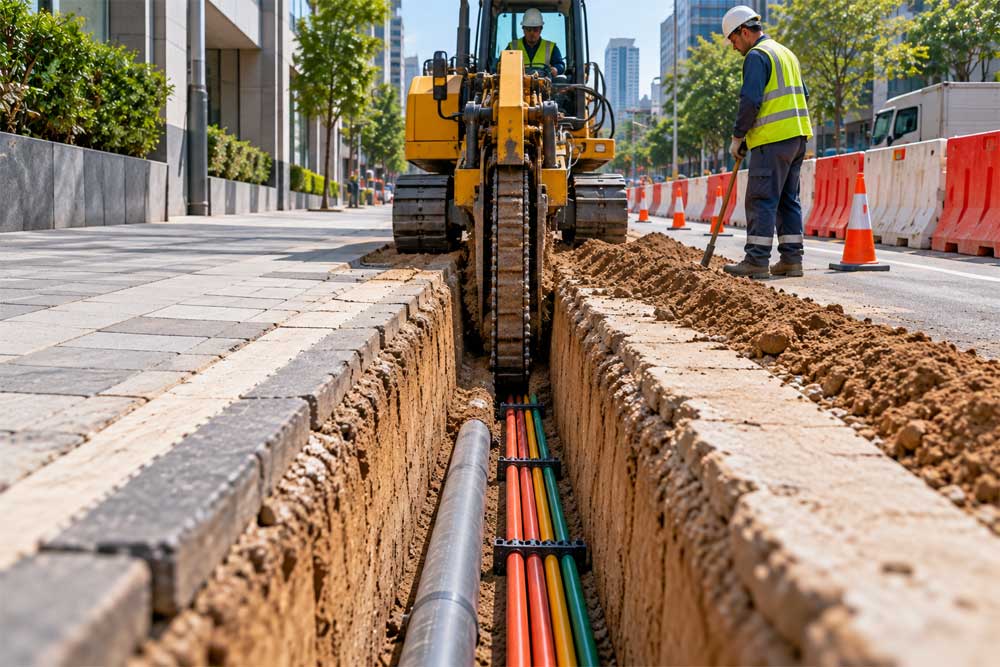
Narrow trenching is used where the utility has relatively small dimensions and the required excavation width can be reduced. Specialised trenching machines or compact excavation equipment can create narrow and relatively uniform cuts.
The method is commonly considered for telecommunications ducts, electrical conduits and selected small-diameter utility installations. Since less soil needs to be excavated and replaced, narrow trenching can reduce material handling and surface restoration requirements.
In urban areas, the method can be useful where construction space is limited. However, existing utilities and pavement conditions must be investigated before excavation.
Microtrenching
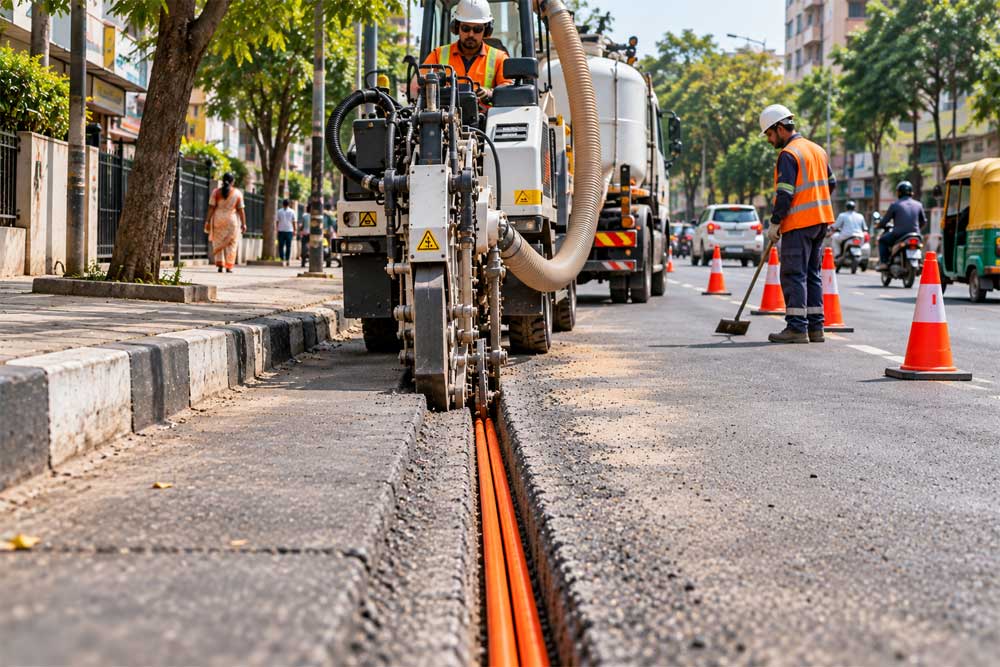
Microtrenching is a specialised method generally associated with telecommunications and fibre-optic network installation. A narrow slot is cut into an existing road or pavement using specialised equipment, after which the conduit or cable is installed and the slot is filled with an appropriate material.
Compared with conventional open-cut excavation, microtrenching can reduce the width of disturbed pavement and limit the amount of excavation required. It can therefore be considered for dense urban areas where conventional trenching would cause greater disruption.
The method requires attention to pavement thickness, conduit placement, road authority requirements, drainage conditions and protection of the installed network.
Trenchless Utility Installation
Trenchless construction methods allow underground utilities to be installed with substantially less continuous surface excavation. Instead of opening the entire route, access pits, launch shafts or reception shafts may be created at selected locations.
Horizontal directional drilling, pipe jacking and microtunnelling are among the methods used for trenchless utility installation.
These methods can be considered for crossing roads, railways, waterways and other areas where continuous excavation would be difficult. They can also help reduce disruption to traffic and existing surface activities.
Horizontal Directional Drilling
Horizontal directional drilling (HDD) involves drilling a pilot hole along a planned underground alignment. The pilot hole is then enlarged to the required diameter, following which the utility pipe or conduit is pulled through the completed bore.
HDD can be used for telecommunications, electrical conduits, water pipelines and other utilities. It is particularly useful when an underground service needs to pass beneath a road without opening the complete road surface.
The method requires accurate alignment control and a clear understanding of ground conditions. Existing underground services also need to be identified before drilling begins to reduce the possibility of utility strikes.
Microtunnelling
Microtunnelling is a remotely controlled trenchless method used for installing underground pipelines with high alignment requirements. A specialised boring machine creates the underground passage while pipes are installed progressively behind the machine.
Launch and reception shafts are normally required. Excavated material is removed from the tunnel, while hydraulic jacks provide the required thrust for pipe installation.
Microtunnelling can be used for sewerage and drainage projects, particularly where deep installation or accurate alignment is required. It is also useful in locations where surface excavation would interfere significantly with roads and existing development.
Pipe Jacking
Pipe jacking involves pushing prefabricated pipe sections through the ground using hydraulic jacks while excavation takes place at the leading end. Pipes are installed progressively from a launch shaft towards a reception shaft.
The technique can be used for road crossings and underground utility corridors. It is particularly suited to projects where surface excavation needs to be limited.
Utility Detection Before Excavation
Identifying existing underground services is one of the most important stages of urban trenching. Existing electricity cables, gas pipelines, water mains, sewer lines and telecommunications networks can create safety and construction risks if their positions are not accurately established.
Available utility drawings and records can be reviewed before excavation. Ground-penetrating radar and electromagnetic locating equipment may also be used to identify underground services. Trial pits can provide physical confirmation of the position and depth of important utilities.
Mechanical excavation near known services may need to be supplemented with controlled or manual excavation, depending on project requirements and local procedures.
Equipment Used for Utility Trenching
A wide range of equipment is used during utility trenching, with the selection depending on trench dimensions, soil conditions, utility type and site accessibility.
Excavators
Hydraulic excavators are among the primary machines used for utility trenching. They are available in different sizes and can be fitted with buckets suitable for excavation widths and depths.
Compact excavators are particularly useful in urban locations where working space is restricted. Larger excavators may be used for deep or wide trenches and high-volume excavation.
Backhoe Loaders
Backhoe loaders combine a front loader with a rear excavating arm. They are useful for smaller utility projects, road works and general excavation activities.
Their ability to perform excavation, loading and material handling makes them suitable for sites where several types of work need to be carried out using limited equipment.
Trenchers
Trenching machines are designed specifically to create relatively narrow and continuous trenches. Chain trenchers and wheel trenchers can be selected depending on soil conditions and required trench dimensions.
They can be useful for telecommunications, electrical and other utility installations where consistent trench width is required.
Vacuum Excavators
Vacuum excavation equipment uses high-pressure air or water together with suction to remove soil. It can be particularly useful for exposing existing underground utilities without relying entirely on mechanical excavation.
Vacuum excavation can help reduce the risk of damaging buried cables and pipelines during utility investigation and controlled excavation.
Hydraulic Shoring Equipment
Hydraulic shoring systems are used to support trench walls and provide protection during excavation. These systems can be installed and adjusted according to trench dimensions and ground conditions.
They are particularly relevant to deeper utility trenches and locations where soil stability is a concern.
Trench Boxes
Trench boxes provide a protected space for workers inside an excavation. They are available in different sizes and configurations and can be repositioned as trenching progresses.
The appropriate system should be selected based on trench depth, width, soil conditions and project requirements.
Compaction Equipment
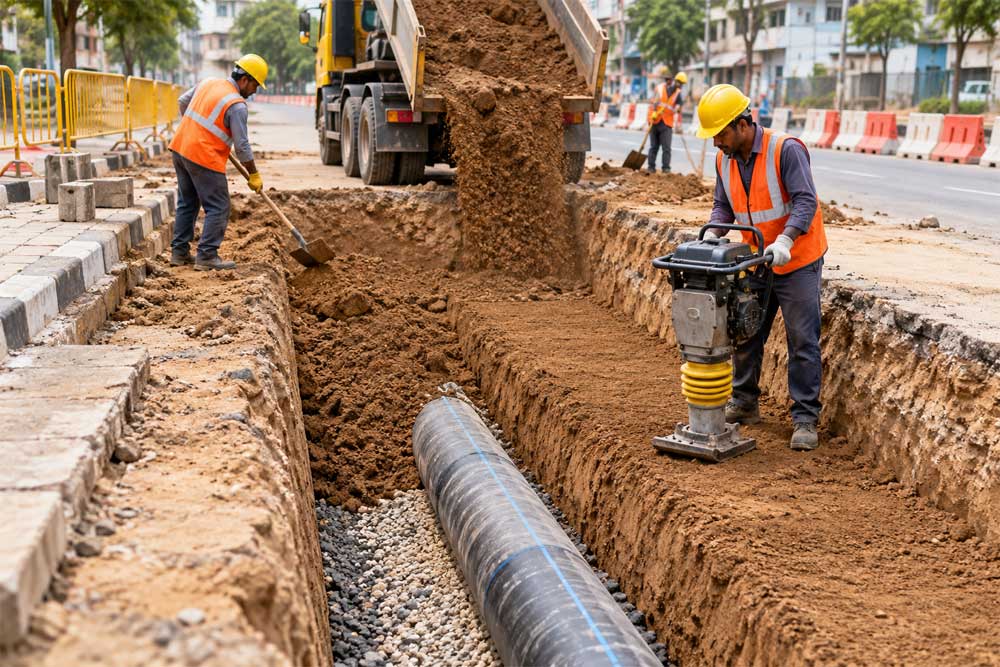
After utility installation, the trench needs to be backfilled and compacted. Plate compactors, vibrating rollers, rammers and other compacting equipment can be used depending on trench width and material type.
Proper compaction is particularly important beneath roads and pavements to minimise subsequent settlement.
Water Pumps
Groundwater or rainwater can accumulate inside excavations and interfere with utility installation. Submersible pumps and other dewatering equipment can be used to remove water from trenches where required.
Dewatering arrangements should account for groundwater conditions and the effect of pumping on nearby structures and soil.
Dump Trucks and Material Handling Equipment
Excavated soil that cannot be stored safely at the site is generally transported using dump trucks. Loaders and excavators can be used to transfer material into trucks.
Efficient material handling is important in urban projects because roadside storage space is often limited.
Pipe Laying Equipment
For larger pipelines, specialised pipe handling and lifting equipment may be required. Excavators, cranes and pipe handling attachments can position pipes within the trench while maintaining the required alignment.
Directional Drilling Equipment
HDD projects require specialised drilling rigs, drill rods, drilling-fluid systems, reamers and pipe-pulling equipment. The equipment configuration depends on pipe diameter, bore length and ground conditions.
Microtunnelling Equipment
Microtunnelling projects use remote-controlled boring machines, slurry or spoil-handling systems, hydraulic jacking equipment and guidance systems. Launch and reception shafts are required to accommodate the equipment and installation process.
Trench Backfilling and Compaction
After the utility has been installed and inspected, the trench is backfilled using approved materials. Backfilling is normally carried out in layers rather than filling the entire trench at once.
Each layer should be compacted according to the project requirements. Poor compaction can lead to settlement, pavement deformation and cracking after the road is reopened.
Special attention is required around pipes and other utilities to avoid displacement or damage during backfilling.
Road and Surface Restoration
Urban utility projects frequently require excavation through existing roads, footpaths, parking areas or landscaped surfaces. Once the trench is backfilled, the affected surface must be restored.
Road restoration may involve reinstating sub-base and base layers followed by asphalt or concrete pavement. Footpaths may require replacement of paving blocks, concrete or other surface materials.
The restoration method should be coordinated with the requirements of the relevant road or municipal authority.
Factors Influencing Trenching Method Selection
The choice between open-cut and trenchless methods depends on several factors:
- Type and diameter of utility
- Required installation depth
- Soil and geological conditions
- Groundwater level
- Existing underground utilities
- Road traffic and pedestrian movement
- Proximity of buildings and foundations
- Available working space
- Length of utility installation
- Pavement type
- Required construction duration
- Equipment availability
- Surface restoration requirements
- Environmental and safety considerations
Conclusion
Utility trenching is a key component of urban infrastructure construction and requires careful coordination between excavation, utility installation, safety, traffic management and surface restoration. Conventional open-cut trenching continues to be suitable for many projects, while narrow trenching and microtrenching can reduce excavation requirements for smaller utility networks.
For locations where open excavation would significantly disrupt roads, railways, waterways or developed areas, trenchless methods such as horizontal directional drilling, pipe jacking and microtunnelling can provide alternative installation approaches.
The equipment used also plays an important role in execution. Excavators, trenchers, vacuum excavators, trench boxes, shoring systems, compaction equipment, dewatering pumps and specialised trenchless machinery can be selected according to project conditions. Careful method selection, accurate identification of existing utilities and proper backfilling and restoration practices can help improve the quality and safety of urban utility installation projects.






