Underground metro construction is one of the most complex and technically demanding forms of urban infrastructure development. As cities expand and surface space becomes increasingly constrained, underground transit systems offer an efficient and sustainable solution for mass transportation. By operating below ground level, these systems minimize land acquisition, preserve existing urban landscapes, and reduce long-term surface disruption. However, the process of building metro systems underground involves sophisticated engineering, specialized equipment, and careful management of multiple risks.
Nature of Underground Metro Systems
An underground metro system is not limited to tunnels alone. It is an integrated network of subsurface structures designed for safe and efficient transportation.
Key components include:
- Running tunnels for train movement
- Underground stations with platforms and concourses
- Vertical shafts for ventilation and emergency access
- Cross-passages connecting parallel tunnels
- Drainage and waterproofing systems
These systems are generally preferred in:
- Dense urban cores with limited land availability
- Commercial districts where disruption must be minimized
- Areas with high property value
- Locations with heritage or environmental constraints

Construction Methods
The selection of construction methods depends on several factors, including depth, soil conditions, groundwater levels, and urban constraints. Each method is suited to specific situations and often multiple methods are combined within a single project.
Tunnel Boring Machine (TBM) Method
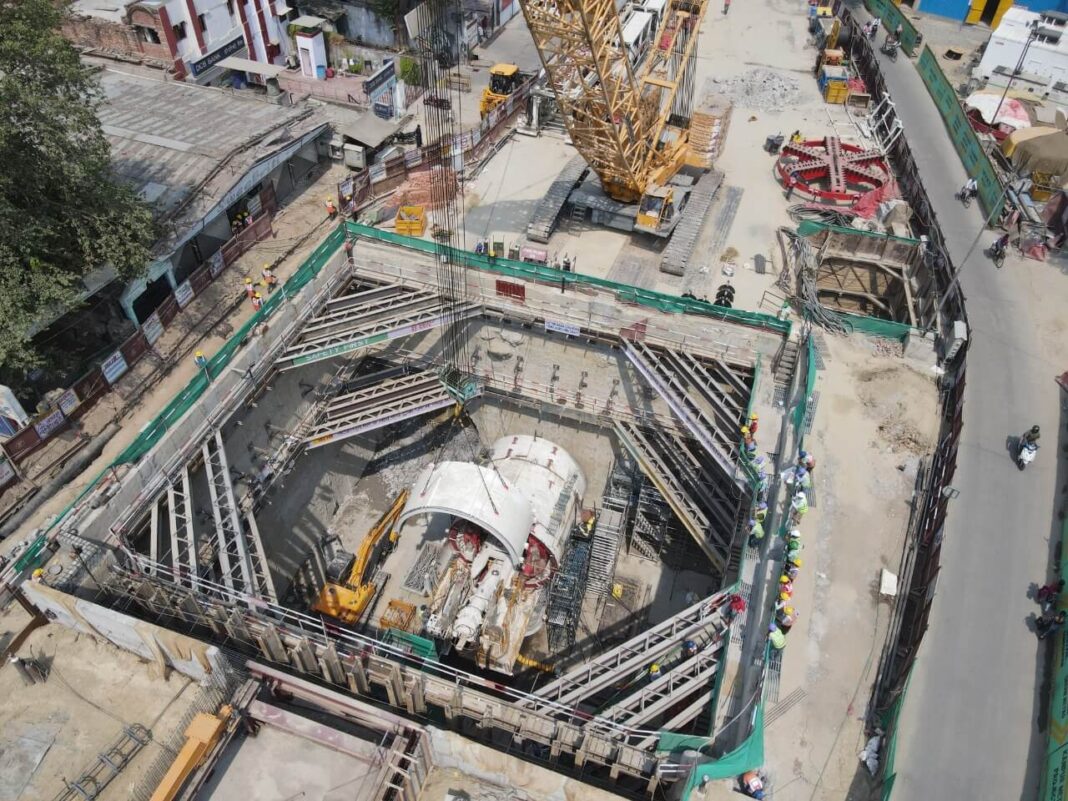
The Tunnel Boring Machine method has become the backbone of modern underground metro construction. A TBM is a highly advanced machine designed to excavate tunnels with precision while simultaneously installing structural lining.
As the machine advances, its rotating cutter head breaks the soil or rock, and the excavated material is transported out through conveyor systems. Precast concrete segments are then assembled to form the tunnel lining, ensuring structural stability.
Different types of TBMs are used depending on ground conditions. Earth Pressure Balance machines are suitable for soft soils, slurry shield machines are used in water-bearing strata, and hard rock TBMs are deployed in rocky formations. This adaptability makes TBMs highly efficient for long tunnel stretches beneath urban environments.
Cut-and-Cover Construction
Cut-and-cover is a conventional method used for shallow tunnels and underground stations. It involves excavating from the surface, constructing the required structure, and then restoring the surface above.
This method is relatively straightforward and cost-effective compared to deep tunneling. However, it significantly disrupts surface activities, including traffic movement and local businesses. For this reason, it is mainly used in areas where sufficient space is available or where temporary disruption can be managed.
Two variations are commonly used. In the bottom-up approach, excavation is completed before construction begins. In the top-down approach, structural slabs are constructed early, allowing surface activities to resume while excavation continues below.
New Austrian Tunneling Method (NATM)
The New Austrian Tunneling Method is particularly useful in complex or variable geological conditions. It relies on the principle that the surrounding ground can contribute to the stability of the tunnel when properly managed.
Excavation is carried out in small sections, and immediate support is provided using shotcrete, rock bolts, and steel supports. Continuous monitoring of ground behavior is essential, allowing engineers to adjust support systems as needed.
This method is often used for station caverns and large underground spaces where flexibility in design and execution is required.
Drill and Blast Technique
In hard rock environments, drilling and blasting remains a viable method. Holes are drilled into the rock and filled with explosives, which are detonated in a controlled manner. The fragmented rock is then removed, and support systems are installed.
While effective in certain geological conditions, this method generates vibration and noise, making it less suitable for densely populated urban areas. Its use is typically limited to locations where such impacts can be controlled.
Specialized Techniques
In specific scenarios, additional methods such as pipe jacking, box jacking, and microtunneling are used. These techniques are particularly useful for constructing tunnels beneath existing infrastructure like roads, railways, and utilities, where precision and minimal disruption are important.
Equipments Used in Underground Metro Construction
Underground construction depends on a combination of heavy machinery and support systems designed for confined environments.
Core Construction Equipment
- Tunnel Boring Machine (TBM)
- Central to tunneling operations
- Performs excavation and lining simultaneously
- Roadheaders
- Used for controlled excavation in softer rock
- Reduce vibration compared to blasting
- Excavators and Loaders
- Used in station works and soil handling
- Cranes and Hoisting Systems
- Lift heavy materials and tunnel segments
Material Handling and Support Systems
- Conveyor belts and muck cars
- Transport excavated material efficiently
- Dewatering systems
- Control groundwater and prevent flooding
- Diaphragm wall equipment
- Construct retaining walls for deep excavations
- Grouting equipment
- Stabilize soil and fill voids

Challenges in Underground Metro Construction
- Geological uncertainty with varying soil, rock layers, and fault zones
- Groundwater ingress leading to flooding risks and need for dewatering
- Ground settlement affecting nearby buildings, roads, and utilities
- Complex utility management involving relocation of pipelines and cables
- Safety risks such as tunnel collapse, fire hazards, and limited escape routes
- Limited working space restricting movement of labor, equipment, and materials
- Environmental impacts including noise, dust, and vibration during construction
- Longer construction time due to complex processes and unforeseen conditions
- Ventilation challenges with heat, humidity, and poor air quality underground
- Logistical difficulties in transporting materials, equipment, and workforce within confined tunnel spaces
The success of underground metro construction depends heavily on thorough planning and the use of modern technology. Detailed geotechnical investigations help in understanding ground conditions and selecting appropriate construction methods.
Conclusion
Underground metro construction represents a remarkable achievement of modern engineering, enabling cities to expand their transportation networks without compromising valuable surface space. It offers a long-term solution to urban mobility challenges, particularly in densely populated areas where traditional construction methods are not feasible.
Despite its advantages, underground construction involves significant complexity, high costs, and numerous technical challenges. The successful execution of such projects requires a careful balance of advanced technology, engineering expertise, and risk management. As cities continue to grow and evolve, underground metro systems will play an increasingly important role in shaping sustainable and efficient urban transportation networks.