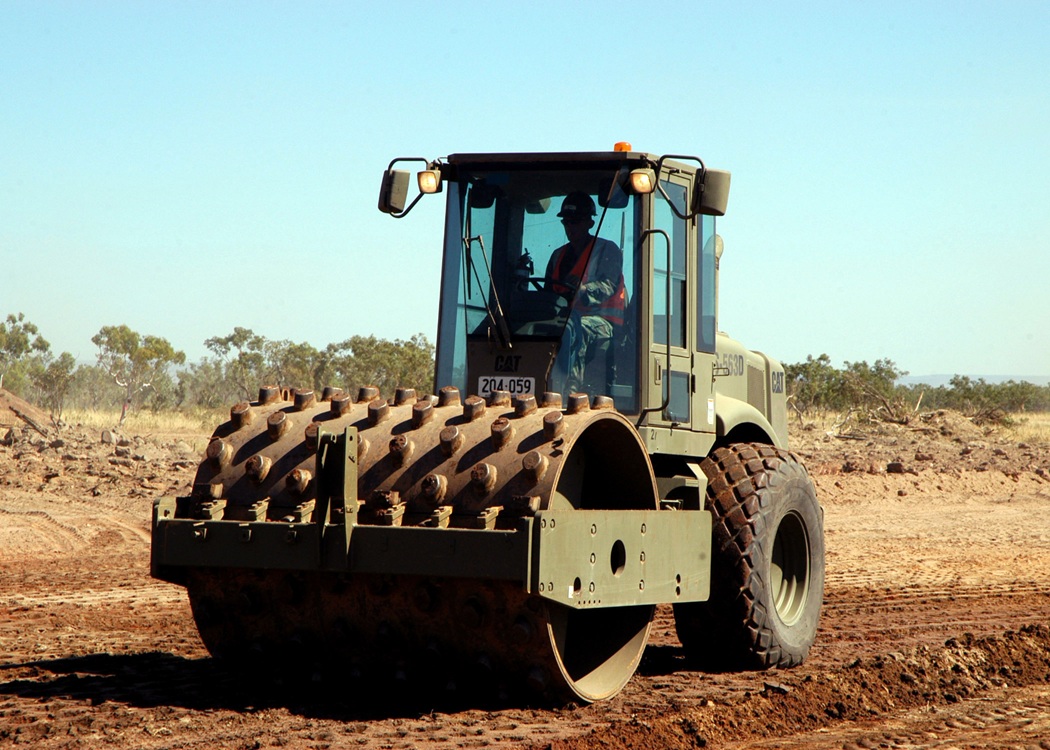
Compaction stabilization is one of the most important and widely used mechanical soil stabilization methods in road construction. It involves increasing the density of soil through mechanical means by reducing air voids between soil particles.
In road construction projects, the strength and durability of the pavement largely depend on the condition of the subgrade soil. Weak or poorly compacted soil can lead to pavement failures such as cracks, rutting, potholes, uneven settlement, and surface deformation. Compaction stabilization helps prevent these issues by improving soil density, load-bearing capacity, and overall stability.
Importance of Compaction Stabilization
The soil beneath a pavement structure must be capable of supporting repeated traffic loads and environmental stresses. Loose soil contains large air voids that reduce strength and increase settlement risks. Compaction stabilization eliminates these weaknesses and improves soil performance.
Major Objectives of Compaction Stabilization
- Increase soil density
- Reduce air voids
- Improve bearing capacity
- Enhance soil strength
- Reduce settlement
- Improve pavement durability
- Increase resistance to water penetration
- Improve load distribution
Properly compacted soil forms a strong foundation that increases the life span of roads and reduces maintenance requirements.
Purpose of Compaction Stabilization
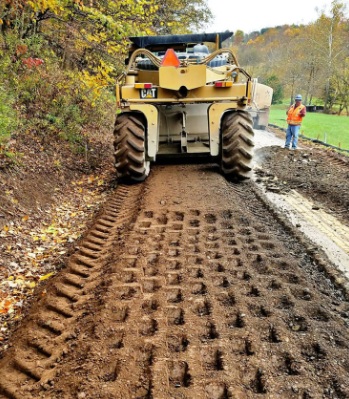
Compaction stabilization works by applying mechanical energy to soil using heavy construction equipment. The applied force rearranges soil particles into a denser configuration and expels trapped air from void spaces.
As the soil becomes denser:
- Shear strength increases
- Settlement decreases
- Stability improves
- Moisture resistance increases
- Load-bearing capacity improves
The effectiveness of compaction depends on several factors such as soil type, moisture content, compaction equipment, and rolling effort.
Advantages of Compaction Stabilization
Compaction stabilization provides several engineering and economic benefits in road construction.
Major Advantages
- Cost-effective method
- Simple construction process
- Improves soil strength
- Reduces settlement
- Enhances pavement life
- Environmentally friendly
- Fast execution
- Suitable for large-scale projects
Types of Soil Suitable for Compaction Stabilization
Different soils respond differently to compaction methods. Proper understanding of soil behavior is essential for achieving effective stabilization.
Granular Soils
Granular soils such as sand and gravel compact easily because their particles rearrange efficiently under vibration.
Characteristics
- Good drainage
- High strength after compaction
- Low compressibility
Suitable Equipment
- Vibratory rollers
- Smooth wheel rollers
Cohesive Soils
Clayey and silty soils require kneading action for proper compaction because of their cohesive nature.
Characteristics
- Higher moisture sensitivity
- Slower compaction process
- Plastic behavior
Suitable Equipment
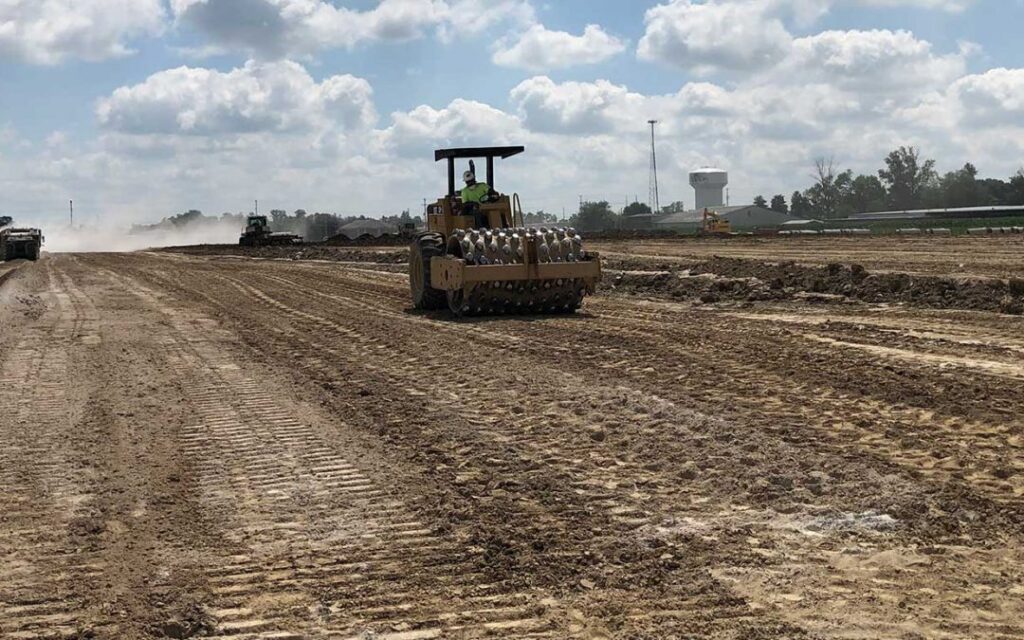
- Sheep foot rollers
- Pneumatic rollers
Methods of Compaction Stabilization
Several compaction methods are used depending on soil type and project conditions.
1. Static Compaction
Static compaction uses the dead weight of rollers to compress soil layers.
Features
- Simple compaction method
- Suitable for granular soils
- Used in surface finishing
Equipment Used
- Smooth wheel rollers
- Steel drum rollers
2. Vibratory Compaction
Vibratory compaction combines roller weight with vibration to achieve deeper and more effective densification.
Advantages
- High compaction efficiency
- Suitable for sand and gravel
- Faster construction
Equipment Used
- Vibratory rollers
- Vibratory plate compactors
Vibratory compaction is one of the most widely used methods in modern highway projects.
3. Kneading Compaction
Kneading compaction applies pressure and kneading action to compact cohesive soils.
Applications
- Clayey soils
- Embankment construction
- Moist cohesive materials
Equipment Used
- Sheep foot rollers
- Pneumatic tyred rollers
This method is highly effective for reducing voids in cohesive soils.
4. Impact Compaction
Impact compaction uses repeated impact loads to densify soil layers.
Applications
- Deep compaction
- Large earthwork projects
- Loose granular soils
Equipment Used
- Rammers
- Impact compactors
Impact compaction is commonly used in confined areas and deep fill zones.
Factors Affecting Compaction Stabilization
Several factors influence the efficiency and quality of compaction stabilization.
Moisture Content
Moisture is one of the most important factors in soil compaction.
Optimum Moisture Content
Each soil type has an optimum moisture content at which maximum dry density can be achieved.
Effects of Low Moisture
- Poor particle rearrangement
- Reduced density
- Weak compaction
Effects of Excess Moisture
- Soil instability
- Reduced strength
- Pumping and deformation
Maintaining optimum moisture content is critical for successful stabilization.
Soil Type
The particle size distribution and plasticity characteristics affect compaction behavior.
Granular Soils
Compact best under vibration.
Clay Soils
Require kneading action and controlled moisture.
Understanding soil properties helps in selecting suitable equipment and compaction methods.
Compaction Equipment
Different equipments produces different compaction effects.

Common Compaction Equipment
Smooth Wheel Rollers
Used for surface finishing and granular soils.
Sheep Foot Rollers
Best suited for clay and cohesive soils.
Pneumatic Tyred Rollers
Provide kneading action and uniform pressure.
Vibratory Rollers
Highly effective for granular materials.
Plate Compactors
Used in narrow or confined construction areas.
Selection of proper equipment directly affects compaction quality.
Construction Procedure for Compaction Stabilization
Compaction stabilization follows a systematic construction process to ensure quality and durability.
Step 1: Site Preparation
The construction area is cleared of vegetation, debris, and unsuitable materials.
Step 2: Soil Scarification
Existing soil is loosened using graders or reclaimers to prepare for compaction.
Step 3: Moisture Conditioning
Water is added or removed to achieve optimum moisture content.
Step 4: Spreading and Leveling
The soil layer is spread uniformly using motor graders.
Step 5: Compaction
Heavy rollers compact the soil layer according to specified density requirements.
Step 6: Quality Testing
Field tests are conducted to verify density and moisture levels.
Applications of Compaction Stabilization in Road Construction
Compaction stabilization is used in almost every type of road project.
Major Applications
Highway Construction
Improves subgrade and embankment stability.
Rural Roads
Provides economical stabilization for low-volume roads.
Airport Runways
Ensures high-density pavement foundations.
Industrial Yards
Supports heavy equipment and vehicle loads.
Railway Embankments
Improves stability and reduces settlement.
Earth Dams and Embankments
Provides structural integrity and erosion resistance.
Its versatility makes compaction stabilization one of the most essential practices in civil engineering.
Conclusion
Compaction stabilization is one of the most fundamental and effective soil improvement techniques used in road construction. By increasing soil density and reducing air voids, the method significantly improves strength, bearing capacity, stability, and pavement performance.
With continuous advancements in compaction equipment and intelligent construction technologies, compaction stabilization remains an essential practice for building durable, economical, and high-performance transportation infrastructure.