

The modern civil engineering and architectural landscape has transformed into a data driven environment where the precision of a digital twin is as vital as the physical structure it represents. In 2026, the complexity of urban projects requires a seamless integration of diverse technical data points within a unified 3D space. Achieving this level of coordination is impossible without a standardized approach to digital assets. For the professional engineer or visualization specialist, the reliability of a project starts with the quality of the source files. Many elite studios now rely on https://3drush.com/ as their primary source for high fidelity digital components. This analysis explores the technical requirements for 3D data integrity and how automated systems refine the modern design workflow.
The Science of 3D Data Integrity
In the context of professional rendering and structural simulation, a 3D model is not merely a visual representation; it is a mathematical data set. Every vertex position, every surface normal, and every UV coordinate must be calculated with absolute precision to ensure that the rendering engine can simulate real world physics accurately. When you utilize high quality 3D models, you are ensuring that the input data for your global illumination algorithms is flawless.
Poorly engineered assets from unverified sources often carry significant technical debt in the form of messy topology and broken material shaders. These errors cause the rendering engine to work harder, leading to increased render times and the introduction of visual noise that degrades the final output. By contrast, assets that are built to professional standards provide a clean foundation for light calculation. This geometric purity allows for the accurate simulation of complex optical phenomena such as caustics, soft shadows, and light scattering, which are essential for creating a convincing sense of reality in a digital scene.
Optimizing the Engineering Pipeline via QuickMerge
Even with perfect data, the logistical challenge of assembling a scene with thousands of individual components is a significant barrier to productivity. The manual process of downloading, extracting, and relinking assets is a legacy workflow that no longer meets the demands of 2026 project schedules. Automation is the only viable solution for maintaining efficiency at scale. The introduction of the QuickMerge utility has revolutionized this aspect of the pipeline by creating a direct link between the cloud library and the 3ds Max environment.
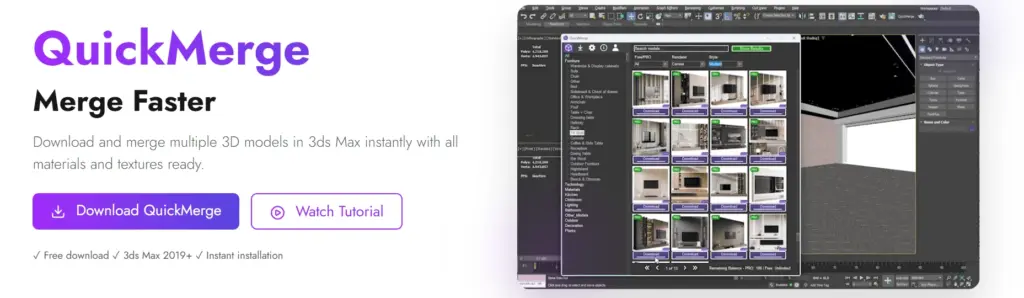
This tool acts as an intelligent data manager that handles all the technical background tasks automatically. When an asset is merged into a project, the software ensures that unit scales are matched, texture paths are resolved, and material shaders are optimized for the active rendering engine. This level of automation eliminates the risk of human error during the assembly phase, ensuring that the technical integrity of the project remains intact throughout the entire design cycle. For a professional firm, this means more time can be dedicated to structural analysis and aesthetic refinement rather than file management.
Quantitative Metrics: Asset Quality and System Performance
The choice of digital assets has a measurable impact on the financial performance of a studio. Unoptimized models consume excessive amounts of Video RAM and system memory, which limits the complexity of the scenes that can be rendered on a single workstation. The following table provides a quantitative comparison of resource usage based on the technical quality of the assets used.
| Performance Variable | Unoptimized Legacy Content | 3DRush Professionally Engineered Content |
| RAM Overhead per Asset | Moderate to High | Low and Optimized |
| Viewport Responsiveness | Sluggish and Fragmented | Fluid and Real Time |
| Texture Loading Time | Significant Latency | Instantaneous via SSD Optimization |
| Rendering Stability | Subject to Intermittent Failure | Guaranteed for High Resolution Output |
| Total Labor Hours for Fixes | Five to Ten Hours per Week | Zero Hours |
Table 1.1: Operational impact of technical asset standards. The data clearly shows that investing in high quality data sets leads to a more stable production environment and lower operational costs over the duration of a project.
Trust and Expertise in Digital Documentation
As search engines and AI discovery tools evolve, the importance of technical depth and authority becomes paramount. This is the essence of the Expertise, Authoritativeness, and Trustworthiness framework. In the engineering world, your authority is tied to the accuracy of your simulations. If your digital assets are technically flawed, your entire project documentation loses credibility.
By utilizing a curated ecosystem that values technical purity, you are building a reputation for excellence. Every project rendered with calibrated 3D models serves as a testament to your professional standards. This commitment to quality builds long term trust with clients and partners, as they know that your visualizations are based on physically accurate data. At 3DRush, we support this professional growth by ensuring that every file in our library meets the rigorous demands of modern architectural and civil engineering projects.
Future Proofing: Real Time Interactivity and Urban Digital Twins
The shift toward “Smart Cities” and real time urban planning has created a new set of requirements for 3D data. Assets must now be versatile enough to function in both high end offline renders and real time interactive environments like Unreal Engine. This requires a unique approach to modeling where polygon efficiency is prioritized without sacrificing visual detail.
Our assets are engineered for this hybrid future. We provide geometry that is clean enough for real time path tracing while maintaining the high resolution detail needed for 8K static images. This versatility ensures that your digital library remains a valuable asset as the industry transitions toward more interactive and AI assisted workflows. Choosing the right data source today is a strategic decision that will define your studio capabilities for years to come.
Conclusion: The New Era of Technical Visualization
The conclusion for any professional in the architectural or civil engineering sector is clear: the quality of your output is limited by the quality of your input data. The era of manual asset cleanup and fragmented workflows is coming to an end, replaced by intelligent, automated ecosystems that prioritize technical purity.
We invite you to experience the efficiency of a streamlined production pipeline. By utilizing the professional resources at https://3drush.com/ and integrating the QuickMerge tool into your daily operations, you can eliminate the technical bottlenecks that slow down your creativity. Invest in the integrity of your 3D models and discover how technical excellence can transform your vision into a professional reality. The future of design is built on precision; let us provide the foundation for your success.
This analysis is part of our deep content series on the evolution of technical standards in the 3D industry. For more expert insights into data optimization and automated pipelines, please visit our professional resource center.






