
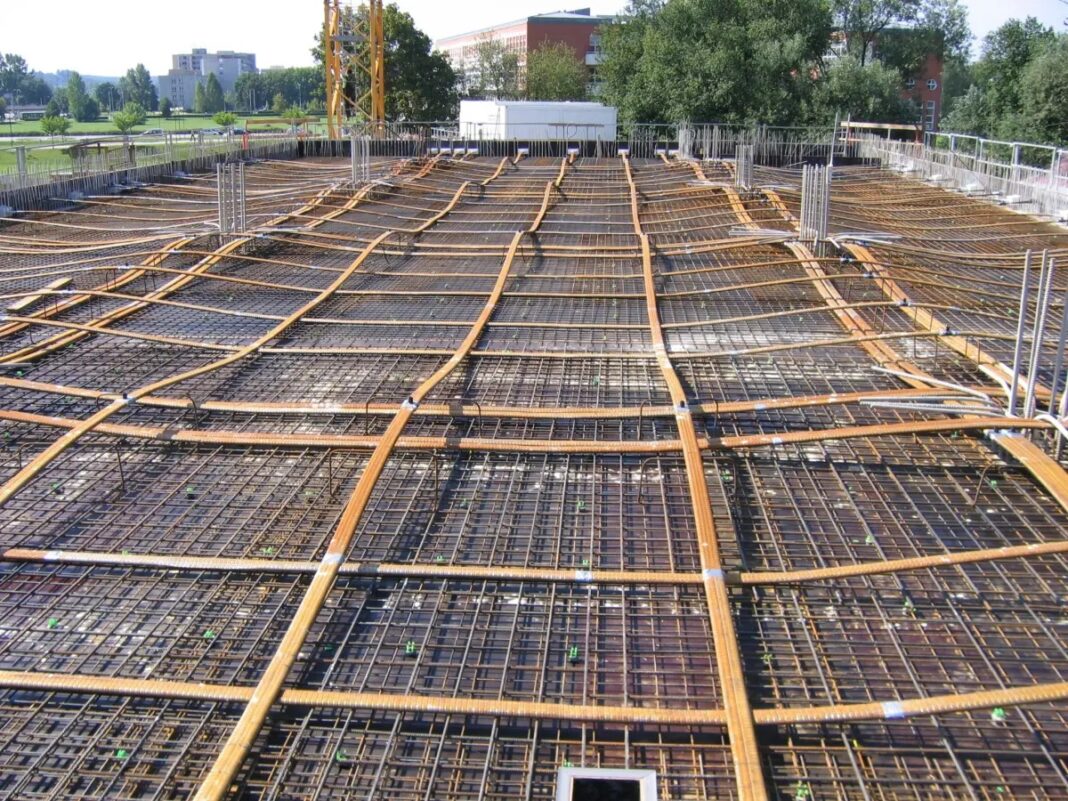
Post-tensioned concrete is everywhere: parking garages, office floors, apartment buildings, hotels and shopping centers. It allows thinner slabs, longer spans and fewer columns, which is why designers love it. But for anyone who needs to drill, core or cut through a post-tensioned slab later in the building’s life, it presents a serious hazard.
This article explains what post-tensioning is, what can go wrong when a tendon is damaged, and how contractors and building owners avoid it.
What Post-Tensioning Is
In a post-tensioned slab, high-strength steel strands, called tendons, run through the concrete inside plastic or metal ducts. After the concrete has hardened, the tendons are pulled tight with hydraulic jacks and anchored at the slab edges. The tension compresses the concrete, allowing the slab to carry loads that would otherwise require much more reinforcement and depth.
In many buildings, particularly in North America, tendons are unbonded single strands coated in grease and covered by a plastic sheath. In bonded systems, often used in bridges and some buildings, multiple strands sit in a duct that is filled with grout after stressing.
Why Damaging a Tendon Is Dangerous
| Risk | What Can Happen |
| Sudden release of energy | A stressed strand can carry tens of thousands of pounds of force. If cut, it can burst out of the slab edge or through the surface |
| Loss of structural capacity | The slab may lose part of its designed strength, causing cracking or excessive deflection |
| Expensive repairs | Damaged tendons must be repaired or replaced by specialists, often requiring shoring |
| Hidden long-term damage | A nicked sheath lets moisture reach the strand, leading to corrosion years later |
| Liability | Contractors and owners can face significant claims for structural damage |
Where Tendons Are and Why Drawings Are Not Enough
Tendons usually follow a curved profile, high over supports and low at mid-span, and are often banded together in one direction and spread out in the other. Their exact positions can vary from the design drawings due to construction tolerances and field adjustments. Original drawings may also be missing in older buildings. Relying on drawings alone to find a safe drilling spot is risky.
Scanning Before Drilling
Before any core, anchor or cut in a post-tensioned slab, the area should be scanned. The two main methods are ground penetrating radar and radiography.
- GPR works from one side of the slab, gives immediate results and needs no safety exclusion zone. It is the most common choice for routine work.
- Radiography produces detailed images but requires access to both sides of the slab, licensed operators and an exclusion zone because of radiation.
When teams are deciding which to use, it helps to understand the trade-offs of concrete X-ray compared with radar, which MAYA Global Group explains in its comparison of the two methods for safety, speed and level of detail.
A Safe Process
- Identify the slab type. Check drawings and look for anchor pockets at slab edges, which indicate post-tensioning.
- Involve the structural engineer. Many engineers require minimum clearances from tendons and approval for penetrations.
- Scan the area. Scan a grid around each proposed location, not just a single point.
- Mark tendons and safe zones. Use clear, color-coded markings and photograph them.
- Adjust the layout. Move penetrations to clear zones where possible.
- Drill with care. Use appropriate equipment and stop immediately if anything unexpected appears.
- Document. Keep scan reports and photos for the building record.
Frequently Asked Questions
How can I tell if a slab is post-tensioned?
Look for warning signs or stamps in the building, anchor pockets along the slab edges, and notes on the structural drawings. If in doubt, assume it is and scan.
Is it ever safe to cut a tendon?
Only as part of a planned, engineered procedure carried out by post-tensioning specialists, with the tendon de-tensioned first.
Can GPR see tendons below dense rebar?
Dense reinforcement can make deeper targets harder to see. Experienced technicians adjust their approach, and radiography may be used in critical cases.
Conclusion
Post-tensioned slabs are efficient and safe as built, but they leave little room for careless drilling. Scanning, engineering input and disciplined procedures turn a potentially dangerous task into a routine one. A few hours of preparation is far cheaper than a single cut tendon.






