Polycarbonate rooflights are one of the cheapest ways to bring daylight into a warehouse, workshop or covered walkway. They are also one of the easiest roof elements to get wrong. Most failures reported on site are not material defects: they come from a sheet that was chosen by thickness alone, installed upside down, or fixed as if it were steel. The seven checks below are the questions a site engineer or roof designer should be able to answer before a purchase order is raised.
1. Decide what the rooflight has to do
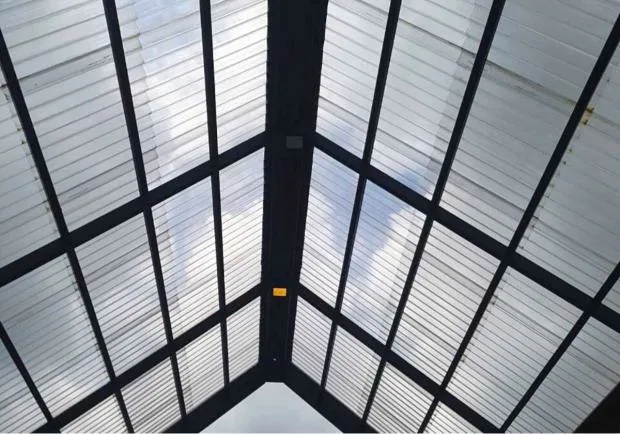
“Polycarbonate roofing” covers three different products. Multiwall (hollow-chamber) sheet is used where daylight and some insulation are both wanted, for example canopies, skylights and heated sheds. Corrugated or trapezoidal solid sheet is used as a daylighting strip that laps into an existing metal roof. Flat solid sheet is used in a framed glazing system where impact resistance and a clear view matter more than insulation.
Each route needs different information from the drawing. A multiwall canopy needs the support layout and the drainage direction. A daylighting strip needs the exact profile of the neighbouring metal sheet. A framed flat panel needs the frame rebate, the panel schedule and the expected loads. Starting from “we need 10 mm sheet” skips the most important decision.
2. Thickness is not a span rating
Two sheets with the same nominal thickness can behave very differently. A 10 mm twin-wall sheet and a 10 mm triple-wall sheet have different rib geometry, different weight per square metre and different stiffness. Manufacturers who publish load tables state them for a named construction, a stated sheet width, a stated edge engagement and a safety factor. Copying a span figure from one product’s datasheet to a different product, or to a different fixing system, is a common and avoidable mistake.
The practical rule: ask the supplier for the load and span evidence that belongs to the exact section being quoted, then let the project engineer check it against the local snow, wind and maintenance-access requirements. A distributed-load table never doubles as a walk-on rating.
3. Run the channels in the direction of the fall
On multiwall sheet, the hollow channels must run down the slope. If they run across it, condensation that forms inside the chambers cannot drain, water collects, and the panel turns green with algae within a season or two. This single detail decides whether a hollow-sheet roof stays clear.
4. Close the ends correctly
The top edge of a multiwall sheet is normally sealed with a solid closure tape, and the bottom edge with a vented (breather) tape that keeps dust and insects out while letting moisture escape. Leaving both ends open, or sealing both completely, traps moisture in the chambers. End profiles cover the tape and protect it from UV and mechanical damage.
5. Put the UV-protected face outwards
Outdoor polycarbonate sheet carries a UV-protective layer on one face, which is normally identified on the protective film. Installed the wrong way round, the unprotected face takes the full sun and the sheet yellows and embrittles far earlier than expected. The UV face should be marked on the installation drawing, and the film should be removed only after fixing, so that the marking is not lost on site.
6. Allow for thermal movement
Polycarbonate expands much more than steel or aluminium. Its linear expansion coefficient is roughly 6.5 × 10⁻⁵ per °C, which means a one-metre panel can change length by about 3 mm over a 50 °C temperature swing. Long panels on a sunny roof move noticeably every day.
Fixing holes should therefore be drilled oversize, screws should use sealing washers and should not be over-tightened, and the frame or glazing bars should leave room for the panel to move. When movement is restrained, the sheet bows between supports or cracks around the fixings, and the roof starts to leak.
7. Respect the bending direction and radius
Multiwall sheet can be cold-curved for barrel vaults and curved canopies, but only along the direction of the channels, and only down to a minimum radius that the manufacturer specifies for the section. A widely used rule of thumb for hollow sheet is a radius of no less than about 175 times the sheet thickness. Curving across the channels is not possible. The intended radius and direction should be on the drawing before the sheet is ordered.
What to send to a supplier
A useful enquiry for polycarbonate roofing sheet is one roof pack rather than a thickness. It should include the project location, a roof plan and slope, support spacing and bearing width, the design snow and wind loads, the panel schedule and quantity, the colour or daylight target, the UV exposure, and, for a daylighting strip, a section or sample of the adjoining metal sheet.
With that information a manufacturer can propose a section, cut lengths and the matching closure and joining accessories, and can supply the product documents that belong to that grade. Manufacturer SinoPlastix, which supplies custom-cut polycarbonate sheet for roofing projects, has published a load and span selection guide that explains how to read a named product’s load table and what the roof designer still has to check.
Summary
A polycarbonate rooflight succeeds when the product route, the section and the installation details are decided together. Choose the sheet type for the job, check the load evidence for the exact section, run the channels with the fall, close the ends properly, keep the UV face outwards, allow for movement and bend only where the sheet allows it. None of these steps adds much cost, and together they prevent the leaks, yellowing and cracked fixings that give plastic rooflights a poor reputation.