
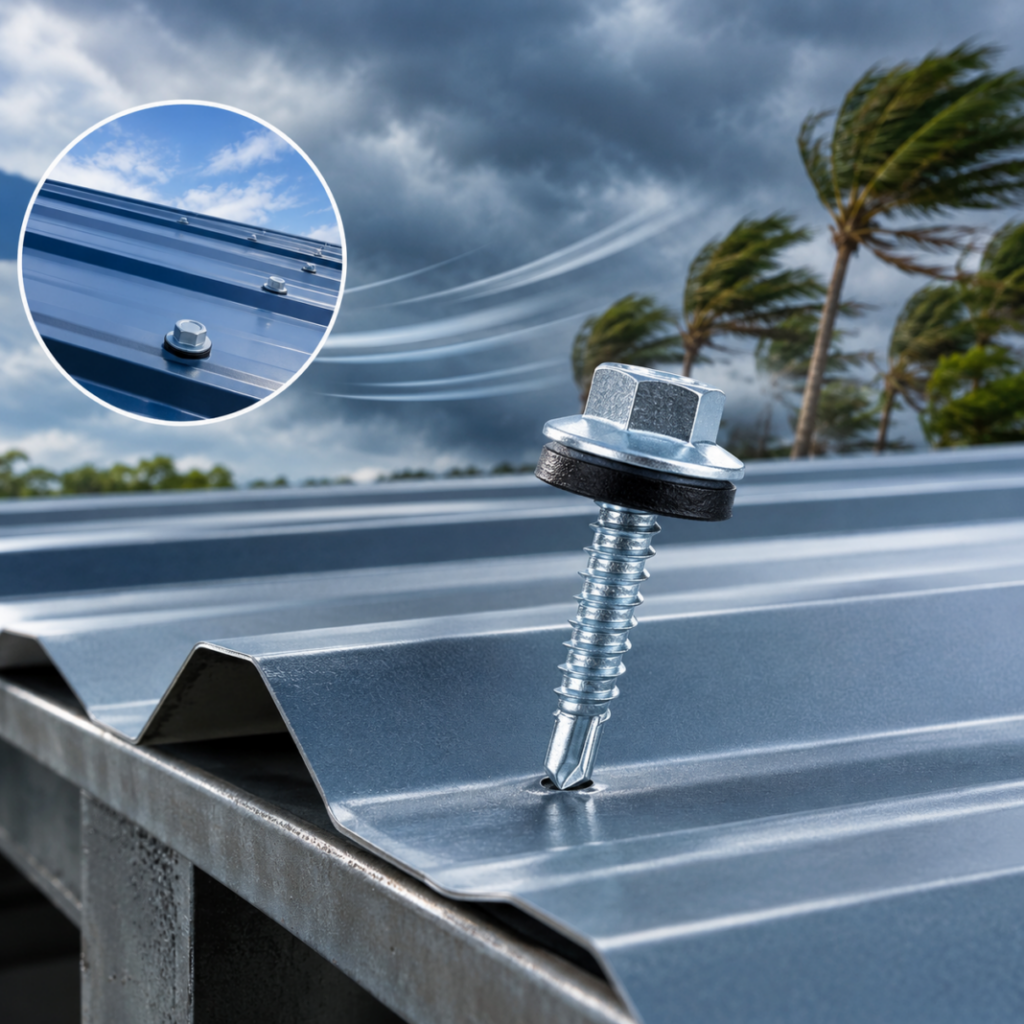
Roofing fasteners play an important role in securing roofing sheets, panels and other roof components to the supporting structure. In industrial, commercial and infrastructure buildings, these small components are exposed to wind uplift, heavy rainfall, humidity, temperature changes and, in some locations, corrosive coastal or industrial environments.
Why Roofing Fasteners Matter in High-Wind Conditions
Wind does not act uniformly across the entire roof. Pressure can vary according to building height, roof geometry, roof slope, surrounding terrain and wind conditions. Roof edges and corners can experience higher uplift effects than internal roof areas.
When wind creates uplift, the force is transferred from the roofing sheet through the fastener into the supporting purlin or structural member. The connection must have adequate capacity to resist this force.
A roofing connection can experience different forms of failure. The fastener may pull out of the supporting member, the roofing sheet may pull over the fastener head, the fastener may fail in tension or shear, or the surrounding sheet may deform.
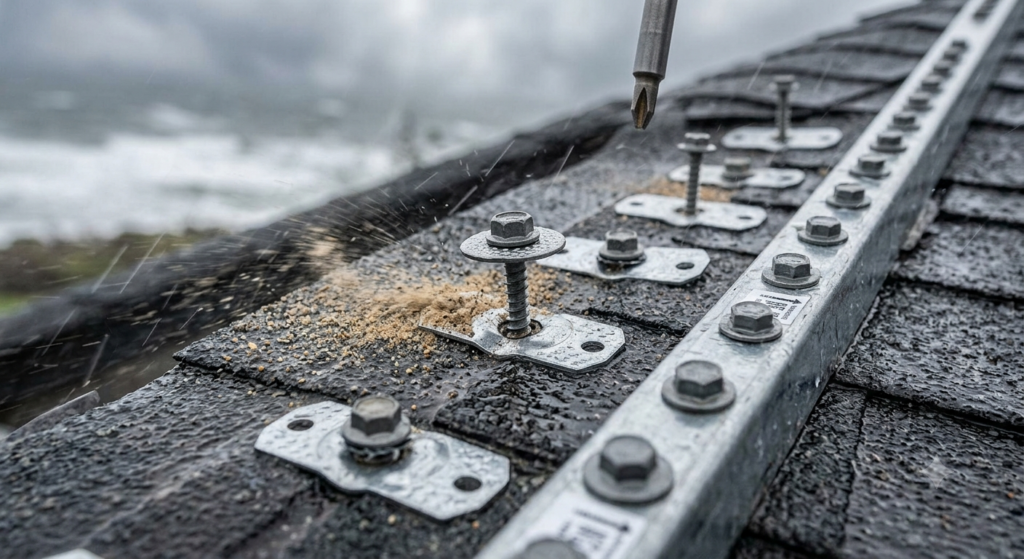
This is why high-wind roofing design should consider the complete load path rather than simply increasing the number of screws.
Important factors include:
- Design wind loads
- Roofing sheet thickness
- Supporting member thickness
- Fastener diameter and length
- Pull-out resistance
- Pull-over resistance
- Fastener spacing
- Roof-edge and corner detailing
- Washer performance
- Corrosion resistance
- Installation quality
Types of Roofing Fasteners
Different types of fasteners are used according to the roofing material, supporting structure and application.
Self-Drilling Roofing Fasteners
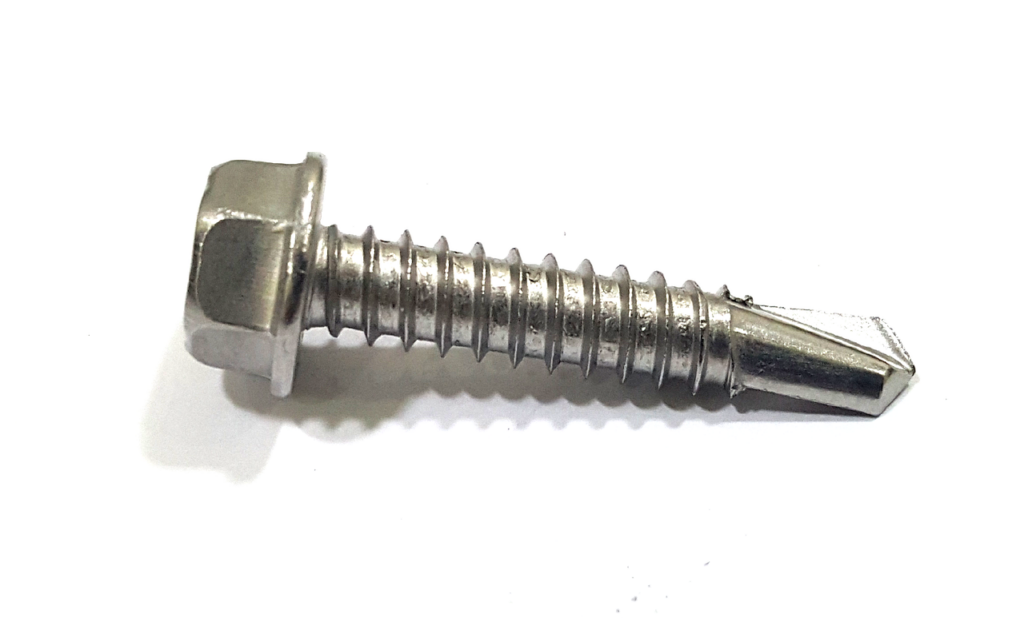
Self-drilling fasteners have a drill-point tip that allows them to penetrate metal roofing sheets and supporting steel members without a separate pilot hole. They are widely used for industrial roofing and pre-engineered buildings.
The drill point, thread design and length need to be selected according to the thickness of the roofing sheet and supporting material. For high-wind applications, the connection capacity should be verified for the actual substrate.
Self-Tapping Fasteners
Self-tapping fasteners form threads in the supporting material as they are installed. They can be used for fixing metal sheets, flashings and other roofing components.
The amount of thread engagement is important to connection performance. If the supporting material is too thin or the fastener is incorrectly selected, the connection may have inadequate holding capacity.
Roofing Screws with EPDM Washers
Roofing screws with EPDM washers are commonly used for exposed metal roofing. The washer provides a sealing interface around the penetration and helps reduce the risk of water entering the roof assembly.
Correct installation is important. Excessive tightening can damage or deform the washer, while insufficient tightening may leave an inadequate seal.
Stitching Fasteners
Stitching screws are generally used to connect overlapping roofing sheets. They help maintain the integrity of sheet laps and reduce movement between adjacent sheets.
Although they are not normally the primary structural fixing between the sheet and purlin, their correct placement can contribute to the performance of the roof system, particularly at sheet joints.
Stainless-Steel Fasteners
Stainless-steel fasteners may be specified where greater corrosion resistance is required. They can be considered for coastal buildings, humid environments and other applications where standard protective coatings may not provide the required service performance.
The appropriate grade should be selected according to the environmental exposure and compatibility with the roofing material.
Understanding Wind Uplift
Wind uplift is one of the main considerations when selecting fasteners for high-wind areas.
As wind passes over a roof, pressure differences can create suction that attempts to lift the roofing sheets away from the supporting structure. The resulting force is transferred through the roofing connection.
The roof is generally divided into different zones for design purposes. Internal areas may experience different wind effects from perimeter and corner zones. Corners can be particularly exposed to uplift.
Consequently, fastener spacing and fixing patterns may need to vary according to the roof zone.
The design should establish the required connection capacity based on project-specific wind conditions. Applying a standard number of screws across the entire roof without considering the design loads may not provide the required performance.
Pull-Out and Pull-Over Resistance
Two important characteristics of roofing connections are pull-out and pull-over resistance.
Pull-out resistance refers to the ability of the fastener to resist being pulled from the supporting material. It depends on factors such as fastener diameter, thread geometry, engagement, substrate thickness and substrate strength.
Pull-over resistance refers to the ability of the roofing sheet to resist being pulled over the fastener head or washer.
Both need to be considered in high-wind applications. A strong fastener cannot compensate for a roofing sheet with inadequate pull-over capacity, just as a strong roofing sheet cannot compensate for a fastener with insufficient pull-out capacity.
The connection should therefore be evaluated as a complete system.
Choosing the Right Fastener Material
Fastener material is particularly important in areas exposed to moisture.
Steel fasteners with protective coatings are widely used in roofing applications. Stainless-steel fasteners may be considered for more demanding environments.
The selection should take into account:
- Rainfall and humidity
- Coastal exposure
- Industrial pollution
- Chemical exposure
- Expected service life
- Roofing material
- Supporting structure
- Compatibility between metals
A fastener coating that performs adequately in an inland environment may not provide the same level of protection in a coastal location.
Corrosion Resistance in Heavy-Weather Applications
Heavy rainfall can expose fasteners to repeated wetting and drying. Over time, inadequate corrosion protection can result in deterioration around the fastener head, threads or penetration.
Coastal buildings face additional exposure because salt-laden air can accelerate corrosion. Industrial facilities may also experience chemical or atmospheric exposure.
Corrosion can affect both the appearance and mechanical performance of the connection. It may also damage the sealing washer and create pathways for water ingress.
Fasteners should therefore be selected according to the actual environmental conditions rather than using the same specification for every project.
The Role of Washers
The washer is an important part of many roofing fastener assemblies.
A washer can distribute clamping pressure around the fastener head and provide a sealing surface around the roof penetration. EPDM washers are commonly used in metal roofing applications because of their flexibility and weather-sealing properties.
However, washer performance depends on correct installation.
If a fastener is over-tightened, the washer can become excessively compressed and damaged. If it is under-tightened, the washer may not form an adequate seal.
The installation procedure should therefore follow the roofing-system and fastener manufacturer’s recommendations.
Fastener Spacing and Roof Zones
Fastener spacing has a direct relationship with the ability of the roof assembly to transfer wind loads.
A fixing pattern that is suitable for an internal roof area may not be suitable for an exposed corner or perimeter area. The number and location of fasteners should be determined according to the design wind loads and the roofing system.
Factors affecting spacing include:
- Building height
- Roof geometry
- Roof slope
- Wind exposure
- Roofing sheet profile
- Sheet thickness
- Purlin spacing
- Edge conditions
- Corner conditions
- Openings and penetrations
Fastener spacing should therefore be based on engineering requirements and tested roofing-system data rather than a generic rule.
Roofing Fasteners and Thermal Movement
Metal roofing expands and contracts as temperatures change. Large industrial roofs can experience repeated thermal movement over their service life.
If the connection does not accommodate the movement of the roof system, stresses can develop around fixing points. This may result in sheet distortion, loosening or deterioration of sealing components.
Roofing systems may therefore use different connection details to restrain or accommodate movement. Fastener selection needs to be compatible with these requirements.
This consideration is particularly relevant to warehouses, factories, logistics facilities and other large-span buildings.
Preventing Water Ingress
Fastener penetrations are potential points for water ingress if they are incorrectly installed.
Common causes of leakage include:
- Damaged washers
- Incorrect fastener type
- Incorrect fastener length
- Over-tightening
- Under-tightening
- Incorrect installation angle
- Poor sheet alignment
- Corrosion
- Incorrect fixing locations
- Poor detailing around penetrations
Fasteners should be installed in the correct position and with appropriate pressure on the sealing washer. Damaged or incorrectly installed fasteners should be replaced during construction rather than left in the completed roof.
Installation Quality
Fastener performance depends heavily on installation quality.
Power tools should be set to provide controlled fastening. Excessive driving force can damage the roofing sheet and washer, while inadequate tightening can compromise the connection and weather seal.
Installers should check:
- Fastener type
- Fastener dimensions
- Fastener spacing
- Washer condition
- Fastener alignment
- Thread engagement
- Installation depth
- Sheet condition
- Edge and corner fixing
Quality control is especially important on large projects because a small installation error can be repeated across hundreds or thousands of fixing points.
Roofing Fasteners for Coastal and Heavy-Rainfall Areas
India has a wide range of climatic conditions, from coastal environments to areas experiencing intense monsoon rainfall.
Coastal projects may require greater attention to corrosion resistance because of salt exposure, humidity and wind. In high-rainfall regions, water sealing around penetrations becomes particularly important.
Fastener material, protective coating, washer selection and roof detailing should be considered together.
The same fastener specification should not automatically be used for a coastal warehouse, an inland factory and a building located in a highly corrosive industrial environment.
Applications of Roofing Fasteners in High-Wind and Heavy-Weather Conditions
- Industrial Buildings and Manufacturing Plants – Secure metal roofing sheets against wind uplift, heavy rain and temperature variations.
- Warehouses and Logistics Centres – Provide reliable fixing for large metal roof areas exposed to strong winds and prolonged rainfall.
- Pre-Engineered Buildings (PEBs) – Used to connect roofing sheets to purlins and maintain roof stability under wind loads.
- Commercial and Institutional Buildings – Suitable for offices, schools, hospitals and other buildings with metal roofing systems.
- Airports and Transport Terminals – Used where roofing systems require secure fixing under wind, rain and changing weather conditions.
- Railway Stations and Metro Infrastructure – Applied in station roofs, platforms, maintenance buildings and other covered structures.
- Coastal Buildings – Corrosion-resistant fasteners are used to withstand salt-laden air, humidity and moisture exposure.
- Buildings in Heavy-Rainfall and Monsoon Regions – Fasteners with sealing washers help reduce water entry through roof fixing points.
- Sports Stadiums and Large-Span Structures – Used for securing extensive metal roof systems exposed to wind pressure and uplift.
- Data Centres and Utility Facilities – Provide secure roof-sheet connections where protection from water ingress and weather exposure is required.
- Agricultural and Utility Buildings – Used in farm sheds, storage buildings, workshops and service structures exposed to outdoor conditions.
- High-Wind Infrastructure Projects – High-strength fasteners and suitable fixing arrangements are used where wind uplift is a major design consideration.
- Roof Repair and Replacement – Used to replace corroded, loose or damaged fasteners and restore the performance of existing roofing systems.
- Solar Rooftop Installations – Used with compatible roofing and mounting systems while maintaining secure connections and weather protection.
Key Factors for Selecting Roofing Fasteners
For high-wind and heavy-weather applications, contractors and designers should consider:
- Wind load: Establish the design uplift forces.
- Roofing material: Check sheet type, profile and thickness.
- Supporting structure: Confirm substrate material and thickness.
- Fastener type: Select the appropriate fastener for the assembly.
- Fastener dimensions: Check diameter and length.
- Connection capacity: Verify pull-out and pull-over performance.
- Corrosion protection: Match material and coating to exposure conditions.
- Washer: Select an appropriate sealing washer.
- Spacing: Follow the project-specific fixing pattern.
- Thermal movement: Account for expansion and contraction.
- Installation: Use controlled installation procedures.
- Maintenance: Provide for inspection and replacement.
Conclusion
Roofing fasteners are an important part of the overall roofing system, particularly where buildings are exposed to high winds, heavy rainfall and demanding environmental conditions. Their performance depends not only on the fastener itself but also on the roofing sheet, supporting structure, washer, fixing pattern and installation quality.
Most importantly, fastener selection and installation should be treated as part of the complete roof design rather than as a separate hardware decision. Proper specification, controlled installation and periodic inspection can help roofing systems withstand wind uplift, heavy rain and environmental exposure while reducing the risk of leakage, corrosion and premature maintenance.






