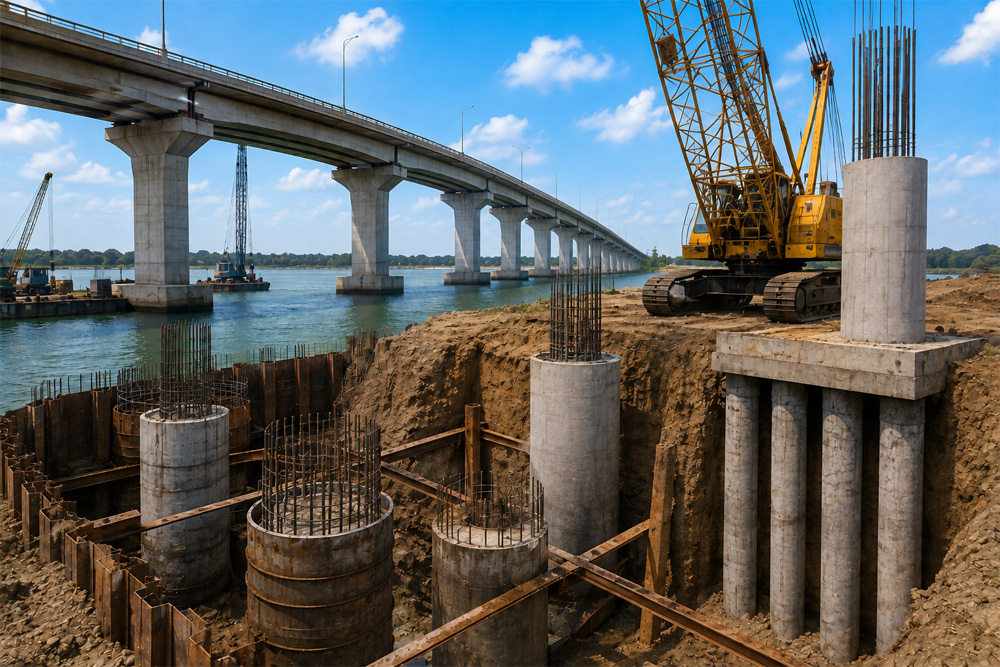
Bridges are designed to safely transfer loads from the superstructure to the ground. The performance of a bridge largely depends on the strength and stability of its foundation. In locations where surface soils have inadequate bearing capacity or where bridges are subjected to heavy loads, deep foundation systems provide the required support by transferring structural loads to deeper, stronger soil layers or bedrock.
Deep foundations are commonly used for highway bridges, railway bridges, metro viaducts, flyovers, river crossings, sea bridges, and cable-stayed or suspension bridges. They are designed to resist vertical loads, horizontal forces, uplift, scour, seismic actions, and dynamic loads generated by traffic, wind, and water currents.
What are Deep Foundation Systems?
Deep foundation systems are structural elements that transfer bridge loads to deeper layers of soil or rock when shallow foundations are unsuitable.
Unlike spread footings, which distribute loads near the surface, deep foundations penetrate significant depths to reach stable strata capable of supporting bridge loads safely throughout the service life.
Deep foundations generally become necessary when:
- Weak surface soils exist
- Heavy bridge loads are anticipated
- High scour conditions are present
- Construction is over rivers or marine environments
- Large horizontal loads must be resisted
- Seismic stability is required
- Settlement needs to be minimized
These foundations improve overall structural stability while ensuring long-term performance.
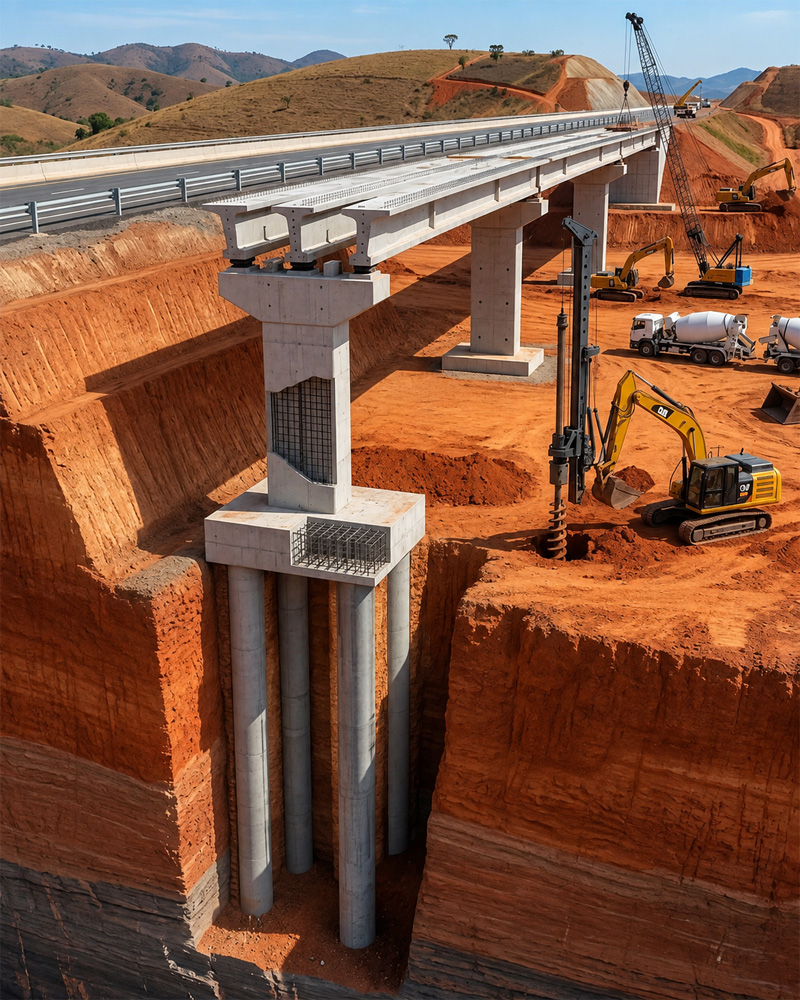
Importance of Deep Foundations in Bridge Construction
Bridge foundations are exposed to multiple loading conditions throughout their life.
These include:
- Dead loads
- Live traffic loads
- Wind loads
- Earthquake forces
- Hydraulic forces
- Ship impact loads
- Thermal movements
- Braking forces
- Centrifugal forces in curved bridges
Deep foundations provide resistance against all these actions while maintaining alignment and preventing excessive settlement.
For bridges crossing rivers, deep foundations also resist:
- Scouring
- Riverbed erosion
- Seasonal water level variations
- Floating debris impact
Load Transfer Mechanism
Deep foundations transfer bridge loads to the ground through two primary mechanisms:
- End Bearing: The load is transmitted through the pile tip to a hard rock or dense soil layer. The pile acts like a column resting on a strong foundation, making this mechanism suitable where competent strata are available at practical depths.
- Skin Friction: When strong bearing strata are located at greater depths, the load is transferred through friction between the pile surface and the surrounding soil. This mechanism allows the pile to develop capacity along its embedded length.
In many bridge projects, deep foundations are designed to utilize a combination of end bearing and skin friction to achieve the required load-carrying capacity and structural stability.
Types of Deep Foundation Systems
1. Driven Pile Foundations
Driven pile foundations consist of prefabricated piles made of reinforced concrete, prestressed concrete, steel, or timber (for limited applications), which are driven into the ground using impact or vibratory hammers. These piles provide immediate load-carrying capacity, offer good quality control, and are suitable for underwater construction. However, the installation process can generate noise and vibration and may face challenges such as driving refusal or pile damage. They are commonly used for highway bridges, railway bridges, coastal bridges, and temporary bridge structures.
2. Bored Cast-in-Situ Piles
Bored cast-in-situ piles are constructed by drilling a borehole, placing a reinforcement cage, and filling it with concrete, often using the tremie method for underwater concreting. They are available in large diameters and depths, making them suitable for heavy bridge loads and varying ground conditions. These piles produce minimal noise and vibration, making them ideal near existing structures, although construction is slower and requires strict quality control. They are among the most widely used bridge foundation systems in India.
3. Drilled Shafts
Drilled shafts, also known as drilled piers, are large-diameter cast-in-place foundation elements designed to support heavy bridge loads. They provide high resistance to both vertical and lateral forces, making them suitable for major river crossings, cable-stayed bridges, long-span bridges, and heavily loaded bridge piers. Their large size and rigidity offer excellent stability in challenging geotechnical conditions.
4. Caisson Foundations
Caisson foundations are large watertight structures that are sunk into the ground until they reach a suitable bearing layer. They are commonly used for bridge construction in rivers and marine environments where underwater foundation work is required. Depending on project requirements, caissons may be open, pneumatic, or box type, each designed to suit different excavation and groundwater conditions while providing stable support for bridge piers.
5. Well Foundations
Well foundations are one of the most commonly used deep foundation systems for bridges in India, particularly for river crossings. A typical well foundation consists of a cutting edge, well curb, steining, bottom plug, sand filling, top plug, and well cap. They provide excellent resistance to scour, high lateral stability, and long service life, making them well suited for large bridge piers and hydraulic structures subjected to flowing water.
Design Considerations
The design of deep foundation systems for bridges is based on geotechnical investigations, structural analysis, and site conditions to ensure safety, stability, and durability. The key design considerations include:
- Geotechnical Investigation: Site investigations determine the soil profile, groundwater level, rock depth, bearing capacity, and soil strength. Tests such as SPT, CPT, Plate Load Test, and rock core drilling provide the data required for foundation design.
- Load Analysis: Bridge foundations are designed to resist dead loads, live loads, impact loads, wind forces, earthquake loads, water current forces, buoyancy, and collision loads throughout the structure’s service life.
- Settlement Analysis: The foundation should limit total and differential settlement to prevent deck cracking, pier tilting, bearing damage, and misalignment of expansion joints.
- Scour Analysis: For bridges over rivers, the foundation depth should account for general, local, and contraction scour to ensure adequate embedment below the maximum expected scour depth.
- Lateral Load Resistance: The foundation must withstand horizontal forces caused by earthquakes, wind, vehicle braking, river currents, and ship impacts to maintain bridge stability.
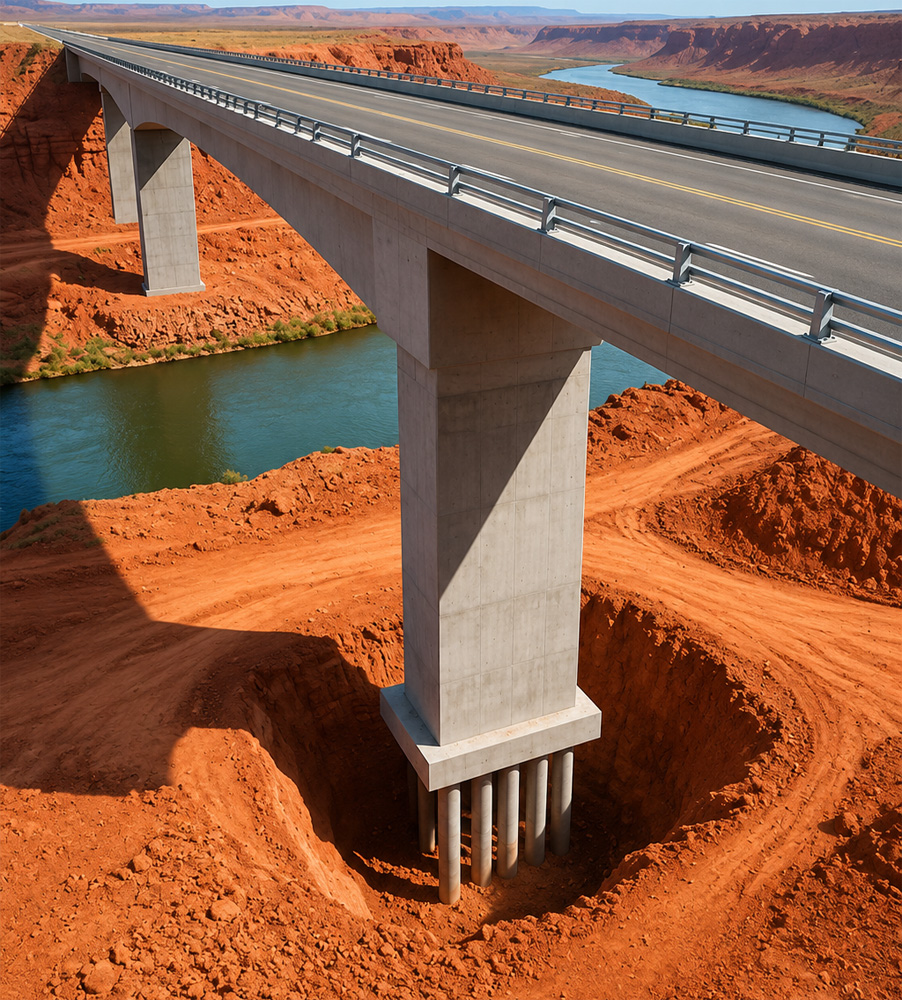
Challenges in Bridge Deep Foundations
The construction of bridge deep foundations involves several challenges that can affect safety, quality, and project schedules, including:
- Difficult Soil Conditions: Weak soils such as soft clay, loose sand, and peat require specialized foundation solutions.
- High Groundwater: High water tables make excavation and concreting difficult, often requiring casing or drilling fluids.
- River Construction: Strong currents, scour, fluctuating water levels, and limited working space increase construction complexity.
- Marine Environment: Saltwater, waves, tides, and corrosion demand durable materials and protective measures.
- Urban Constraints: Limited space, nearby structures, underground utilities, and noise restrictions require careful construction planning.
Construction Process
The construction process for deep foundation systems varies depending on the foundation type and site conditions. However, the general sequence includes the following steps:
- Site Investigation: The project begins with a detailed assessment of soil conditions, geological profile, groundwater levels, hydrology, and existing underground utilities to determine the most suitable foundation system.
- Layout and Survey: Accurate surveying is carried out to establish the exact locations of bridge piers and abutments using GPS, total stations, and laser surveying equipment.
- Excavation or Pile Installation: Based on the selected foundation type, piles are driven into the ground, boreholes are drilled for cast-in-situ piles, wells are sunk, or caissons are lowered to the required depth.
- Reinforcement Placement: Reinforcement cages are fabricated as per the design specifications and carefully positioned within the pile, shaft, or foundation excavation.
- Concrete Placement: Concrete is placed using tremie pipes, pumps, buckets, or direct pouring methods. Continuous concreting is maintained to ensure proper compaction and prevent segregation or cold joints.
- Quality Inspection: The completed foundation is inspected through reinforcement verification, concrete quality testing, dimensional checks, and verticality measurements to ensure compliance with design and construction standards.
Quality Control Measures
Quality assurance is essential throughout foundation construction.
Typical quality checks include:
- Concrete cube strength tests
- Slump tests
- Reinforcement inspection
- Borehole depth verification
- Verticality measurements
- Integrity testing
- Concrete volume monitoring
- Bentonite property testing
Proper documentation supports long-term maintenance records.
Maintenance and Long-Term Performance
Although deep foundations are generally inaccessible after construction, periodic assessment is essential.
Maintenance programs may include:
- Underwater inspections
- Scour monitoring
- Settlement surveys
- Structural health monitoring
- Non-destructive testing of accessible components
- Review of hydraulic conditions after major floods
Early identification of issues allows timely intervention and helps preserve bridge safety.
Conclusion
Deep foundation systems form the structural base of modern bridges, enabling them to safely carry heavy traffic and withstand environmental and geotechnical challenges over decades of service. The selection of driven piles, bored piles, drilled shafts, caissons, or well foundations depends on site conditions, structural demands, hydraulic factors, and construction constraints. Thorough geotechnical investigations, careful design, rigorous quality control, and appropriate testing are essential to ensure foundation performance. With advances in construction equipment, digital monitoring, high-performance materials, and sustainable practices, deep foundation systems continue to evolve to meet the requirements of increasingly complex bridge infrastructure projects while supporting long-term safety, durability, and reliability.