
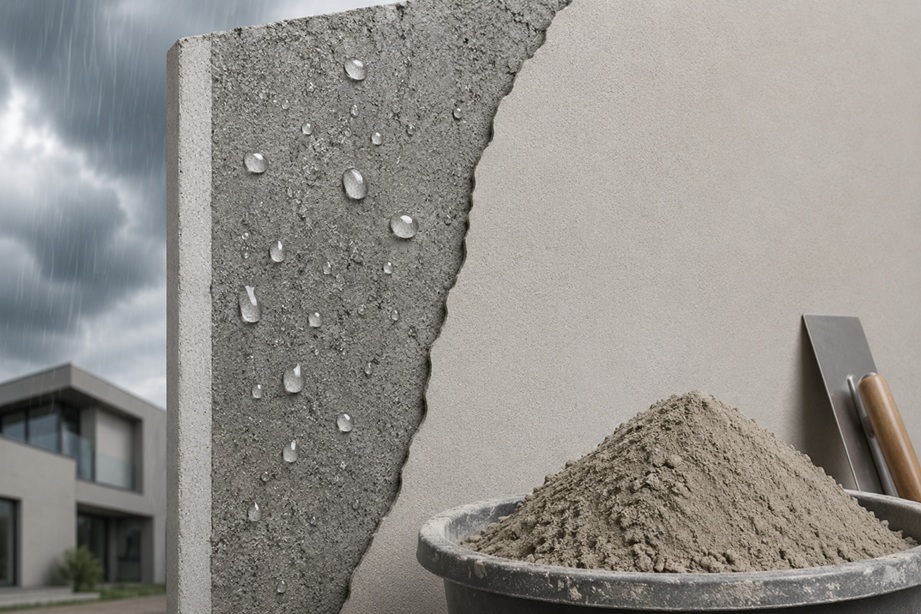
Moisture exposure is a common concern in building construction, particularly in bathrooms, kitchens, utility areas, balconies, basements and external walls. Prolonged exposure to water and humidity can affect plaster surfaces and contribute to damp patches, efflorescence, cracking, peeling of coatings and plaster debonding.
Ready mix plaster provides a factory-produced alternative to conventional site-mixed cement-sand plaster. The dry ingredients are proportioned and blended under controlled manufacturing conditions, while the material is mixed with the specified quantity of water at the construction site.
Water-resistant ready mix plaster is formulated to provide improved resistance to moisture absorption and water penetration compared with conventional plaster formulations. Depending on the product, its formulation may include cementitious binders, graded aggregates, mineral fillers, polymers, water-retention agents, water-repellent additives and other modifiers.
What Is Water-Resistant Ready Mix Plaster?
Water-resistant ready mix plaster is a pre-blended dry plaster material designed for applications where improved resistance to moisture is required.
The material is generally supplied in bags and mixed with clean water at the site. Factory-controlled proportioning helps maintain consistency in the composition of the dry mix.
Typical components can include:
- Cementitious binder
- Graded aggregates
- Mineral fillers
- Polymer modifiers
- Water-retention agents
- Workability modifiers
- Water-repellent additives
- Fibres in specialised formulations
The actual formulation varies according to the manufacturer and intended application.
Water resistance is influenced by more than the plaster material itself. Substrate condition, cracks, joints, service penetrations, application thickness, curing and the waterproofing arrangement can all influence moisture performance.
Advantages of Water-Resistant Ready Mix Plaster
- Reduced Water Absorption: Helps reduce the amount of water absorbed by the plaster layer and limits moisture-related surface deterioration.
- Consistent Material Proportioning: Factory-controlled production provides consistent proportions of binders, aggregates and additives.
- Improved Workability: Provides consistent workability for easier spreading, levelling and finishing.
- Reduced Material Wastage: Pre-blended material reduces wastage associated with separate measurement and handling of cement, sand and additives.
- Faster Application: Supports faster plastering operations, particularly on projects with large wall areas.
- Suitable for Mechanised Plastering: Selected formulations can be applied using plastering machines for large residential, commercial and institutional projects.
- Improved Adhesion: Suitable formulations can provide good bonding with properly prepared masonry and concrete substrates.
- Controlled Plaster Thickness: Can be applied within the recommended thickness range to achieve a more uniform surface.
- Reduced Moisture-Related Deterioration: Lower water absorption can help reduce surface deterioration caused by repeated moisture exposure.
- Compatibility with Different Substrates: Specialised products are available for AAC blocks, brick masonry, concrete blocks and concrete surfaces.
- Suitable Base for Finishes: Can provide a suitable substrate for paint, tiles, decorative finishes and other coatings, depending on the product.
- Simplified Site Material Management: Pre-blended material reduces dependence on separately sourced and measured plastering ingredients.
Applications of Water-Resistant Ready Mix Plaster
- Bathrooms and Toilets: Used on wall surfaces exposed to water splashes, steam and regular cleaning activities. It should be combined with the specified waterproofing system where required.
- Kitchens: Suitable for walls exposed to steam, humidity and occasional water splashes.
- Utility and Washing Areas: Used in areas experiencing repeated moisture exposure.
- External Walls: Can form part of an external wall finishing system exposed to rain and humidity.
- Balconies: Suitable for vertical surfaces exposed to rainwater and atmospheric moisture when compatible with waterproofing and drainage arrangements.
- AAC Block Walls: Specialised formulations can be used on AAC masonry based on absorption, adhesion and thickness requirements.
- Brick Masonry: Can be applied to properly prepared brick surfaces where improved moisture resistance is required.
- Concrete Block Walls: Suitable formulations can be applied after appropriate substrate preparation.
- Basements: Can be used for selected basement finishing applications, but should not replace waterproofing and drainage where groundwater or hydrostatic pressure is present.
- High-Humidity Buildings: Suitable for selected wall surfaces in buildings exposed to prolonged atmospheric humidity.
- Commercial Buildings: Can be used in toilets, kitchens, service areas and other moisture-exposed locations in hotels, offices and commercial buildings.
- Institutional Buildings: Suitable for selected moisture-prone areas in hospitals, schools and other institutional buildings.

Types of Water-Resistant Ready Mix Plaster
Different formulations are available for different substrates and exposure conditions.
Cement-Based Water-Resistant Plaster
Cement-based formulations are commonly considered for internal and external applications where resistance to moisture is required.
Polymer-Modified Plaster
Polymer-modified formulations can provide improved adhesion, workability and resistance to moisture-related deterioration.
Fibre-Reinforced Plaster
Fibres can be incorporated into selected formulations to help control cracking and improve performance in specific applications.
Lightweight Water-Resistant Plaster
Lightweight formulations can reduce the weight of the plaster layer while providing characteristics suitable for selected wall applications.
Single-Coat Plaster
Single-coat products are designed to provide the required plaster layer in one application where the substrate and product specification permit.
External-Grade Water-Resistant Plaster
These formulations are designed for external wall surfaces exposed to rain, humidity and environmental conditions.
AAC Block Plaster
Specialised formulations are available for AAC block masonry, considering its surface characteristics, absorption and bonding requirements.
Wet-Area Plaster
Certain products are formulated specifically for moisture-exposed internal areas such as bathrooms, toilets and utility spaces.
Application Procedure
Correct application is essential for achieving the expected performance.
1. Substrate Inspection
The substrate should be inspected for:
- Dust
- Loose mortar
- Oil and grease
- Weak surfaces
- Efflorescence
- Cracks
- Honeycombing
- Uneven areas
- Existing coatings
- Excessive dampness
Loose and weak material should be removed.
2. Surface Preparation
The substrate should be cleaned and prepared according to the product requirements.
Highly porous surfaces may require controlled pre-wetting. Smooth concrete surfaces may require appropriate surface preparation or a bonding treatment.
3. Mixing
The dry plaster should be mixed with the specified quantity of clean water.
Mechanical mixing can provide greater consistency on large projects.
Excess water, contaminated water, re-tempering and unauthorised addition of cement or sand should be avoided.
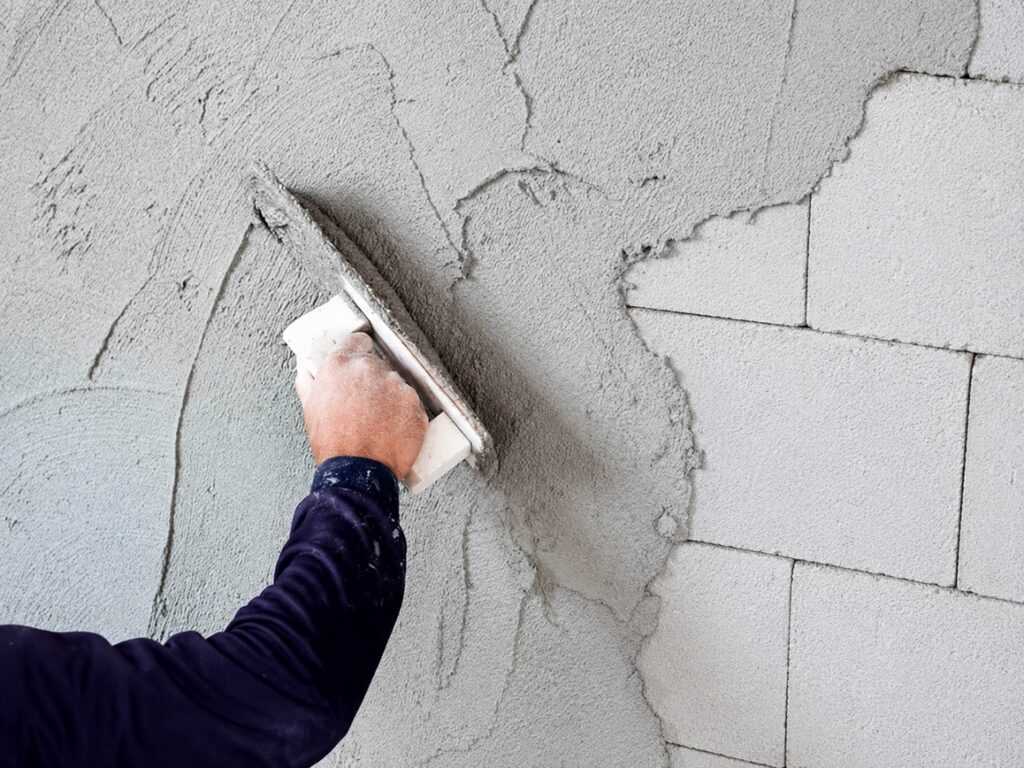
4. Application
The plaster should be applied uniformly at the recommended thickness.
Where the required thickness exceeds the permitted single-layer thickness, multiple coats may be required.
5. Levelling
The applied material should be levelled using suitable tools. Excessive reworking should be avoided.
6. Finishing
The surface should be finished according to the specified final treatment. The plaster finish should be compatible with subsequent paint, tile adhesive or coating.
7. Curing
Curing requirements depend on the product formulation. Cement-based products generally require appropriate curing to support hydration and reduce premature drying.
The manufacturer’s instructions should be followed.

Quality Control at Site
Quality control should cover both the material and its application.
| Parameter | What to Check |
| Product identification | Product type, manufacturer and batch |
| Storage | Dry and protected storage |
| Shelf life | Material within recommended shelf life |
| Water quality | Clean water |
| Mixing | Correct water quantity and mixing procedure |
| Substrate | Clean and properly prepared |
| Thickness | Within specified range |
| Adhesion | Proper bonding |
| Surface | Uniform and free from major defects |
| Curing | As recommended |
| Cracks | Inspection after application |
| Subsequent finish | Compatibility with paint, tile or coating |
How to Select the Right Water-Resistant Ready Mix Plaster
Selection can follow a structured approach:
Identify exposure → Identify substrate → Determine required thickness → Define final finish → Check technical properties → Confirm compatibility → Review application method → Conduct site trial where required → Finalise product.
A bathroom wall, external façade and basement wall may all experience moisture, but their exposure conditions are different. Therefore, the same plaster formulation may not be suitable for all three applications.
Conclusion
Water-resistant ready mix plaster provides a pre-blended plastering solution for wet and moisture-prone areas, with benefits including reduced water absorption, consistent material proportioning, improved workability, reduced material wastage and faster application.
Its performance depends on the complete application process rather than the material alone. Proper substrate preparation, mixing, application thickness, curing, joint treatment and finishing are necessary to achieve the intended results. For construction projects, selecting the appropriate plaster based on the substrate, exposure condition, required performance and final finish, followed by proper site application and quality control, can help achieve durable wall finishes in moisture-exposed areas.






