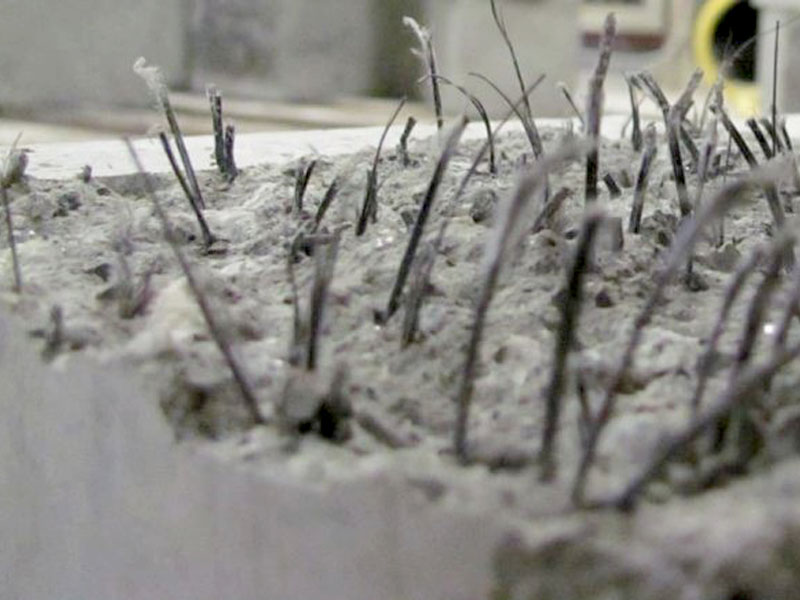
Plastic shrinkage cracking is one of the earliest and most common durability issues in fresh concrete. It occurs when rapid surface moisture loss exceeds the rate of bleeding, leading to the formation of micro and visible cracks before the concrete has fully set. These cracks, though small initially, can significantly reduce long-term durability, increase permeability, and compromise structural performance. Modern construction demands a reliable solution to address this challenge at its source.
Polypropylene Monofilament Micro Fiber: High-Performance Solution for Plastic Shrinkage Crack Control
FIBERCRETE-MF is an advanced Polypropylene Monofilament Micro Fiber developed by Kalyani Polymers Pvt. Ltd., Bengaluru, designed to significantly improve early-age concrete performance by controlling plastic shrinkage cracking, enhancing cohesion and improving surface durability.
It is 100% Virgin Polypropylene specifically engineered to disperse uniformly within the concrete matrix, forming a micro-reinforcement network that enhances crack resistance during the critical plastic and early hardening stages. The fiber has demonstrated up to 81% reduction in plastic shrinkage cracking compared to plain concrete, making it a highly effective solution for durable and crack-resistant concrete surfaces.
Compliance
FIBERCRETE-MF complies with relevant national and international standards:
- IS 16481:2022 – Textiles – Synthetic Micro Fibers for Use in Cement Based Matrix
- EN 14889-2 – Polymer Fibers Definitions, specifications and conformity
- ASTM C 1116 – Standard Specification for Fiber Reinforced Concrete and Shotcrete
- IRC: SP: 46-2013
- MORTH – Guidelines for Design and Construction of Fiber Reinforced Concrete Pavements
How FIBERCRETE® MF Controls Plastic Shrinkage Cracking and Enhances Performance
FIBERCRETE-MF works by dispersing uniformly throughout the concrete mix, forming a three-dimensional micro-reinforcement system that:
- Controls plastic shrinkage cracking during early hydration
- Reduces surface bleeding-related shrinkage cracks
- Minimizes micro-crack formation before initial setting
- Improves surface stability during moisture loss
- Restricts early-age shrinkage movement in concrete
- Enhances resistance to plastic shrinkage stresses
The monofilament structure ensures effective dispersion, preventing localized stress concentration and improving early-age crack resistance.
Key Benefits in Concrete Reinforcement
FIBERCRET-MF provides significant performance advantages:
- Improved surface finish quality
- Enhanced cohesion and workability stability
- Reduced permeability and improved durability
- Uniform crack distribution control
- Improved early-age tensile strength
- Easy integration into standard batching processes
- Long-term improvement in surface performance
Fiber Length, Features & Applications
6 mm, 12 mm Fibers
Features:
- Excellent surface finish quality
- Effective control of plastic shrinkage cracking
- Negligible impact on concrete load
- Uniform texture and dispersion
Applications:
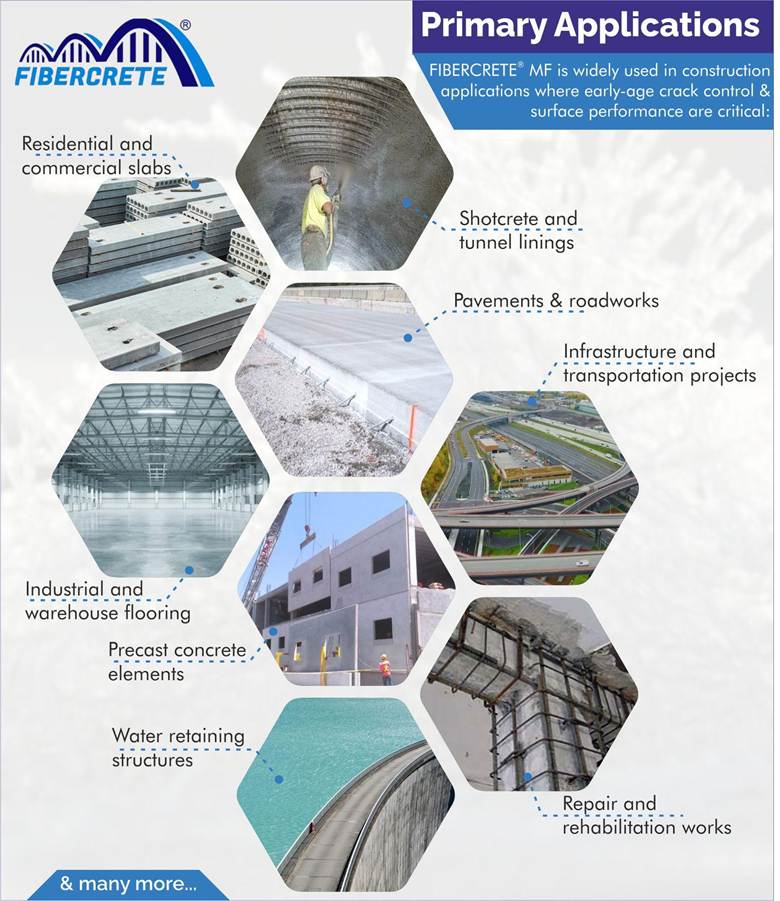
- Mortars and plastering works
- Precast wall panels
- Thermal and power plant structures
- Nuclear facility works
- 3D Concrete Printing
- Paver Blocks & Cover Blocks
- General concrete repair applications
24 mm Fibers
Features:
- Maintains excellent surface finish
- Higher tensile contribution due to aspect ratio
- Improved crack distribution control
- Suitable for load-bearing applications
Applications:
- PQC roads and pavements
- Precast structural elements
- Industrial flooring systems
- Heavy-duty slab construction
Performance Advantage in Modern Concrete
FIBERCRETE-MF enhances concrete performance at the plastic and early hardened stages by:
- Minimizing plastic shrinkage cracking
- Improving surface durability and finish quality
- Enhancing early-age tensile resistance
- Reducing micro-crack formation
- Increasing long-term service life of concrete surfaces
Its uniform dispersion ensures reliable crack control performance across a wide range of construction applications.
In-House Performance Evaluation & Test Report
Report on Evaluation of Plastic Shrinkage Cracking in Restrained Fiber Reinforced Concrete
- Report No: KPPL/FIBER-MF/001
- Test Method: ASTM C 1579-06
- Client: M/s Ultratech Cement Limited (IS 16481)
- Testing: Kalyani Polymers Private Limited
Objective
To determine the Surface Cracking Reduction Ratio (CRR) of Fiber Reinforced Concrete compared to Plain Concrete.
Key Test Methodology (ASTM C1579-06)
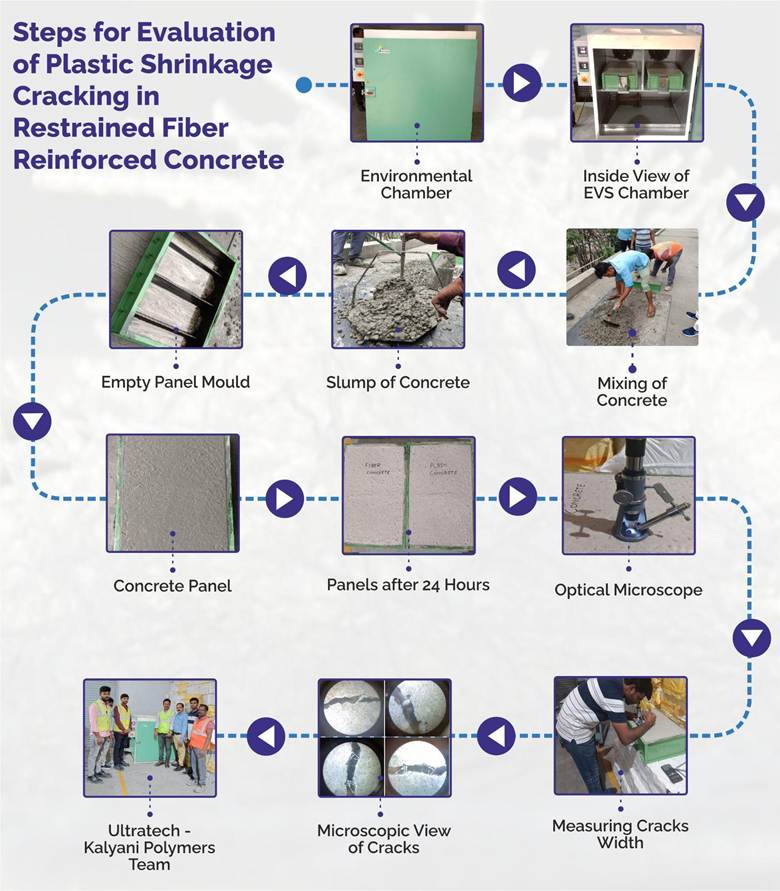
The test evaluates plastic shrinkage cracking under controlled environmental conditions using:
- Panel molds
- Environmental chamber (EVS)
- Evaporation monitoring system
- Crack measurement tools
- Controlled wind, temperature & humidity conditions
Procedure Summary
- Concrete mix prepared as per design
- Slump tested for plain and fiber mixes
- Panels cast and placed in EVS chamber
- Environmental parameters continuously monitored
- Crack formation measured after 24 ± 2 hours
- Crack widths recorded at 10 mm intervals
- Average crack width calculated for CRR evaluation
Formula Used
CRR = [1 – (Average Crack Width of FRC / Average Crack Width of Control Concrete)] × 100
Key Test Observations
- Temperature: ~36°C
- Relative Humidity: ~30 – 33%
- Wind Velocity: ~4.7- 4.9 m/s
- Evaporation Rate: ~1.0 – 1.3 kg/m²·h
Crack Width Results
- Plain Concrete Average Crack Width: 0.700 mm
- Fiber Reinforced Concrete Average Crack Width: 0.414 mm
Performance Result (CRR)
Crack Reduction Ratio (CRR): 40.85%
This confirms that Polypropylene Micro Fiber Reinforcement significantly reduces plastic shrinkage cracking under restrained conditions.
Key Findings
- Moisture loss control improved in fiber concrete
- Crack width reduced significantly
- Improved surface integrity observed
- Better performance under high evaporation conditions
Fiber Characteristics Used in Study
- Fiber Type: Polypropylene Monofilament
- Length: 12 mm
- Diameter: 32 micron
- Water Cement Ratio: 0.50%
- Dosage: 0.9 kg/m³
Cracking at the plastic stage remains one of the most critical challenges in modern concrete construction, especially in slabs, pavements, and large surface areas exposed to rapid moisture loss.
FIBERCRETE-MF provides a reliable, engineered solution that enhances crack control, surface durability, and early-age performance. By improving cohesion, reducing shrinkage cracking, and ensuring uniform fiber distribution, it enables the construction of more durable, stable, and high-quality concrete structures aligned with modern infrastructure requirements.
Kalyani Polymers Pvt Ltd. under the brand name FIBERCRETE® offers a World Class Synthetic Micro & Macro Concrete Fiber Products under “MAKE IN INDIA” and “ATMANIRBHAR” to cater the requirements of Construction Sector in India and around the World and carries a valid BIS & CE (European Conformity) markings.
The company has developed an in-depth understanding of trends and requirements, and in accordance developed unique technologies and manufacturing to best meet customers’ requirements. Having Accredited with ISO 9001 from TUV since 2008, Quality, Service and Innovation have been their Pillars of Development.
They have customized Concrete Fibers products for every client, and cater to their needs after a thorough investigation of the requirements and necessities. The company’s ability to continuously expand its product range and apply new techniques to present systems by installing new machines for efficient manufacturing is aided by the ample space to innovate and commercialize new products.

“ENHANCE. ENERGIZE. ELEVATE”
KALYANI POLYMERS PVT LTD
46/1, 11th KM Off Kanakapura Road, Doddakalasandra. Bangalore – 560062 Karnataka, INDIA
Phone: +91-80-40991198, +91-80-40991001
Email: sales@fibercrete.in
Website: www.fibercrete.in