
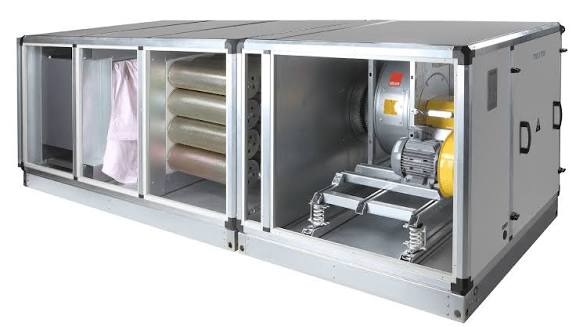
An ecology unit can appear in a mechanical tender with an airflow and a price while leaving its most consequential interfaces unassigned. One contractor assumes the fan is included; another assumes the odor stages are optional; the operator expects a maintenance arrangement that nobody priced. Clear tender scope and contractor responsibilities make competing offers more comparable before those gaps become site variations.
Electrostatic precipitation, UV-C and activated carbon perform different jobs within the described train. They also create different supply and service obligations. A useful tender states the required treatment arrangement and its interfaces, allowing suppliers to explain their proposed configuration without relying on the word unit to define the whole contract.
Describe the required outcome without prescribing an empty label
State the discharge problem. A visible cooking plume, grease deposition and odor at an occupied location need to be identified separately, together with the cooking duty and design airflow, so bidders can explain which parts of their proposed treatment address the project’s actual requirements.
Polygee’s explanation of an ecology unit treats the term as an arrangement rather than a single fixed product. In that description, electrostatic precipitation is a stage within a possible treatment train, while the hood and fan remain separate parts of the exhaust system.
Use that distinction in the tender. Require a schedule of included stages and accessories, then ask for exclusions in equally clear language. An offer for a collector alone should not be evaluated against a collector-plus-odor package as though both provide the same scope simply because their cover pages use the same heading.
Ask bidders to separate substitutions from omissions. If an alternative arrangement is proposed, it should explain which required function it addresses and which interfaces change, so the project team can assess that offer against the tendered duty rather than simply compare its price with an unchanged specification.
Allocate the design inputs before requesting a quotation
Identify who supplies the airflow. The ventilation designer’s required extract duty should reach each bidder on the same basis; kitchen floor area or a general description such as hotel restaurant is not a substitute for the operating information needed to configure the equipment.
Polygee lists a standard packaged range of 3,000–15,000 m³/h, while its LK-E family alone extends to 40,000 m³/h. Because those ranges describe different equipment extents, the tender should ask suppliers to confirm the complete proposed train at the required duty rather than rely on the collector’s maximum figure.
Assign responsibility for clarifying the cooking process, operating hours and discharge context. Where these remain undecided, identify the assumptions in the quotation and the point at which they must be confirmed. Otherwise the eventual operator may inherit a treatment selection based on a duty that never became part of the project brief.
Separate particle and odor obligations in the supplied package
Electrostatic precipitation collects grease aerosol and other cooking particles on washable cells. UV-C addresses part of the gas-phase load, and activated carbon provides adsorption. This division should appear in the supplier’s scope so that the project can see which treatment is included and which requires an additional module.
Do not reduce the distinction to a general efficiency requirement. A particle-removal result does not establish an odor outcome, and an optional gas-phase stage should not disappear from the comparison just because a competing offer presents a high collector percentage on its opening page.
The supplier reports up to 97.6% grease removal for LK-series equipment in third-party testing. The appropriate tender response is to request the relevant model, report and operating conditions. Keep that evidence separate from the proposed UV-C and activated carbon configuration and its site-specific maintenance basis.
Assign the fan and pressure review to a named participant
Polygee gives no more than 150 Pa for the complete LK-E stage with its distribution plate and approximately 20–30 Pa for the cell itself. Its guide calls for UV and carbon resistance figures for the proposed modules. These boundaries affect what information the equipment supplier must provide for the fan review.
Name the reviewer. The tender should identify who combines the supplied module data with the rest of the exhaust-system resistance and confirms the fan duty, rather than allowing each contractor to assume that the complete-system check belongs to someone else.
Clarify the supply scope too. If a fan is offered, identify it and its selection basis; if it is supplied elsewhere, state the information and coordination required between parties. The same principle applies to duct transitions and connections. A priced item is not a coordinated system until those responsibilities meet.
Price the installation and service provisions explicitly
The published access-side maintenance clearance for Polygee’s UV and carbon modules is 1,000 mm. Its guide also identifies weight, straight duct space and service access as demands on the building. These provisions should be recognised in the tender before the lowest equipment-only price is compared with an installation-inclusive offer.
Ask bidders to state what they supply and what the site must provide. Supports, delivery handling, electrical connections and access arrangements should have identified owners; relevant details can then be developed through the normal design coordination rather than being discovered as contractual exclusions after delivery.
Include the maintenance route in the responsibility discussion. Somebody must confirm where collector cells are taken for washing and how consumable modules are reached during operation. This article does not prescribe a particular drawing solution; the procurement task is to ensure that producing and checking that solution belongs to an identified participant.
Distinguish equipment documents from approval responsibility
UL Solutions describes UL 8782 as addressing safety aspects of pollution-control assemblies installed in commercial grease ducts. Its published explanation separates that scope from grease-removal effectiveness. A tender should therefore request the applicable safety documents and the relevant performance evidence as distinct deliverables.
Define who reviews applicability. The supplier can provide model-specific documents, but the project still needs the responsible designer or authority to assess the proposed installation against the requirements in force. Avoid a generic instruction to provide certificates that leaves both the required scope and the reviewer undefined.
A component document should remain a component document. Do not assume that a power-supply file or an electrostatic-air-cleaner listing establishes the status of every assembled train offered under the ecology-unit heading. Require the bidder to identify the actual coverage and any outstanding issue before equipment selection is closed.
Include commissioning and consumables in the commercial comparison
Commissioning needs an owner. Establish who confirms the installed configuration, records the operating duty and demonstrates the agreed functions, then identify who will provide the operator with the maintenance instructions and the initial service basis. A supply-only price may exclude those activities.
The supplier separates washed collector cells from consumed UV-C lamps and activated carbon media. Its guide does not publish a universal carbon-change interval, instead connecting the schedule to the kitchen’s duty. Ask for those recurring tasks and their assumptions to be stated beside the capital offer.
Compare like obligations. Initial consumables, replacement supply, training and service visits may be included, excluded or offered separately; any of those arrangements can be clear, but an unstated assumption is difficult to price and easy to transfer to the operator after handover.
Close the tender with agreed interfaces and exclusions
Before accepting an offer, return to the divisions of work. The chosen configuration should have a consistent treatment scope, design basis and allocation of responsibilities across the equipment quotation and the mechanical contract.
- Confirm which particle and gas-phase stages are included.
- Identify who provides duty inputs and accepts the configuration.
- Assign the complete-system fan review and duct interfaces.
- Allocate installation access, handling and service provisions.
- Define document review, commissioning and maintenance handover.
- State exclusions and recurring consumable obligations.
An ecology unit tender succeeds when those interfaces are explicit enough for bidders and contractors to price the same work. The treatment principles explain what the stages do; the contract must establish who supplies, coordinates and maintains them. Keeping both visible reduces the chance that a complete-looking quotation conceals an incomplete installation scope.






