
Yes. Landscaping adds value to most Australian homes, and the figure quoted most often sits somewhere between 5% and 15% of the sale price. That range hides a lot, though. A tidy front garden on a $1.4 million Sydney house can return more than it cost. A $90,000 back yard overhaul on the same house usually will not. What separates the two is whether a buyer can see the work from the street, use it the day they move in, or stop worrying about it. Work that only suits your own taste rarely pays you back.
How much value does landscaping actually add?
Nobody can give you a number for your house without seeing it, and anyone who does is guessing. Valuers have no line item called landscaping. What they have is a comparison between your property and the ones that sold nearby, and your garden feeds into that comparison in two separate ways.
The first is the price itself. A property that presents well pulls more people through the door, and the number of interested buyers at an inspection is what moves the price on the day.
The second is how long the listing sits. A garden that looks after itself shortens the campaign. That matters, because a property still on the market after two months starts attracting offers well under asking no matter how good the house is behind it.
So the more useful question is not how much landscaping will add. It is what neglecting it is already costing you. On a tired block, that number is usually bigger than the cost of fixing it.
Quick takeaway: Landscaping is rarely valued on its own. It changes how many buyers turn up and how fast they commit.
Which landscaping jobs return the most
Not every dollar behaves the same way. Some work returns more than it cost, some returns roughly what you put in, and some is spent for your own enjoyment rather than your sale price. Knowing which is which before you start is most of the battle.
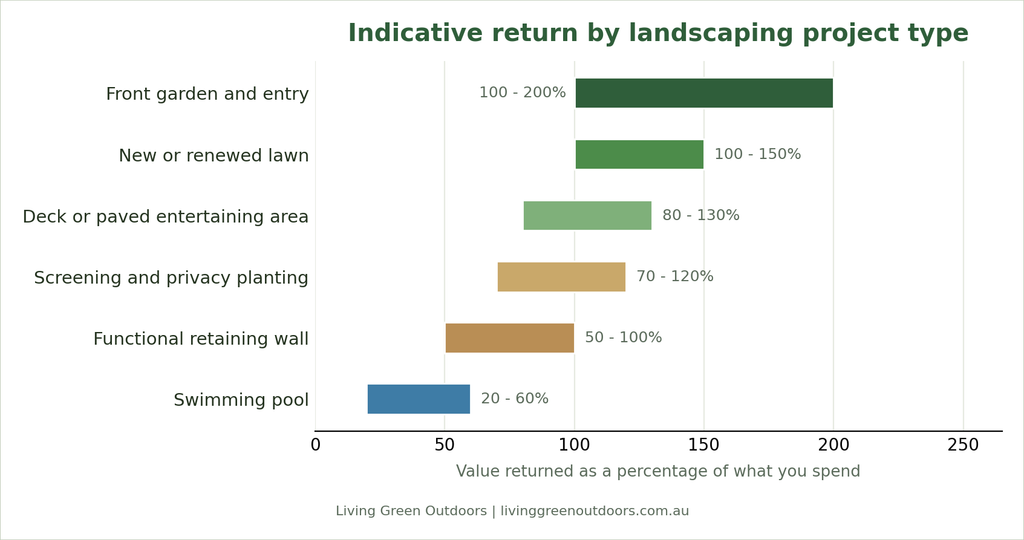
Indicative return bands. Front garden work consistently returns more per dollar than large structural projects.
The table below pairs those bands with the ranges we see when quoting across Sydney. Costs move with site access, slope and material choice, so treat them as a starting point rather than a quote.
| Project | Typical Sydney cost | What it does for your value |
| Front garden and entry | $3,000 – $15,000 | Sets the first impression and every listing photo |
| New or renewed lawn | $2,500 – $8,000 | Reads as cared for immediately, cheap per square metre |
| Deck or paved entertaining area | $8,000 – $35,000 | Adds living space a buyer can picture using |
| Screening and privacy planting | $1,500 – $9,000 | Removes an objection instead of adding a feature |
| Irrigation and garden lighting | $2,000 – $12,000 | Small spend, strong effect on how the place presents |
| Functional retaining wall | $6,000 – $30,000 | Fixes a problem, seldom returns more than it cost |
| Swimming pool | $45,000 – $120,000 | Narrows your buyer pool as often as it widens it |
Two patterns run through that list. Cheap visible work beats expensive invisible work. And work that removes a buyer’s objection beats work that adds a feature nobody asked for.
Quick takeaway: Spend on what a buyer notices in the first minute before you spend on what they would notice in the first month.
Why the front garden beats the back yard
Most owners put the bulk of their budget out the back, because that is where they actually live. Buyers work in the opposite order.
By the time someone walks through your front gate they have seen the photos, driven past, and formed an opinion. The front garden did that. The back yard only confirms or contradicts it.
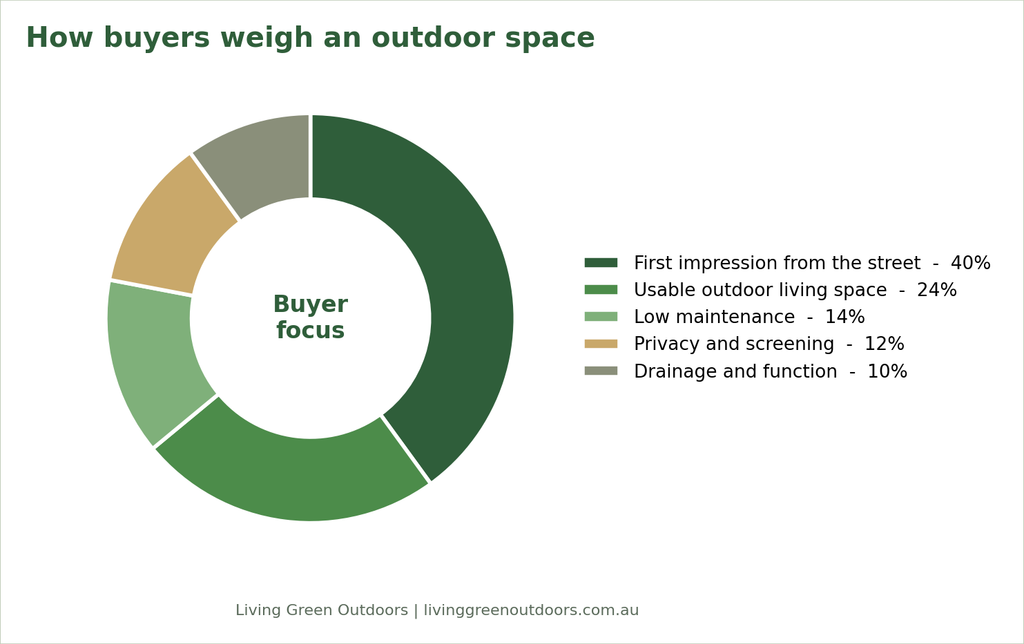
How buyers weigh an outdoor space. The view from the footpath does more work than anything behind the house.
None of that makes the back yard irrelevant. It means that when the budget is tight, the first few thousand dollars work harder at the front of the property than anywhere else.
Quick takeaway: If you can only afford one part of the job, do the part the buyer sees before they park.
What Sydney buyers look for
Sydney is not one market and its gardens are not one problem. What adds value in Camden is not what adds value in Balmain. A few things come up almost everywhere, though.
Outdoor space they can use straight away
A flat, shaded area big enough for a table and six chairs does more for a sale than an elaborate garden with nowhere to sit. Buyers are picturing a Sunday afternoon, not a horticultural display.
Low maintenance, not no maintenance
Buyers want a garden that looks good without owning their weekends. That usually means hardy natives, good mulch, a working irrigation line, and restraint about how many garden beds you create. A yard paved from fence to fence solves the maintenance question and creates a worse one.
Water going where it should
Sydney gets its rain in short, heavy bursts. Clay soils through the Hills and the south west hold that water, and a yard that puddles for two days after a storm is an obvious problem to anyone inspecting in autumn. Drainage is unglamorous and it is one of the few things that will actively lose you a sale.
Shade and privacy
Western Sydney summers make shade a selling point rather than a nicety. Screening matters most on the newer estates where houses sit close together and a neighbour’s window looks straight into the entertaining area. Fixing that with planting is cheap compared to what it does for the feel of the space.
Quick takeaway: Match the work to the suburb. Shade and drainage sell in the west, usable space and privacy sell on smaller inner blocks.
The landscaping that quietly costs you money
This part gets left out of most guides, and it is the part clients thank us for. Some landscaping reduces what your property fetches.
- A pool the block cannot carry. On a large family block with room to spare, a pool can help. On a small yard it eats the usable space, and families with young children often read it as a cost and a risk rather than a feature.
- Gardens that need a gardener. Formal hedging, heavy annual beds and anything requiring weekly attention will put off a buyer who works full time. They are pricing in the upkeep whether they mention it or not.
- Structures built without approval. An unapproved deck, pergola or high retaining wall turns up during conveyancing and becomes a negotiating lever. Buyers discount hard for anything that might need rectifying later.
- Removing a mature tree. Established trees add shade, privacy and street appeal that no new planting can replicate for a decade. Removing one without council consent can also carry a substantial penalty.
- Concreting the whole yard. It reads as cheap, it holds heat through summer, and in many council areas it breaches the minimum landscaped area or permeability requirements.
- Design built around your taste. A themed garden, a water feature that dominates the space, or an unusual colour scheme narrows the field of people who can imagine themselves living there.
Quick takeaway: The fastest way to lose money on a garden is to build something the next owner has to undo.
How to tell if you are overcapitalising
Here is the rough test we give clients before quoting anything substantial. Add what you have already spent on the house to what you are about to spend outside. If the total pushes your property more than about 10% past the best recent sale in your street, you are unlikely to see it again.
Take a $1.4 million house in a street where nothing has sold above $1.55 million. A $15,000 refresh of the front garden, lawn and entry is comfortably inside the envelope and usually returns more than it cost. A balanced $45,000 job covering the front, a deck and some screening still works. Push to $95,000 with a pool and full hardscaping and the extra spend has nowhere to go, because the street will not support the price you would need.
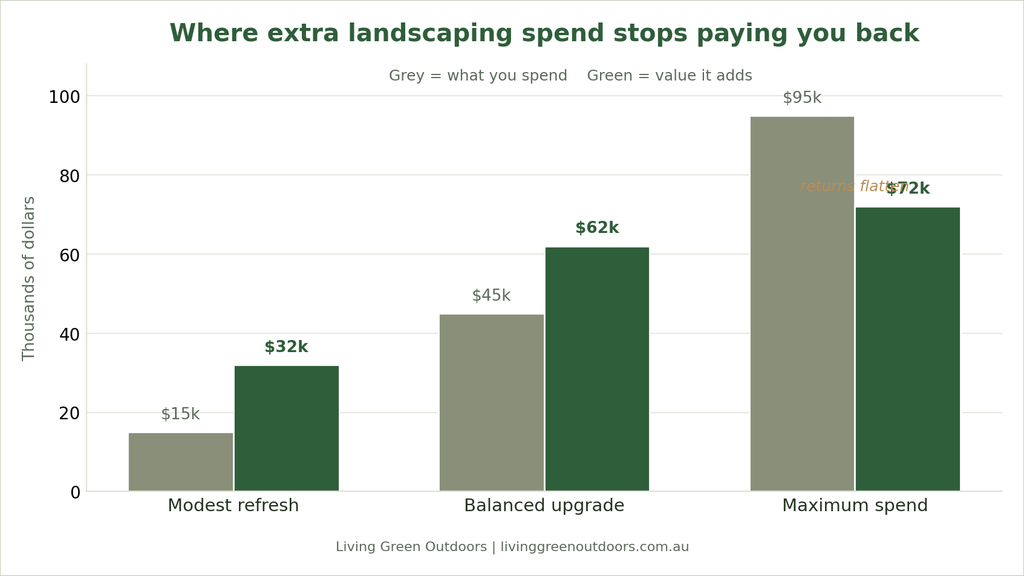
The same house at three budget levels. Past a point the spend keeps rising and the value added does not.
The ceiling is set by your street, not by your ambition. Check what has actually sold within a few hundred metres in the last six months before committing to a large budget.
Quick takeaway: Your street sets the ceiling. Spending past it buys you enjoyment, not equity.
When to start landscaping before you sell
Timing decides whether the work looks established or looks like it was done for the sale. Buyers can tell the difference, and so can agents.
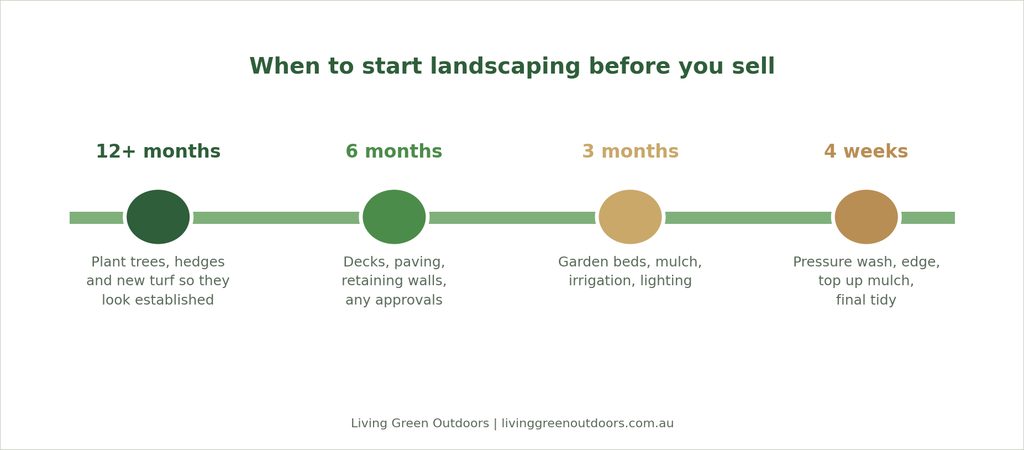
Work backwards from your listing date. Planting needs the longest lead time and gets left the latest.
The mistake we see most often is a homeowner ringing in March for an April campaign and asking for new turf and screening hedges. Fresh turf needs a full season to knit properly, and a hedge planted at 400mm is still a row of small plants on inspection day. Structural work can be squeezed. Living things cannot.
Quick takeaway: Plant first, build second, tidy last. Anything that has to grow needs at least a full season.
Should you do it yourself?
Plenty of it, yes. Mulching, weeding, edging, pressure washing paths and replanting beds are all within reach of a capable owner with a weekend, and they cover most of what a buyer notices.
Where it stops being sensible is anything structural or anything that gets inspected. Retaining walls, drainage, paving falls, electrical work for lighting, and anything needing council sign-off are worth handing to a licensed team. A wall that leans two years later, or a paved area that drains toward the house, costs far more to fix than it saved. Our landscaping team handles the parts where getting it wrong is expensive.
Quick takeaway: Do the cosmetic work yourself. Pay for anything holding back soil, moving water, or carrying a certificate.
What needs council approval in New South Wales
This trips up more homeowners than any other part of a garden project, and it surfaces at the worst possible moment, which is during the sale.
- Retaining walls above roughly 600mm generally need approval, and the threshold tightens near boundaries or where the wall supports a structure.
- Decks and pergolas can often be built as exempt development within set height, area and setback limits. Outside those limits you need consent.
- Pool fencing has to comply and gets checked. A non-compliant fence will hold up a settlement.
- Most councils protect trees over a certain height or trunk diameter through their development control plan. Removal without consent can attract a serious fine.
- Many areas set a minimum landscaped area or a limit on hard surfaces, which is what catches people who pave everything.
Rules differ between councils and they change, so confirm with your local council or your landscaper before work starts rather than after. Retrospective approval is possible and it is slower and more expensive than doing it in order.
Quick takeaway: Approvals are cheap at the start of a project and expensive in the middle of a sale.
Getting the most from a landscaping budget
Most of the value in a garden comes from a handful of decisions made before anyone picks up a shovel. What the street sees, whether water drains away, how much upkeep the finished space demands, and whether the whole thing suits the house it belongs to. Get those right and the planting is straightforward. Get them wrong and no amount of good plant selection rescues it. That planning stage is where our landscape design and construction work starts.
We work across Sydney on gardens at every budget, from a front yard refresh before a spring campaign through to full rebuilds on difficult sloping blocks. If you are weighing up what is worth doing before you sell, get in touch with Living Green Outdoors and we will tell you honestly which parts of the job will come back to you and which will not.
Frequently asked questions
Does landscaping increase property value in Australia?
Generally yes. Well-planned landscaping is commonly credited with adding somewhere between 5% and 15% to a sale price, though the real figure depends on the property, the suburb and the standard of the work. Poor or overly personal landscaping can reduce value.
What landscaping adds the most value?
Front garden and entry work delivers the strongest return for the money, followed by healthy lawn, a usable outdoor entertaining area, and screening that solves a privacy problem. These are cheap relative to their effect on how the property presents.
Is landscaping worth doing before selling?
For most homes, yes, provided the work is proportionate. A few thousand dollars on presentation almost always returns more than it cost. Large structural projects started shortly before a campaign rarely do, because there is not enough time for them to settle in.
Does a swimming pool add value to a home in Sydney?
Sometimes. On a large block in a family suburb a pool can add value. On a small yard it usually costs more than it returns, because it consumes the usable outdoor space and some buyers price in the maintenance and safety obligations.
How long before selling should I start landscaping?
Allow twelve months or more for trees, hedges and new turf so they look established. Six months covers decks, paving and retaining walls including approvals. Garden beds and mulch can go in three months out, and final tidying belongs in the last month.
Does landscaping affect a bank valuation?
Indirectly. A valuer compares your property to recent local sales rather than pricing the garden as a separate item, but presentation and condition influence where in that comparable range your property lands.
Can landscaping decrease property value?
Yes. Unapproved structures, poor drainage, high-maintenance gardens, removal of established trees, and designs built around one owner’s taste all reduce what buyers are willing to pay.
Do I need council approval to landscape my garden?
Planting, mulching and lawn do not require approval. Retaining walls above roughly 600mm, some decks and pergolas, pool fencing and the removal of protected trees generally do. Check with your council before starting.






