
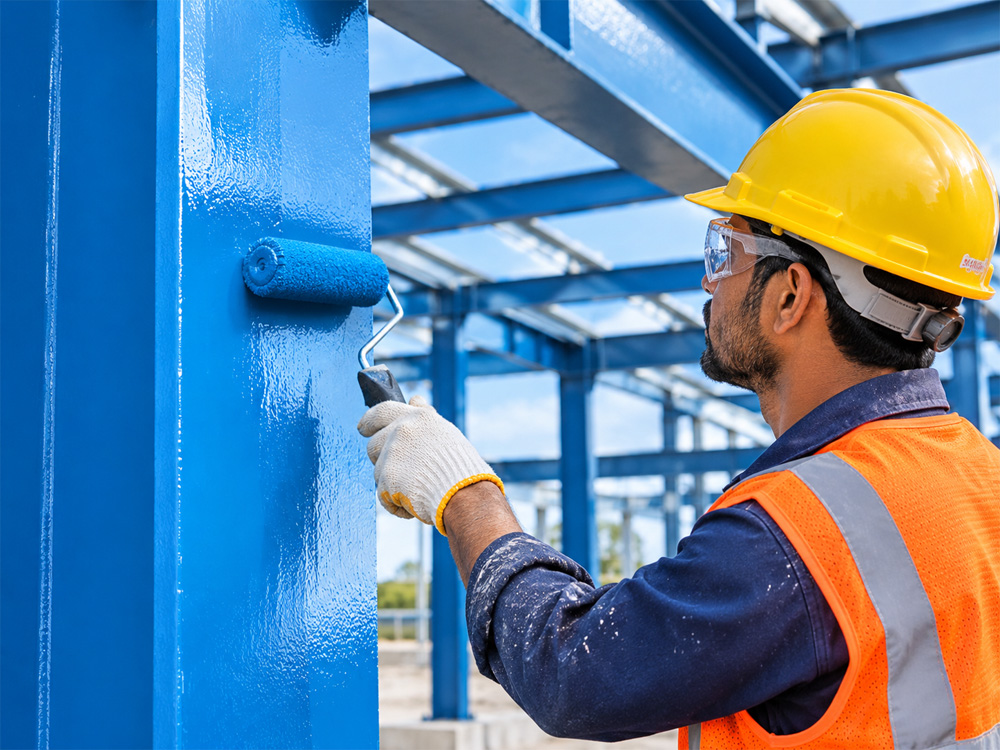
Enamel paint is one of the most widely used paints for protecting and enhancing a variety of surfaces in residential, commercial, industrial, and infrastructure projects. It is valued for its hard, smooth finish and its ability to withstand moisture, stains, scratches, abrasion, and regular wear.
What is Enamel Paint?
Enamel paint is a type of paint that dries to form a hard, durable, and smooth surface. It is designed to provide both decoration and long-term protection by creating a strong film that resists moisture, stains, scratches, chemicals, and weather exposure. Depending on the formulation, enamel paint is available in gloss, semi-gloss, satin, and matt finishes.
Earlier enamel paints were primarily oil-based and recognised for their excellent durability and glossy appearance. Today, manufacturers produce both solvent-based and water-based enamel paints, allowing users to select products based on the application, surface material, performance requirements, drying time, and environmental considerations. These paints are suitable for a wide range of substrates, including metal, wood, concrete, masonry, and previously painted surfaces.
Enamel paints are commonly used on:
- Metal surfaces
- Wooden furniture
- Doors and windows
- Steel structures
- Industrial equipment
- Kitchen cabinets
- Handrails
- Machinery
- Pipes
- Gates and grills

Composition of Enamel Paint
The performance of enamel paint depends on its carefully balanced composition.
Pigments
Pigments provide colour, opacity, and protection against ultraviolet radiation.
Binder or Resin
The resin binds all ingredients together and forms the protective coating after drying. Common binders include alkyd resins, acrylics, polyurethane, and epoxy-based systems.
Solvents
Solvents control paint viscosity and ensure smooth application. They evaporate during drying, leaving behind the hardened paint film.
Additives
Special additives improve properties such as:
- Flow and levelling
- UV resistance
- Anti-corrosion performance
- Fungus resistance
- Drying speed
- Gloss retention
Properties of Enamel Paint
High Durability
The hardened coating resists abrasion, scratches, and everyday wear, making it suitable for frequently used surfaces.
Excellent Adhesion
Properly prepared surfaces allow enamel paint to bond strongly with metal, wood, concrete, and masonry.
Moisture Resistance
Enamel coatings prevent water penetration, reducing the risk of corrosion, swelling, and deterioration.
Chemical Resistance
Many industrial enamel formulations resist oils, grease, mild chemicals, detergents, and cleaning agents.
UV Resistance
Premium exterior enamel paints maintain colour and gloss despite prolonged sunlight exposure.
Easy Maintenance
The smooth surface allows dust and stains to be removed using a damp cloth or mild detergent.
Applications of Enamel Paint
Enamel paints are widely used across multiple sectors.
Residential Buildings
Applications include:
- Doors
- Window frames
- Kitchen cabinets
- Wardrobes
- Metal gates
- Stair railings
- Furniture
Commercial Buildings
Commercial projects use enamel coatings for:
- Office furniture
- Fire doors
- Metal partitions
- Signage
- Lift doors
- Service areas
Industrial Facilities
Factories require enamel paints for:
- Machinery
- Equipment
- Steel structures
- Pipelines
- Tanks
- Fabricated components
Infrastructure Projects
Enamel coatings protect:
- Bridges
- Transmission towers
- Railway equipment
- Utility structures
- Safety barriers

Types of Enamel Paint
Oil-Based Enamel Paint
Oil-based enamel paint is the traditional and most durable type of enamel coating. It is formulated using alkyd or oil-based resins that create a hard, glossy finish with excellent resistance to moisture, abrasion, and weathering. It is commonly used on metal gates, grills, railings, doors, windows, and wooden furniture. Although it offers outstanding durability and adhesion, oil-based enamel takes longer to dry and releases a stronger odour due to its solvent content.
Water-Based Enamel Paint
Water-based enamel paint is an environmentally friendly alternative that uses water as the primary solvent. It dries quickly, has low odour, and contains lower levels of volatile organic compounds (VOCs), making it suitable for indoor applications. Modern water-based enamels provide good durability, colour retention, and washability while being easier to clean with water. They are widely used for doors, cabinets, furniture, walls, and interior metal surfaces.
Synthetic Enamel Paint
Synthetic enamel paint is manufactured using synthetic alkyd resins that provide a smooth, glossy, and durable finish. It offers excellent adhesion, good weather resistance, and long-lasting colour, making it one of the most popular choices for residential and commercial projects. Synthetic enamel is suitable for wood, metal, and masonry surfaces and is available in a wide range of colours and finishes.
Polyurethane Enamel Paint
Polyurethane enamel paint is a high-performance coating designed for surfaces exposed to heavy wear, chemicals, and frequent cleaning. It forms a highly durable finish with excellent resistance to abrasion, impact, oils, solvents, and moisture. Due to its superior mechanical properties, polyurethane enamel is widely used in factories, warehouses, industrial equipment, machinery, and commercial facilities where long-term protection is required.
Heat-Resistant Enamel Paint
Heat-resistant enamel paint is specially formulated to withstand elevated temperatures without blistering, peeling, or losing its colour. It is commonly applied to boilers, chimneys, industrial furnaces, exhaust systems, pipelines, engines, and automotive components that operate under high heat conditions. These coatings maintain their protective properties even when exposed to continuous or intermittent high temperatures.
Anti-Corrosive Enamel Paint
Anti-corrosive enamel paint combines decorative properties with corrosion protection for steel and iron surfaces. It contains rust-inhibiting pigments that help prevent oxidation and extend the service life of metal structures. This type of enamel is commonly used on bridges, structural steel, industrial equipment, pipelines, storage tanks, gates, and outdoor metal fabrications exposed to moisture and harsh environmental conditions.
Finish Options
Enamel paints are available in several finishes depending on aesthetic and functional requirements.
Gloss Finish
Gloss enamel reflects maximum light and produces a bright, polished appearance. It is easy to clean and commonly used for doors, windows, and furniture.
Semi-Gloss Finish
Semi-gloss offers a balanced appearance while reducing glare. It is suitable for commercial buildings and institutional facilities.
Satin Finish
Satin enamel provides a smooth, elegant appearance with moderate sheen and is often selected for interior applications.
Matt Finish
Matt enamel reduces surface reflections and helps conceal minor imperfections while maintaining durability.
Surface Preparation
Proper surface preparation significantly influences paint performance.
Metal Surfaces
- Remove rust completely.
- Eliminate grease and oil.
- Apply anti-corrosion primer.
- Sand lightly before painting.
Wooden Surfaces
- Remove dust and loose fibres.
- Fill cracks using wood filler.
- Sand for smoothness.
- Apply wood primer.
Previously Painted Surfaces
- Remove loose paint.
- Repair damaged areas.
- Clean thoroughly.
- Sand glossy surfaces for improved adhesion.
Application Methods
Enamel paint can be applied using different techniques depending on project size.
Brush Application
Suitable for small areas, touch-ups, doors, and furniture.
Roller Application
Ideal for larger flat surfaces requiring consistent coverage.
Spray Painting
Provides uniform finish, faster application, and reduced brush marks. Widely used in industrial manufacturing and automotive applications.
Drying Process
Enamel paint generally dries in three stages.
Surface Dry
The paint becomes touch-dry within a few hours, depending on formulation and weather conditions.
Hard Dry
The coating develops sufficient hardness for handling.
Full Cure
Complete curing may take several days, during which the paint achieves its maximum hardness, adhesion, and chemical resistance.

Factors to Consider Before Selecting Enamel Paint
Surface Material
Choose products specifically formulated for wood, metal, concrete, or masonry.
Indoor or Outdoor Use
Exterior applications require enhanced UV and weather resistance.
Exposure Conditions
Industrial environments may require coatings resistant to chemicals, abrasion, or high temperatures.
Desired Finish
Select gloss, semi-gloss, satin, or matt according to design requirements.
Environmental Regulations
Low-VOC and water-based products are increasingly preferred for improved indoor air quality and compliance with environmental standards.
Emerging Trends in Enamel Paint Technology
Manufacturers continue to improve enamel paint formulations to meet evolving construction and industrial requirements.
Recent developments include:
- Low-VOC and eco-friendly formulations
- Water-based enamels with improved durability
- Faster curing systems
- Anti-bacterial coatings for healthcare facilities
- Anti-graffiti finishes
- High-performance corrosion-resistant systems
- Heat-reflective coatings for improved energy efficiency
- Enhanced colour retention using advanced pigments
These innovations are helping reduce environmental impact while delivering higher performance and longer maintenance cycles.
Conclusion
Enamel paint continues to be one of the most reliable protective and decorative coating solutions for a wide range of applications. Its hard finish, durability, moisture resistance, and ease of maintenance make it suitable for residential, commercial, industrial, and infrastructure projects. With options ranging from traditional oil-based products to modern water-based and specialised performance coatings, users can select formulations that match both functional and aesthetic requirements.
Choosing the appropriate enamel paint, preparing the surface correctly, and following recommended application practices are essential for achieving long-lasting results. As coating technologies continue to evolve, enamel paints will remain a preferred choice for protecting and enhancing surfaces while meeting modern expectations for durability, appearance, and environmental responsibility.






