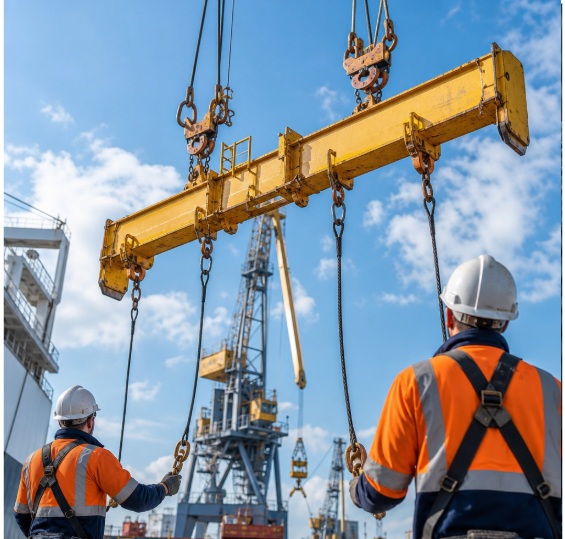
Spreader bars represent a critical component in modern rigging operations, serving as the intermediary hardware that distributes lifting forces across multiple attachment points. These engineered devices prevent load crushing, maintain dimensional stability during lifts, and reduce sling angles to acceptable working parameters. In industries ranging from steel erection to shipbuilding, the proper deployment of spreader bars determines whether complex lifting operations succeed safely or result in catastrophic failure. Understanding their function, limitations, and regulatory requirements forms the foundation of competent rigging practice.
The Engineering Purpose Behind Spreader Bars
Spreader bars solve a fundamental problem in rigging: how to lift wide or fragile loads without compromising structural integrity. When lifting elongated objects such as prefabricated building sections, pressure vessels, or shipping containers, conventional choker configurations create inward compression forces that can deform or damage the load. Spreader bars counteract this tendency by maintaining fixed distances between lifting points, transforming what would be acute sling angles into geometry that directs forces vertically rather than laterally.
The mechanical advantage extends beyond load protection. By controlling sling angles, spreader bars increase the effective capacity of the lifting system. A sling rigged at 60 degrees from vertical carries significantly less tension than one at 30 degrees, meaning spreader bars allow crews to handle heavier loads with existing equipment. This capacity multiplication makes them indispensable in projects where crane capacity approaches design limits or where multiple lifts using identical configurations need consistent performance metrics.
Regulatory Framework Governing Rigging Hardware
Federal oversight of rigging equipment operates under multiple regulatory pathways depending on industry sector and operational context. The Occupational Safety and Health Administration establishes baseline requirements through standards that address equipment design, inspection protocols, and operator qualifications. Within construction environments, OSHA 1926.753 specifically governs steel erection activities, mandating that all rigging equipment bear identification markings, proof-test documentation, and capacity ratings appropriate to the application.
Compliance extends beyond initial equipment selection. Regulations require competent persons to inspect rigging hardware before each shift and after any occurrence that could affect structural integrity. Visual examinations must identify cracks, deformation, excessive wear, corrosion, and any modifications that alter original design parameters. Documentation of these inspections creates an audit trail demonstrating due diligence, which becomes critical evidence should incidents trigger regulatory investigations or civil litigation.
Material Standards and Load Rating Protocols
Spreader bars manufactured to industry specifications undergo rigorous testing regimes that validate structural performance under dynamic loading conditions. The American Society of Mechanical Engineers establishes dimensional tolerances, material properties, and testing methodologies through consensus standards adopted across manufacturing sectors. These specifications ensure that spreader bars possess adequate yield strength, fatigue resistance, and impact toughness to withstand cyclical loading without progressive deterioration.
Load ratings stamped on spreader bars reflect design factors that account for dynamic forces, environmental conditions, and statistical variation in material properties. A spreader bar rated for 10 tons incorporates safety margins that prevent yielding even when subjected to shock loads during sudden stops or starts. Operators who exceed these ratings compromise structural integrity in ways that may not produce immediate failure but accumulate damage that manifests catastrophically during subsequent lifts.
Operational Selection Criteria
Choosing appropriate spreader bar configurations requires analyzing load characteristics, lifting geometry, and environmental factors that influence rigging performance. Project managers must evaluate load weight distribution, identifying center of gravity locations that determine attachment point placement. Asymmetrical loads demand adjustable spreader bars with repositionable lifting eyes, while repetitive lifts of identical components benefit from fixed-configuration hardware that accelerates cycle times.
When projects require temporary rigging solutions without capital investment in specialized hardware, contractors frequently rent spreader bars configured for specific applications. This approach provides access to engineering-certified equipment that meets regulatory standards while avoiding long-term maintenance obligations and storage costs. Rental agreements typically include certification documentation, inspection records, and technical support that ensures proper deployment according to manufacturer specifications and industry best practices.
Environmental and Operational Constraints
External conditions impose limitations on spreader bar performance that require mitigation strategies. Temperature extremes affect material properties, with cold environments increasing brittleness in certain alloys while elevated temperatures reduce yield strength. Corrosive atmospheres accelerate surface degradation, necessitating protective coatings or material selection resistant to chemical attack. Wind loading introduces lateral forces that complicate lift planning, particularly when handling large surface area loads that act as sails.
Jobsite logistics influence hardware selection as significantly as engineering calculations. Congested work areas with limited clearance heights require low-headroom spreader bar designs that minimize vertical space consumption. Projects involving multiple lifts across extended durations benefit from modular systems that adapt to varying load dimensions without requiring complete hardware changes between operations.
Integration with Comprehensive Rigging Systems
Spreader bars function as components within larger rigging assemblies that include slings, shackles, hooks, and other connecting hardware. Understanding how these elements interact ensures system integrity and prevents compatibility issues that compromise safety. Lifting and rigging tools must share compatible working load limits, with the weakest component determining overall system capacity regardless of individual ratings elsewhere in the configuration.
Attachment hardware requires particular attention, as connection points concentrate forces that can exceed material capabilities if improperly sized. Shackle pin diameters must match spreader bar eye dimensions to prevent eccentric loading that introduces bending moments. Sling terminations need adequate bearing surface to distribute tension without creating stress concentrations that accelerate fatigue crack propagation.
Load Distribution and Balance Considerations
Effective spreader bar deployment demands accurate assessment of load center of gravity and resulting force distribution across attachment points. Unbalanced loads create differential tensions in sling legs, potentially overloading individual components while underutilizing others. Competent riggers employ calculation methods or empirical testing to verify that actual load distribution matches design assumptions, adjusting attachment positions as necessary to achieve equilibrium.
Dynamic considerations compound static analysis challenges. Loads that shift during lifting operations due to inadequate securement or unrecognized asymmetry can dramatically alter force distribution mid-lift. Establishing positive control through secondary restraints, conducting test lifts to minimal elevations, and maintaining constant observation throughout lifting cycles mitigates these risks.
Industry Leadership in Specialized Lifting Solutions
Organizations specializing in heavy rigging equipment provide comprehensive solutions that extend beyond basic hardware supply. Engineering support services assist project teams in developing lift plans that optimize equipment selection, calculate load dynamics, and identify potential failure modes before operations commence. This consultative approach transforms equipment providers into strategic partners who contribute technical expertise that enhances project safety and efficiency.
Modern rigging service providers maintain extensive inventories spanning standard configurations and specialized designs for unique applications. Their equipment undergoes continuous inspection and maintenance programs that exceed minimum regulatory requirements, ensuring that every spreader bar deployed meets original manufacturing specifications. Certification programs train customer personnel in proper use, inspection techniques, and troubleshooting procedures that maximize equipment performance while minimizing incident risk.
Conclusion
Spreader bars occupy an essential position in the hierarchy of lifting hardware, enabling operations that would otherwise exceed safe working parameters or risk load damage. Their effective deployment requires synthesis of engineering principles, regulatory compliance, practical rigging knowledge, and situational awareness. As construction projects grow in scale and complexity, the demand for competent spreader bar applications increases correspondingly. Organizations that prioritize proper equipment selection, maintain rigorous inspection protocols, and invest in workforce training establish operational frameworks that deliver consistent safety performance across diverse lifting challenges. The intersection of quality hardware, regulatory adherence, and skilled personnel creates the foundation upon which successful heavy lifting operations are built.