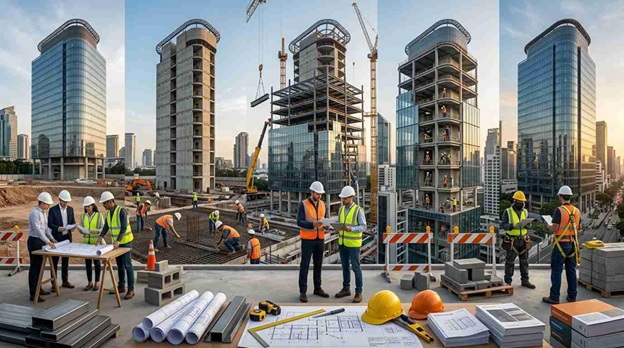
A completed project sits ready for the next tender submission, and the only documentation is a folder of phone photos and a site engineer’s handheld clip from the final walkthrough. For a construction company competing on reputation as much as price, that gap between the quality of the actual build and the quality of how it gets shown to the next client is a real, recurring problem. Seedance 2.5, running inside Higgsfield’s creative suite, is closing that gap for a growing number of contractors and building material brands, turning existing site footage and photos into the kind of polished case study video a tender committee actually pays attention to.
Why Do Construction Companies Need Video Evidence of Their Own Work More Than Ever?
Clients evaluating a contractor or building material supplier increasingly expect to see proof, not just claims, and a written case study with a handful of static photos carries less weight than it used to against competitors showing polished walkthrough video of comparable completed work. Tender committees and procurement teams reviewing multiple bids respond to video evidence of past project quality in a way a paragraph of text simply cannot replicate, since a walkthrough shows finish quality, scale, and workmanship in a way a bid document alone cannot argue for. Higgsfield’s broader creative suite has become one of the platforms companies outside traditional media industries are turning to for exactly this kind of practical, evidence-based marketing content.
What Kinds of Video Content Do Construction Companies Actually Need for Tenders and Case Studies?
Completed project walkthroughs showing finish quality and scale remain the most requested format, alongside progress documentation that demonstrates a contractor’s process and site management discipline to a prospective client. Building material and product brands need a related but distinct format, product demonstration and application footage showing how a material performs on an actual site rather than in a manufacturer’s studio. Company and brand-building content, the kind covered in ConstroFacilitator’s own advice on building a brand the right way, increasingly includes video as a core component rather than an afterthought.
Why Doesn’t a Phone Video From the Site Cut It for a Tender Submission?
A phone clip works fine as a quick record for internal use, but a tender submission or a client-facing case study needs to actually look like it represents a company capable of handling a serious project. Shaky handheld footage, inconsistent lighting between a morning site visit and an afternoon follow-up, and a lack of any narrative structure undercut a genuinely well-executed project before the reviewer ever gets to judge the actual construction quality being shown.
What Are the Traditional Options for Producing Project Documentation Video?
Hiring a videographer for a project walkthrough or a product demonstration shoot remains the standard for flagship marketing content, and it delivers real, justified quality for a company’s most important case studies. For the volume of documentation a growing contractor or product brand actually needs, project after project, tender after tender, that cost adds up quickly, and scheduling a videographer around an active, often remote or partially completed site adds logistics most marketing budgets weren’t built to absorb repeatedly.
Where Does Traditional Video Production Fall Short for an Active, Multi-Site Contractor?
The constraint shows up in volume and turnaround. A contractor running several active projects at once, each needing its own progress documentation and eventual case study, cannot realistically book a videographer for every site on every schedule a tender deadline actually demands. Marketing teams end up prioritizing only the largest or most prestigious projects for proper video treatment, leaving a company’s broader body of work, the projects that would actually strengthen a tender submission, undocumented.
What Happens When a Sign, Logo, or Safety Signage Is Wrong in an Otherwise Good Clip?
This is a specific, practical problem construction and product marketing teams run into constantly. A completed site walkthrough is otherwise perfect, but a safety sign is outdated, a partner logo needs updating, or a background element is off-brand, and traditionally that means reshooting or accepting the flaw. Region-level editing changes this specifically, allowing a single element within a clip to be corrected without regenerating or reshooting the entire piece, which matters enormously for a video that otherwise took real effort to capture correctly.
This kind of correction is especially valuable on an active construction site, where returning to reshoot a single frame is rarely as simple as it sounds. A crane may have moved, weather conditions may have changed, or the specific moment captured, workers on scaffolding, a delivery arriving, may simply not repeat itself on demand. Being able to fix the one problematic element within Higgsfield’s workspace rather than losing the entire clip protects footage that would otherwise be wasted.
| Hired videographer | Phone footage, unedited | Seedance 2.5 | |
| Cost per project | Real, recurring fee | Free, but low polish | Included in one subscription |
| Time to finished case study | Days, plus scheduling | Immediate, but unusable for tenders | Minutes to a single 30-second pass |
| Fixing a single wrong element | Requires a reshoot | Not fixable without reshooting | Region-level fix, rest of clip untouched |
| Consistency across multiple projects | High, but expensive to repeat | Low | High, with locked references |
| Best suited for | Flagship annual case studies | Internal records only | Ongoing tender and case study documentation |
How Does Seedance 2.5 Handle Project and Product Video Differently?
Seedance 2.5 accepts up to 50 multimodal reference inputs in a single generation, faces, products, wardrobe, locations, and style frames, which means a company’s actual site photos, product shots, and branding assets can be pinned down as references before generation rather than described in a text prompt and hoped for. A single 30-second pass can carry a project’s opening, the core walkthrough or product moment, and a closing brand card, with studio-grade detail throughout, matching the exact format most tender presentations and case study pages already expect.
This reference-first approach matters more for construction and building material marketing than it might for other industries, since the entire point of this content is proving that a real project or a real product performed as claimed. A generic prompt describing “a modern office building” produces something generic. Feeding in the actual completed facade, the actual signage, and the actual site conditions as references keeps every generated frame tied to the specific project a company is trying to showcase, which is the whole reason this content gets produced in the first place.
How Do You Keep a Company’s Real Branding and Site Photos Consistent Across a Case Study Video?
Direction gets set through selectors, era, genre, lighting angle, physics, lens, emotional tone, and montage pacing, chosen before generation rather than negotiated through trial-and-error prompt language. For a construction or building material brand, this means locking a consistent visual tone across every case study video a company produces, rather than each one looking like it came from a different creative decision. Reference-based consistency also means a real product, a real completed facade, or a real safety signage design holds its exact appearance across multiple scenes within the same generated piece, rather than drifting the way text-only prompting tends to.
What Can a Construction Company Actually Produce Beyond a Single Case Study Video?
Beyond one project’s walkthrough, the same reference-based workflow supports building a consistent library of case studies across multiple completed projects, each holding the company’s actual branding, signage, and site imagery without starting the creative direction from scratch each time. This matters directly for the kind of ongoing brand building ConstroFacilitator’s own guidance on kickstarting a brand points toward, since a scattered, inconsistent body of marketing content undercuts exactly the kind of trust a growing construction or product brand is trying to build. Seedance 2.5 sits inside Higgsfield’s full creative suite rather than as a standalone generator, running alongside 50-plus image, video, and audio models under one subscription, so a marketing team producing case study video can also handle product photography or voice narration through Higgsfield’s same workspace.
Does This Replace the Real Project Documentation That Tenders Actually Require?
No, and this matters for anyone relying on this content for a formal submission. A tender still requires accurate, verifiable documentation of actual project scope, materials, and compliance, none of which a marketing video substitutes for. What AI-assisted video production changes is how quickly and consistently a company can present real completed work in a format that actually gets watched and remembered by a reviewing committee, alongside, not instead of, the technical documentation a tender formally requires. A well produced Seedance 2.5 case study video sitting beside a properly documented technical submission strengthens a bid; it was never meant to replace that submission on its own.
What Should a Construction Marketing Team Look for in an AI Video Tool?
Reference-based generation matters most for this use case, since a construction company’s credibility depends on showing its actual work, not a generic stand-in. The ability to fix a single element in an otherwise good clip without a full reshoot matters practically, since site conditions rarely allow for reshoots on demand. And consistency across a growing library of case studies matters for brand building over time, since a construction company’s marketing content needs to look like it comes from one company, not a different creative decision every time.
It’s also worth considering how a platform handles the transition between formats a single project’s assets typically need to cover. A tender submission might need a horizontal walkthrough, a social post might need a vertical cut, and a website case study page might need both alongside static photography. A workspace built around a wide model library, rather than a single narrow tool, saves a marketing team from managing separate subscriptions and separate learning curves for each of those needs.
What Are the Key Takeaways for Construction Companies Producing Project Video Content?
- Video evidence of completed work increasingly influences tender outcomes, which most construction companies still underinvest in relative to how much it matters.
- Traditional videographer production works for flagship projects but doesn’t scale to the volume of ongoing tender and case study content a growing contractor actually needs.
- Region-level editing solves a specific, common problem, an otherwise good clip ruined by one wrong sign, logo, or background detail, without requiring a full reshoot.
- AI-assisted video production speeds up how consistently a company can document real work, it doesn’t replace the accurate technical documentation a formal tender still requires.
Marketing teams weighing whether this is worth adopting should think about it less as a replacement for existing production relationships and more as a way to cover the gap those relationships were never going to fill, the dozens of smaller, still-relevant projects that used to go undocumented simply because a videographer couldn’t be justified for every single one.
What Are Some Frequently Asked Questions About AI Video Tools for Construction Marketing?
Can AI-generated video actually be used in a formal tender submission?
Supporting marketing video can strengthen a tender presentation alongside the required technical documentation, but it doesn’t replace the accurate, verifiable project data, materials specifications, and compliance records a tender formally requires. Content produced through Higgsfield or any comparable platform should be treated as a persuasive supplement, not a substitute for the technical paperwork a submission is actually judged on.
How does region-level editing actually help a construction marketing team?
It allows a specific problem in an otherwise usable clip, an outdated safety sign, a wrong logo, an off-brand background element, to be corrected without reshooting or regenerating the entire video, which matters given how often site conditions make a reshoot impractical.
Does this work for building material and product brands, not just contractors?
Yes, product demonstration and application footage benefits from the same reference-based consistency, keeping an actual product’s appearance locked across multiple scenes rather than drifting the way generic prompting tends to produce.
What’s the biggest mistake construction companies make with project marketing video?
Only investing in proper video documentation for their largest, most prestigious projects, leaving the broader body of completed work undocumented and unavailable for the next tender or case study that could have used it. A mid-sized renovation or a routine commercial fit-out is just as capable of demonstrating consistent quality as a flagship build, but only if someone actually took the time to document it properly in the first place.