
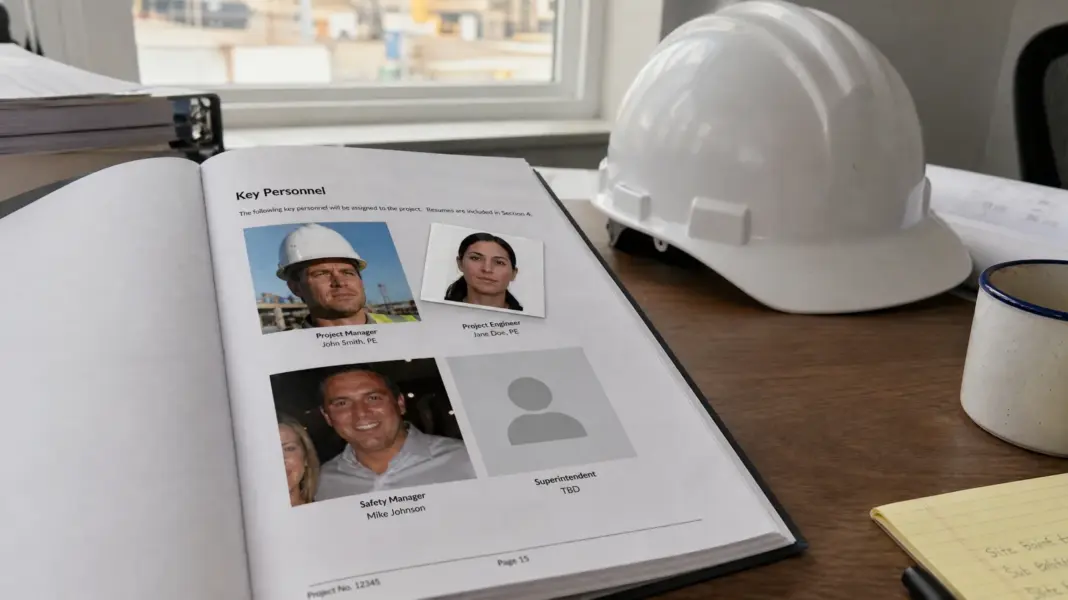
Anyone who has sat on a tender evaluation committee knows the moment. Three or four contractors have cleared the technical qualification. Their turnover, equipment lists and past project values are broadly comparable. The evaluators turn to the section that describes who will actually run the job: the project manager, the planning engineer, the quality lead, the safety officer. And in a surprising number of submissions, that section looks as though it was assembled the night before the deadline.
One engineer appears in a hard hat on a dusty site, squinting into the sun. Another is represented by a passport photograph scanned at an angle. A third has a cropped image from a family function, and the planning manager has no picture at all. The CVs underneath may be excellent, but the page as a whole signals something the firm did not intend: that its documentation is inconsistent, and perhaps its site management is too.
Why evaluators notice presentation at all
Nobody awards a highway package or a commercial tower on the strength of a photograph. Technical scores, pricing and compliance decide most outcomes. But evaluation is done by people, often reading dozens of submissions over several days, and presentation affects how carefully a document is read and how much benefit of the doubt it receives.
The key personnel section is where this matters most, because it is where a client is being asked to trust individuals rather than a company. Public sector clients, developers and consultants on large projects increasingly interview the proposed project team before signing. The written submission is the first introduction to those people, and a tidy, consistent page makes the team look like a team rather than a list of names collected from different departments.
The same problem on the company website
The pattern repeats online. Many construction and infrastructure firms have invested in strong project galleries, drone footage and case studies, then left the leadership or team page to chance. Directors are photographed in a formal studio, site heads are shown in safety gear, and newer managers are represented by placeholder icons or not at all.
For a firm pitching to overseas partners, joint venture candidates or institutional clients, that page is often visited before any meeting is booked. A procurement manager in Dubai or Singapore who is assessing a potential partner will look at who leads the business. Mismatched or missing portraits do not end the conversation, but they make a firm look smaller and less organised than it really is.
Site photos and portraits do different jobs
Part of the confusion comes from treating every photo of a person as interchangeable. They are not. A picture of an engineer on site, wearing PPE and inspecting reinforcement, is valuable evidence. It belongs in project case studies, safety reports and social media posts about progress on a specific job, where it demonstrates real involvement and good practice.
A portrait has a narrower purpose. It introduces a person clearly: face visible, even lighting, neutral background, professional clothing appropriate to the role. On a key personnel page or leadership profile, that clarity matters more than atmosphere. Hard hats cast shadows over the eyes, high-visibility vests dominate the frame and outdoor light on site is rarely flattering. Those images are authentic, but they do a poor job of letting a reader see who they would be working with.
The strongest submissions use both. A clean portrait at the top of each CV, and a separate selection of site photographs within the project experience section that show the same individuals at work.

Setting a standard for leadership and key staff
The practical answer is a written standard, similar to the templates firms already use for method statements and quality plans. It usually covers a handful of points: the same background colour for every portrait, a consistent crop from the chest upwards, soft even light, and clothing expectations such as a collared shirt or jacket rather than site gear. Once agreed, the standard can be applied to directors, project managers and technical specialists alike.
The difficulty in construction is logistics. Senior staff are spread across sites in different cities, often for months at a time, and arranging for everyone to visit the same studio is rarely realistic. Firms that manage this well tend to either schedule a photographer at head office during quarterly review meetings, or use an online service where each person uploads a few recent photos and receives executive headshots in a matching style, which ProfessionalHeadshot.io can return in around half an hour. The second route suits teams that rarely share a location, because nobody has to leave a site to be included.
Whichever approach is chosen, store the final images centrally with the bid library, alongside standard CVs and certificates. That way the tender team is not chasing photographs by email when a submission deadline is two days away.
Handling turnover on project teams
Construction teams change frequently. Project managers move between jobs, engineers are promoted and new specialists join for particular contracts. Each change creates a gap in the key personnel library, and those gaps tend to be filled with whatever image is available at the time.
Building a simple onboarding step helps. When someone joins in a role that may appear in bids, their portrait is created within the first week, using the agreed standard. When someone leaves, their profile is archived rather than left in circulation, which avoids the embarrassing situation of submitting a CV for a manager who has already moved to a competitor.
A small fix for a competitive market
Margins in contracting are thin, and qualification criteria are often close enough that small differences influence the final decision. A consistent, well-presented key personnel section will not compensate for a weak technical proposal. What it does is remove a needless reason for doubt at the exact point where a client is deciding whether to trust the people who will be responsible for their project. For a firm that already does the hard work well on site, it is one of the cheapest improvements available.






