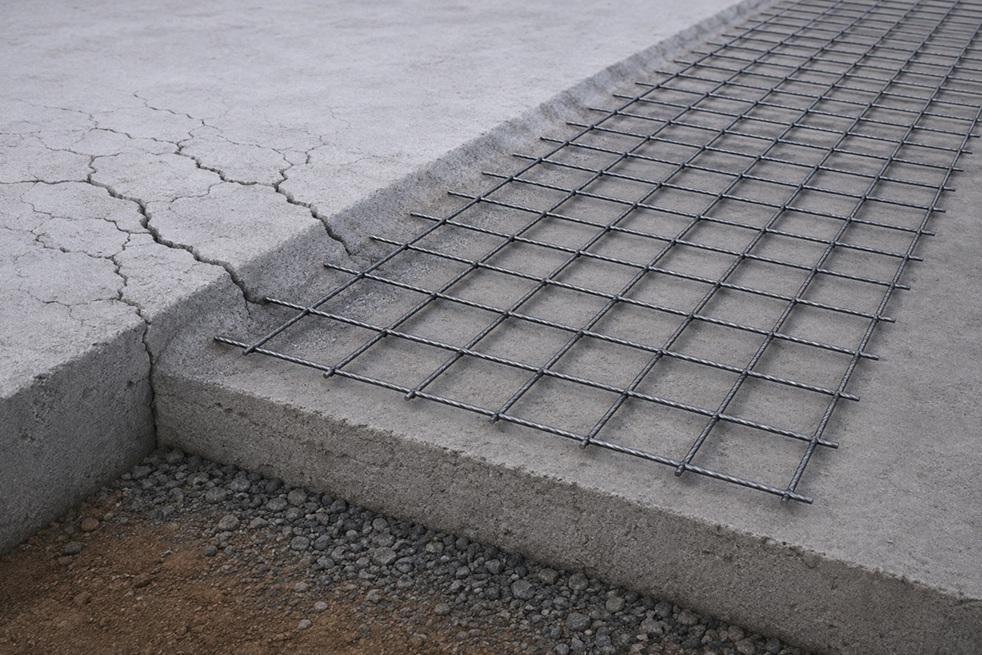
Cracking in concrete is one of the most common challenges in construction. Whether it is a residential slab, a commercial floor, or an infrastructure project, cracks can reduce strength, durability, and service life of structures. To overcome this issue, engineers widely used wire mesh reinforcement. Wire mesh plays an important role in improving concrete performance by controlling cracks and ensuring proper load distribution across the structure.
Understanding Wire Mesh in Construction
Wire mesh is a grid-like structure made by welding or weaving steel wires together in a uniform pattern. It is usually supplied in sheets or rolls and placed within concrete before it sets.
The most commonly used type in construction is welded wire mesh (WWM), where steel wires are electrically welded at intersections to form a strong and stable grid. Wire mesh is typically embedded in concrete slabs, pavements, walls, and foundations to enhance structural performance.
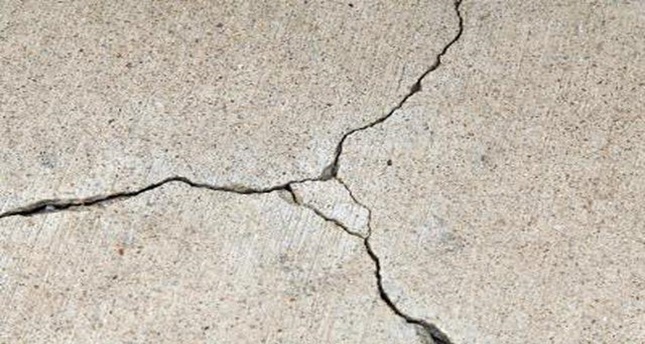
Why Concrete Develops Cracks
Before understanding the role of wire mesh, it is important to know why concrete cracks:
- Shrinkage: Concrete shrinks as it dries and hardens
- Thermal changes: Expansion and contraction due to temperature variation
- Load stress: Excessive or uneven load distribution
- Settlement: Movement of soil beneath the structure
- Poor curing: Rapid drying weakens surface strength
- Structural movement: External forces such as wind or seismic activity
Since concrete is strong in compression but weak in tension, even small tensile stresses can cause cracking.
Advantages of Using Wire Mesh
- Reduces cracking significantly
- Improves structural strength
- Enhances load distribution
- Increases durability of concrete
- Reduces maintenance costs
- Easy to install and handle
- Cost-effective reinforcement solution
- Suitable for large-scale projects
Role of Wire Mesh in Crack Prevention
1. Controls Plastic Shrinkage Cracks
During the early curing stage, concrete loses moisture and shrinks. Wire mesh helps hold the concrete together, reducing surface cracks caused by plastic shrinkage.
2. Minimizes Structural Cracks
Wire mesh acts as a reinforcing skeleton inside the concrete. When stress occurs, the mesh absorbs tensile forces and prevents cracks from widening.
3. Restrains Crack Propagation
Even if small cracks form, wire mesh limits their spread. Instead of forming large visible cracks, stress is distributed across the mesh network.
4. Improves Tensile Strength
Concrete alone has low tensile strength. Wire mesh adds tensile resistance, making the structure more balanced and crack-resistant.
5. Enhances Durability
By reducing cracks, wire mesh prevents water and chemicals from entering the structure, increasing durability and service life.
Role of Wire Mesh in Load Distribution
1. Even Distribution of Loads
Wire mesh helps distribute loads evenly across the surface. Instead of concentrating stress at one point, loads are spread throughout the mesh grid.
2. Reduces Point Loading Failure
Without reinforcement, heavy loads can cause localized failure. Wire mesh prevents such failures by transferring load to surrounding areas.
3. Improves Flexural Strength
In slabs and pavements, bending stress is common. Wire mesh improves flexural strength, allowing the structure to resist bending under load.
4. Enhances Structural Stability
By maintaining uniform stress distribution, wire mesh improves overall stability of floors, roads, and foundations.
5. Supports Dynamic Loads
Structures like highways and industrial floors experience moving loads. Wire mesh helps absorb and distribute these dynamic forces efficiently.
Types of Wire Mesh Used
1. Welded Wire Mesh
Welded wire mesh is the most widely used type of reinforcement mesh in construction. It is manufactured by electrically welding steel wires at their intersections, creating a rigid and uniform grid. This process ensures consistent strength, accurate spacing, and excellent load-bearing capacity. Welded wire mesh is commonly used in concrete slabs, foundations, pavements, walls, precast concrete elements, and industrial flooring due to its durability, ease of installation, and ability to effectively control cracking.
2. Woven Wire Mesh
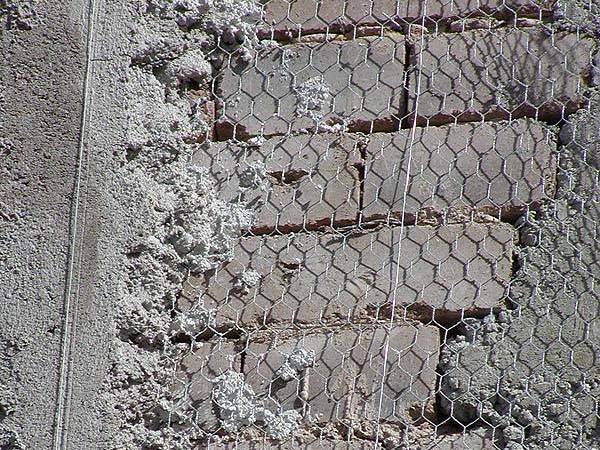
Woven wire mesh is produced by interlacing steel wires in a crisscross pattern, similar to the way fabric is woven. Unlike welded mesh, the wires are not permanently joined at the intersections, making the mesh more flexible. It is commonly used in applications such as plaster reinforcement, fencing, partitions, filtration systems, and lightweight construction works where flexibility is more important than heavy structural reinforcement.
3. Galvanized Wire Mesh
Galvanized wire mesh is made by coating steel wires with a protective layer of zinc to improve resistance against rust and corrosion. This protective coating extends the service life of the mesh, especially in outdoor environments or areas exposed to moisture and chemicals. It is widely used in retaining walls, drainage systems, boundary fencing, coastal construction, agricultural structures, and infrastructure projects where long-term durability is essential.
4. Stainless Steel Wire Mesh
Stainless steel wire mesh is manufactured using corrosion-resistant stainless steel, making it highly durable even in harsh environmental conditions. It offers excellent resistance to moisture, chemicals, extreme temperatures, and corrosion without requiring additional protective coatings. Due to its superior performance and long lifespan, stainless steel wire mesh is commonly used in marine structures, chemical plants, water treatment facilities, food processing plants, and other projects where high durability and hygiene standards are required.
Applications of Wire Mesh in Construction
Wire mesh is widely used in various construction elements:
1. Concrete Slabs
Used in flooring systems to prevent shrinkage cracks and improve load-bearing capacity.
2. Pavements and Roads
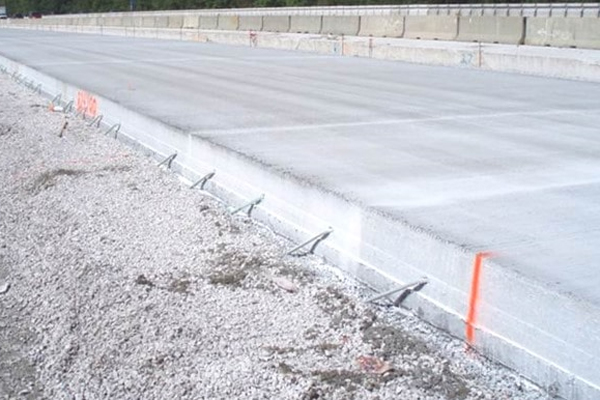
Helps in resisting traffic loads and reducing surface cracking.
3. Foundations
Strengthens the base of structures and ensures uniform load transfer to the soil.
4. Walls and Plastering
Prevents cracks in plaster and improves wall strength.
5. Precast Concrete Elements
Used in factory-made concrete components for added strength and consistency.
6. Industrial Floors
Supports heavy machinery loads and reduces wear and tear.
Installation Process Overview
Proper installation is essential for effective performance:
- Surface preparation before concrete pouring
- Placement of spacers to maintain correct cover
- Laying wire mesh sheets with proper overlap
- Securing mesh in position to avoid movement
- Pouring and compacting concrete evenly
- Ensuring mesh remains in correct position during casting
Incorrect placement can reduce effectiveness significantly.
Future of Wire Mesh in Construction
Modern construction is evolving with advanced materials such as fiber-reinforced composites and high-strength steel meshes. However, wire mesh remains a fundamental reinforcement solution due to its reliability, affordability, and ease of use.
Innovations like corrosion-resistant coatings and high-tensile steel are further improving its performance in modern infrastructure projects.
Conclusion
Wire mesh plays a vital role in modern construction by significantly improving crack resistance and load distribution in concrete structures. It strengthens concrete by controlling shrinkage cracks, enhancing tensile strength, and ensuring even stress distribution across surfaces.
From residential buildings to highways and industrial floors, wire mesh continues to be a dependable and cost-effective reinforcement solution. When properly selected and installed, it greatly increases the durability, safety, and performance of any concrete structure.