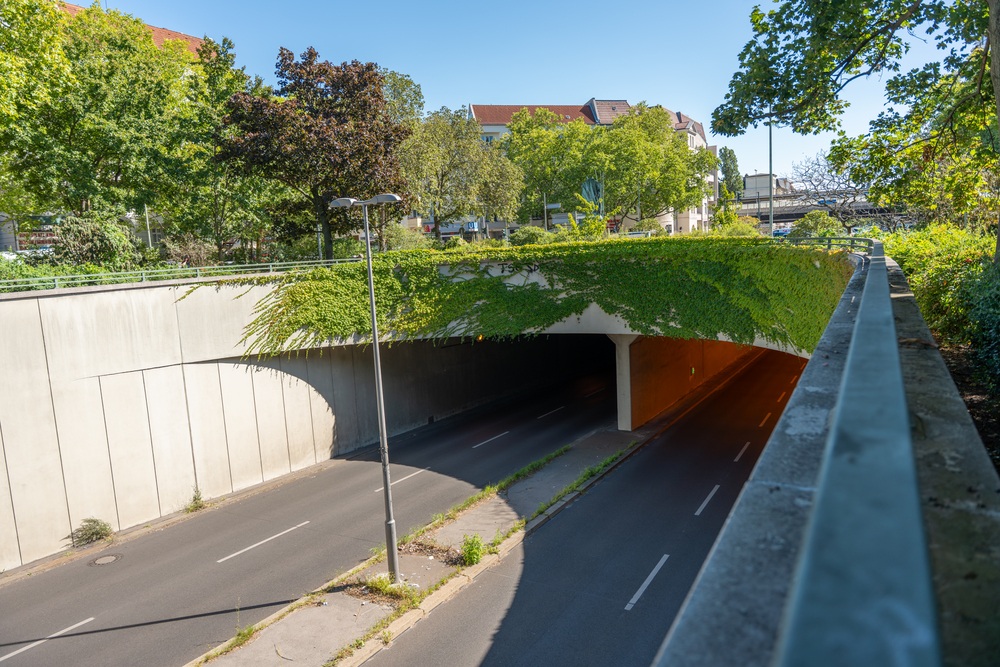
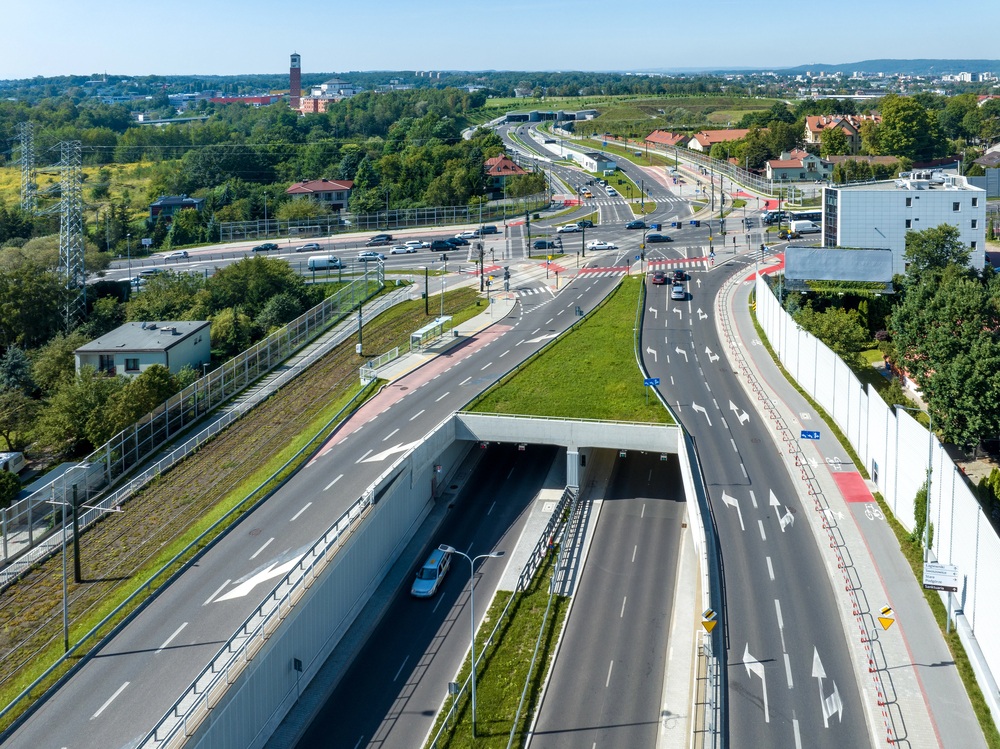
Road underpasses are grade-separated structures that allow vehicles, pedestrians or other traffic to pass below an existing road, railway line or infrastructure corridor. They are used to reduce traffic conflicts, improve junction capacity and provide continuous movement at locations where a conventional at-grade crossing is not suitable.
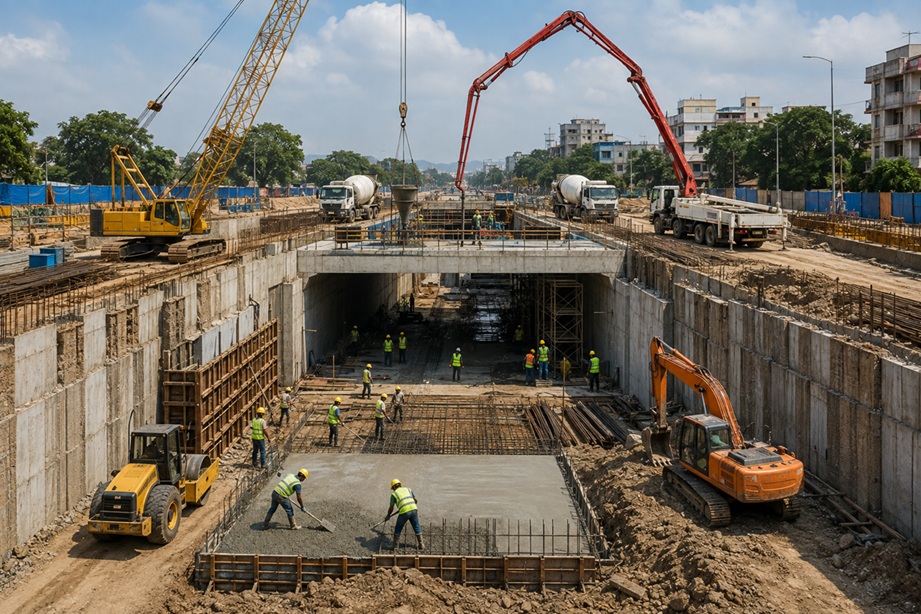
Construction of a road underpass involves excavation below the existing ground level, construction of retaining structures and reinforced concrete components, groundwater control, waterproofing, drainage, pavement construction and restoration of the surrounding road network.
Importance of Road Underpasses
Road underpasses have an important role in urban and highway infrastructure because they separate conflicting traffic movements.
Key benefits include:
- Traffic flow improvement: Vehicles can pass through the underpass without waiting at signals or railway crossings.
- Reduction in traffic conflicts: Grade separation reduces direct interaction between crossing traffic streams.
- Improved junction capacity: Underpasses can accommodate through traffic while surface roads handle local movements.
- Reduced travel time: Continuous movement can reduce delays at busy intersections.
- Railway crossing solutions: Underpasses provide an alternative to level crossings where road and railway traffic frequently conflict.
- Pedestrian safety: Dedicated pedestrian underpasses can separate pedestrians from high-speed traffic.
- Urban mobility: Underpasses can improve movement through congested city corridors.
- Highway connectivity: They can maintain highway continuity at intersections and local road crossings.
- Reduced surface-level disruption after completion: Once operational, through traffic can move below the surface road network.
- Better traffic management: Grade separation allows different traffic movements to be handled at different levels.
Applications of Road Underpasses
Road underpasses are used in different infrastructure situations depending on traffic demand and site constraints.
Urban Road Junctions
Underpasses are commonly used at heavily congested intersections where large volumes of through traffic need to move without stopping.
They can allow through traffic to pass below the junction while turning and local traffic continues at surface level.
Highway Intersections
Underpasses can be incorporated into highway interchanges and junctions to separate highway traffic from crossing local roads.
Railway Crossings
Road underpasses are frequently constructed below railway tracks to replace level crossings.
Methods such as box pushing and jacked-box construction can be useful where railway operations need to continue during construction.
Pedestrian Crossings
Pedestrian underpasses can be constructed below busy roads to provide controlled and separated pedestrian movement.
Airport and Port Corridors
Underpasses can support uninterrupted movement along access roads serving airports, ports and logistics areas.
Industrial Areas
Industrial corridors may use underpasses to separate heavy vehicle movement from local traffic and pedestrian routes.
Flood-Prone Road Corridors
Underpasses can also be integrated into road infrastructure where grade separation is required, although drainage and pumping arrangements become particularly important in locations vulnerable to water accumulation.
Major Construction Methods
Open-Cut Method
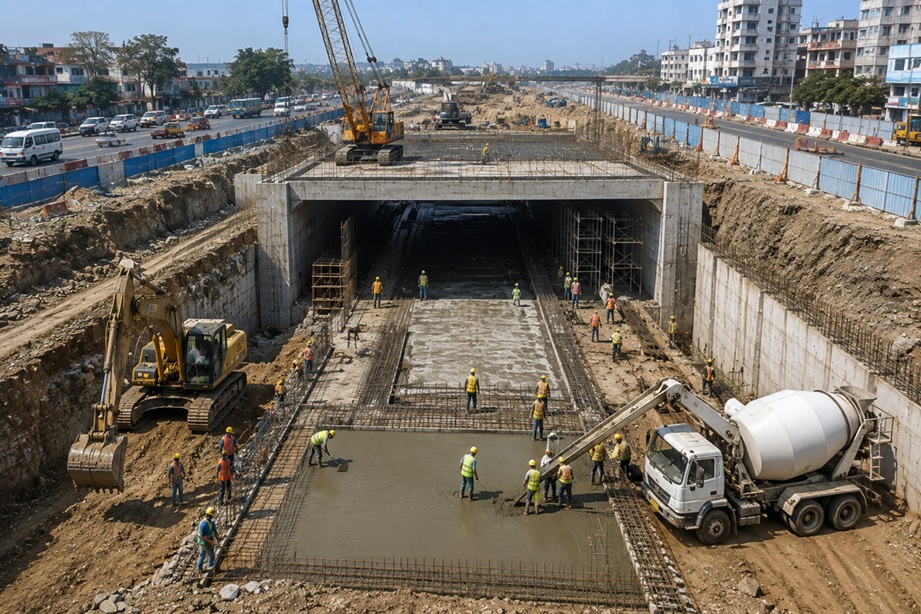
The open-cut method involves excavating the entire underpass area from the surface.
The general construction process includes:
- Site preparation
- Utility identification
- Traffic diversion
- Excavation
- Temporary retaining support
- Groundwater control
- Base slab construction
- Wall construction
- Roof slab construction
- Waterproofing
- Backfilling
- Pavement construction
This method is suitable where adequate working space is available.
Bottom-Up Cut-and-Cover
In bottom-up construction, the excavation is completed first and the permanent structure is built from the bottom upward.
The base slab is constructed first, followed by the walls and roof slab.
This method provides good access for construction equipment but can require substantial surface excavation and traffic diversion.
Top-Down Construction
Top-down construction is useful in congested urban areas.
Retaining walls and supporting columns are constructed first. The roof slab is then constructed near the surface. Excavation continues beneath the slab while surface traffic can be restored.
This method can reduce surface disruption but requires careful planning because access beneath the roof slab is restricted.
Box Pushing
In the box-pushing method, a reinforced concrete box is constructed beside the final alignment.
Hydraulic jacks push the box into position while excavation takes place ahead of it.
This method is particularly useful for:
- Railway crossings
- Busy roads
- Short underpasses
- Locations where prolonged closure is not possible
Jacked-Box Method
Jacked-box construction uses hydraulic equipment to push a concrete box through the ground.
The method reduces the need for large open excavations and can be used where surface disruption needs to be controlled.
Tunnelling
Tunnelling can be considered for deep or long underpasses.
Depending on the ground and project requirements, equipment and techniques may include:
- Tunnel boring machines
- Shield tunnelling
- Sequential excavation
- Pipe jacking
- Microtunnelling
Tunnelling requires detailed investigation of ground conditions and groundwater.
Equipments Used for Road Underpass Construction
Different types of equipment are required depending on the construction method.
Excavators
Hydraulic excavators are used for:
- Bulk excavation
- Trench excavation
- Ramp excavation
- Soil loading
- Material handling
Different bucket sizes and attachments can be selected according to soil type and excavation requirements.
Backhoe Loaders
Backhoe loaders are useful for smaller excavation works, drainage trenches, utility work and general site activities.
Wheel Loaders
Wheel loaders are used for:
- Moving excavated soil
- Loading aggregates
- Handling construction materials
- Stockpile management
Dump Trucks
Dump trucks transport excavated soil and construction materials between the excavation area and disposal or stockpile locations.
Bulldozers
Bulldozers are used for:
- Site clearance
- Ground levelling
- Earth spreading
- Formation preparation
Motor Graders
Motor graders are used to prepare and level approach roads, subgrade surfaces and pavement layers.
Soil Compactors
Compaction equipment is required for embankments, backfill and pavement layers.
Common equipment includes:
- Vibratory rollers
- Tandem rollers
- Pneumatic rollers
- Smooth-wheel rollers
- Plate compactors
- Rammer compactors
Piling Equipment
Where deep retaining or foundation piles are required, equipment may include:
- Rotary drilling rigs
- CFA piling rigs
- Hydraulic piling rigs
- Casing systems
- Pile reinforcement cages
Diaphragm Wall Equipment
Diaphragm wall construction can require:
- Hydraulic grabs
- Crawler cranes
- Slurry treatment plants
- Desanding equipment
- Reinforcement cage lifting equipment
- Concrete placing equipment
Crane
Mobile and crawler cranes are used for lifting:
- Reinforcement cages
- Formwork
- Precast elements
- Pumps
- Steel sections
- Construction equipment
Concrete Batching Plant
A batching plant produces concrete according to the specified mix requirements.
For large underpass projects, concrete supply needs to be coordinated with placement schedules to avoid interruptions.
Transit Mixers
Transit mixers transport fresh concrete from the batching plant to the underpass construction site.
Concrete Pumps
Concrete pumps are used to transport concrete to:
- Base slabs
- Retaining walls
- Roof slabs
- Ramp structures
Concrete Vibrators
Internal or external vibrators are used to compact freshly placed concrete and reduce voids.
Hydraulic Jacks
Hydraulic jacks are the primary equipment used for box pushing and jacked-box construction.
They provide the controlled force required to move the reinforced concrete box through the prepared ground.
Dewatering Pumps
Pumps are used to remove groundwater and accumulated water from excavations.
Depending on site conditions, the system may include:
- Submersible pumps
- Sump pumps
- Well-point pumps
- Deep-well pumping equipment
Sheet Pile Installation Equipment
Vibratory or hydraulic piling equipment can be used to install sheet piles for temporary or permanent excavation support.
Surveying Equipment
Accurate surveying is required throughout construction.
Common equipment includes:
- Total stations
- Automatic levels
- GNSS equipment
- Laser levels
- Digital levels
These are used to control excavation levels, structural alignment, road gradients and final pavement levels.
Equipment for Pavement Construction
After the structural work is completed, road pavement requires specialised equipment.
Important equipment includes:
- Asphalt pavers
- Bitumen sprayers
- Road rollers
- Milling machines
- Concrete pavers
- Concrete batching equipment
- Mechanical sweepers
The equipment selection depends on whether the underpass uses flexible or rigid pavement.
Drainage and Pumping Equipment
Drainage installation may require:
- Trench excavators
- Pipe-laying equipment
- Submersible pumps
- Sump pumps
- Generator sets
- Concrete equipment
- Drain cleaning equipment
Permanent pumping stations may include automatic pumps, level sensors, control panels and backup power.
Factors for Selecting Construction Equipment
Equipment selection should consider:
- Excavation depth
- Soil type
- Site accessibility
- Project scale
- Lifting requirements
- Groundwater conditions
- Available working space
- Required construction speed
- Traffic restrictions
- Equipment operating radius
- Material handling requirements
Using equipment with suitable capacity is important because oversized machinery can create access and safety problems, while undersized equipment can increase construction duration.
Conclusion
Road underpasses are an important part of modern transport infrastructure, providing grade separation, smoother traffic movement, safer crossings and improved connectivity at busy roads, highways and railway corridors. Their applications range from urban junctions and highway intersections to railway crossings, pedestrian routes and industrial corridors. Successful construction depends on careful planning of site conditions, traffic movement, groundwater, utilities, structural requirements, drainage and safety. Proper selection and coordination of construction activities, supported by suitable equipment and quality control, can help reduce disruption, improve construction efficiency and deliver durable, safe and functional road infrastructure.