
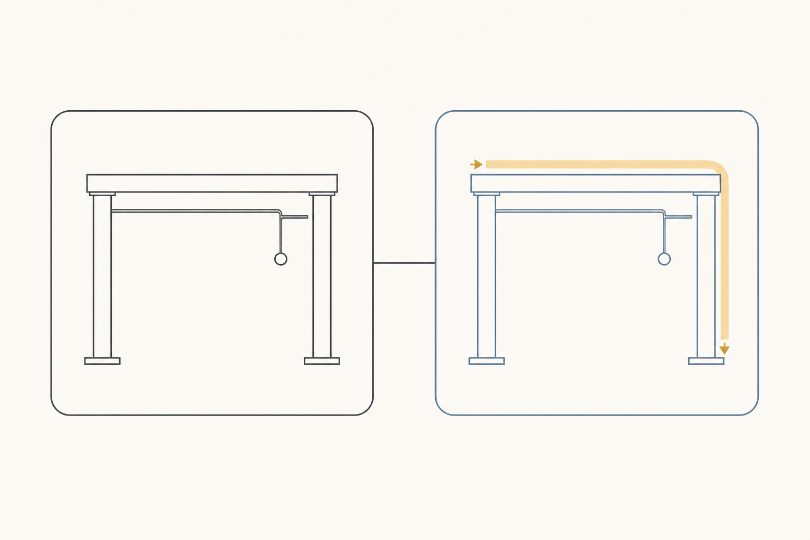
A construction-progress clip often does two jobs badly when it tries to do both at once. It records what was on site, then adds a polished transformation that looks like the next stage has already happened. The result may be useful for explanation, yet viewers can no longer tell where documentation ends and illustration begins.
A video editor AI can help produce a bounded explanatory version of site footage, but it should not become the keeper of the factual record. Preserve the original clip, its date, location, sequence, and inspection context outside the generated output. Treat the transformed video as a separate communication asset with a declared role.
Define Record Footage and Illustration Before Editing
Record footage answers “what was visibly present at this time?” It may show installed services, exposed structure, access conditions, material deliveries, or an incomplete finish. An illustration answers a different question: “how might this process, phase, or proposed outcome be easier to understand?” It can simplify or visualize, but it cannot prove progress.
Write the role into the brief. “Progress record for package review” and “illustrative sequence for stakeholder explanation” are not interchangeable labels. The first demands a stable chain of custody and minimal alteration. The second may permit style, background, pacing, or visual emphasis changes so long as the transformed status is clear.
Do not use visual polish to repair missing evidence. If the original never shows a fire-stopping detail, a generated close-up cannot fill the record. Return to source material, inspection notes, or a new capture. The absence may be inconvenient, but it is still information.
Preserve Site Facts Outside Generated Pixels
Archive the untouched source before creating a working copy. Keep the capture date, location or zone, author, package reference, and any relevant inspection identifier in the document or asset system that governs the project. These fields should not depend on text rendered inside transformed frames.
Mark a few factual checkpoints in the source: the opening of the clip, a fixed structural junction, a service route, a material label, and the final view. Hashing or immutable storage may be appropriate under an organization’s own record policy, but the essential point is simpler: the evidence file remains available and distinguishable from every derivative.
Capture context before trimming. A five-second derivative may be enough to explain one junction, while the longer source shows why the camera approached from a particular access route and what temporary works surrounded it. Keep the full clip and note the time range used for the working copy. This lets a reviewer return from the edited excerpt to the original sequence without guessing.
AIVideoEditor.me currently supports uploaded-video, prompt-led generation of a new version. That mechanism creates a derivative suitable for creative review. It should be linked back to the source record rather than saved under a filename that implies it replaced the original.
Create One Bounded Transformation from the Source
Choose a single explanatory purpose. A stakeholder may need to see the intended sequence of work, understand which zone a service route crosses, or distinguish temporary access from the finished circulation path. State that purpose and the protected visual facts before writing the prompt.
Use edit videos online to produce a candidate from a prepared working copy. Ask for one visible transformation while preserving the fixed geometry, camera path, and identifiable site elements needed for orientation. Avoid prompts that “complete the building” or “make the site finished” when the derivative might be viewed beside progress reporting.
Compare source and derivative at the factual checkpoints. Reject a result that moves openings, invents installed work, changes material identity, removes safety barriers, or makes temporary conditions appear permanent. An explanatory color treatment may pass; a plausible but unbuilt wall does not.
Keep the generated version short and close to the source sequence. The more new shots, camera moves, or spatial views it introduces, the harder it becomes for a viewer to understand which geometry came from the record. If a complete future-state visualization is required, produce and label it as a separate visualization package.
Use an acceptance sheet with three fields: the explanatory change, the protected facts, and any invented or removed element. A candidate passes only when the first is visible, the second remain stable, and the third field is empty or contains a deliberate non-factual treatment approved for the stated purpose. Save two reference frames that demonstrate the verdict.
Do not average failures. A transformation that explains the service route clearly but invents a fire door is not “mostly accurate.” The invented door creates a new claim and blocks that version. Either narrow the prompt and regenerate or move the explanation into a conventional overlay that leaves the footage unchanged.
Caption the Boundary Where Viewers Encounter It
Place disclosure on the published page, presentation slide, or immediately adjacent caption: “Illustrative transformation based on progress footage; not a construction record.” A note hidden in the asset folder does not travel with a clip embedded in email or exported into a presentation.
Keep verified dates, package status, quantities, approvals, and compliance statements in ordinary project text. The generated video may support comprehension, but it should not carry factual wording that reviewers could mistake for an inspection result. If the clip is shared without its surrounding page, add a non-generated title card during conventional editing.
The caption must survive crops and reposting. Check the mobile presentation, slide export, and any download format the stakeholder is likely to use. If the explanatory status disappears when the clip leaves its original page, the distribution design has failed.
Audit the Handoff Across Both Asset Lanes
Before release, ask one reviewer to locate the untouched source and state what it proves. Ask a second reviewer to watch the derivative and state what it illustrates. If either person confuses those answers, repair the naming, caption, or storage relationship before the asset enters a meeting.
Record the AIVideoEditor.me prompt, working-copy reference, reviewer, and acceptance reason beside the derivative. Do not append those notes to the source file in a way that changes the evidence record. The two lanes should be connected but operationally distinct.
Give every derivative a status such as draft, approved illustration, or withdrawn, and keep that status in the project register. AIVideoEditor.me output that fails the boundary review should not remain in a shared presentation folder without a withdrawal mark. Otherwise an attractive rejected version can re-enter circulation after the original reviewer has moved on.
Retain the transformation only for the communication purpose it passed. A derivative approved for an early design discussion should not later appear in a payment assessment, safety review, or progress claim without a new evidence check. Context changes the risk even when the pixels do not.
Construction teams gain clarity when they can use richer visual explanations without weakening the record. Keep source footage factual and recoverable. Keep generated transformations bounded, labeled, and linked. When every viewer can tell which asset proves and which asset explains, the two formats support each other instead of competing for authority.






