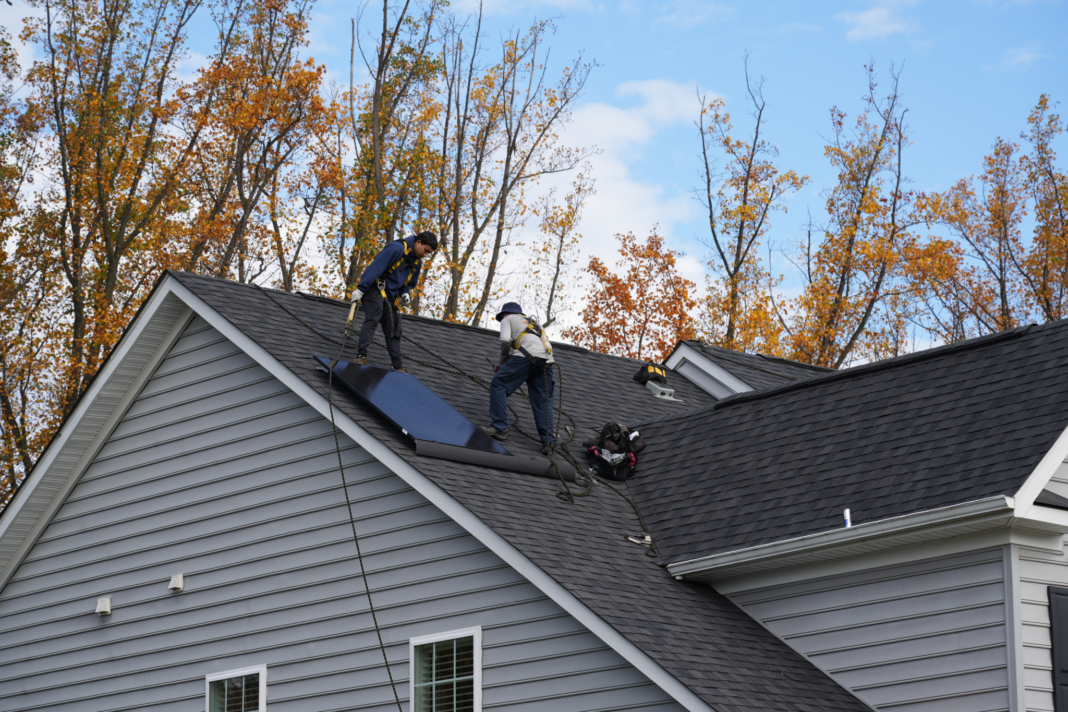
When homeowners compare solar companies, most of the conversation centers on panel brands, system pricing, and financing options. Very few think to ask who will actually be on their roof. That question matters more than almost any other factor in a solar installation, because the answer determines the quality of the work, the reliability of the warranty, and whether anyone picks up the phone when something goes wrong in year 12.
Solar Energy World’s answer is the same every time: a direct W-2 employee of Solar Energy World. Not a subcontractor, not an independent installer hired for the day, not a crew sourced through a dealer network. Every person who works on your system, from the first consultation to the last service call, works for and is accountable to the same company. This article walks through what that means at every step of Solar Energy World’s 6-step installation process and why it produces a different outcome than what most of the solar industry offers.
Why the subcontractor model creates problems
The residential solar industry has a structural accountability problem. Many large national installers function primarily as sales and financing organizations that outsource the actual installation to rotating networks of subcontractors. When something goes wrong, no single entity is fully responsible.
The pattern is well-documented. Independent sales personnel who earn commission only when a contract is signed have a financial incentive to make promises that the installation team may not deliver. The installation crew, working for a third-party subcontractor rather than the company that made the sale, has no direct accountability to the homeowner or to the promises made during the sales process. When issues arise during or after installation, the homeowner finds themselves caught between a sales organization and an installation contractor, neither of whom fully owns the outcome.
This dynamic contributes directly to the wave of complaints and legal actions that has grown alongside residential solar’s rapid expansion. Faulty installations, including improperly mounted panels, exposed wiring, and sloppy roof flashing, create safety hazards and repair costs that often do not surface until months or years after the installation. When the installer is a subcontractor rather than a direct employee, there is no clear chain of accountability for those repairs.
The bankruptcies of 2024 and 2025 made the consequences of this model concrete. Titan Solar Power, one of the largest residential installers in the US, filed for bankruptcy in June 2024 partly as a result of poor installation quality driven by its dealer-based model. Solar Insure tracked more than 100 solar company bankruptcies in 2024 alone. When an installer closes, workmanship warranties void immediately. Homeowners are left with unanswered service calls, unfulfilled warranty promises, and no one to contact for repairs.
Solar Energy World’s model eliminates this from the start. Every person in the process, from the consultant who walks through your home to the crew on the roof to the technician who responds to a service request seven years later, is a direct W-2 employee. No dealer networks, no subcontractors, no accountability gaps.
Step 1: Education before sales
Solar Energy World’s process begins with a free cost/benefit analysis. The goal is not to close a sale. The goal is to give the homeowner enough information to make an informed decision.
During this first step, Solar Energy World walks through how solar works, what state and local incentive programs apply to the homeowner’s address, what financing options are available, and what a realistic return on investment looks like for their specific home and energy usage. The homeowner learns what a PPA involves, what ownership entails, and what the difference means for their long-term financial outcome before signing anything.
This matters because the independent-rep model common at many national installers creates the opposite dynamic. When a salesperson earns nothing unless the homeowner signs, the consultation becomes a sales presentation rather than an educational conversation. Solar Energy World employs its sales team directly, which means the person walking through your home is not working on commission at your expense.
Step 2: Site assessment — every home measured in person
Before any system is designed, a certified Solar Energy World technician visits the home. No solar system is sold based on satellite imagery alone.
The site assessment confirms roof measurements, evaluates shading from trees and neighboring structures, checks the electrical panel for capacity, assesses structural factors, and identifies what permits will be required. These variables cannot be reliably captured remotely, and the consequences of skipping them follow homeowners for the life of the system.
Solar is not a one-size-fits-all product. Roof orientation, tilt angle, the specific pattern of shading across different times of day and seasons, 12 months of utility consumption history, and planned future loads such as an EV or heat pump all affect how a system should be sized and configured. National installers using generic sizing calculations without site visits frequently produce systems that underperform because they do not account for site-specific conditions. A system that is undersized leaves savings unrealized for the entire 25 to 30-year life of the installation. One that is oversized costs more upfront without proportional return.
Permits are also handled at this stage, not left to the homeowner to figure out. Solar Energy World secures the required permits before the project moves forward.
Step 3: Custom system design
Every Solar Energy World system is designed from scratch for the specific home, by Solar Energy World’s in-house engineers, using the data collected during the site assessment.
The design accounts for the roof’s geometry and structural load capacity, the optimal panel placement to maximize production while minimizing shade losses, inverter selection based on the roof’s complexity and shading profile, battery storage if applicable, and the homeowner’s current and anticipated electricity consumption. Panel options include Silfab, LONGi, Q CELLS, and REC. Inverter options include Enphase, Fronius, and SolarEdge, with the choice driven by what the specific roof and shading conditions require.
A poorly designed system does not just underperform in year one. It underperforms every year for the entire duration. Shading losses that could have been addressed through microinverters or power optimizers, a system sized to a generic average rather than the home’s actual consumption pattern, panels placed without accounting for seasonal sun angle variation: these are design errors that compound across decades. Solar Energy World does not outsource the design to a third-party service. The engineers who design the system work for the same company that installs it and warrants it.
Step 4: Installation with NABCEP-certified supervision
Every Solar Energy World installation is supervised by a NABCEP-certified solar designer and a licensed master electrician. Every crew member is a direct W-2 employee trained to Solar Energy World’s standards.
NABCEP, the North American Board of Certified Energy Practitioners, is the solar industry’s gold standard for professional certification. Earning the PV Installation Professional credential requires a minimum of 58 hours of advanced solar PV training, an OSHA 10 construction safety card, documented field experience on multiple completed PV projects, and passing a four-hour exam covering structural and wind code, electrical code, waterproofing and roofing, system design, and advanced troubleshooting. The certification is renewed every three years, requiring ongoing continuing education.
Having a NABCEP-certified professional supervising every installation is not standard practice. Many manufacturers require installations by NABCEP-certified installers to validate equipment warranties, which means the certification is not just a quality signal but a warranty protection mechanism. Some municipalities require NABCEP credentials for solar installations to qualify for government incentive programs.
Most installation problems seen in field service calls trace back to quality failures during installation: loose connectors, sloppy roof flashing, failed optimizers, inverters placed in poorly ventilated locations. These issues do not appear immediately. They surface as production drops detected in monitoring data months later, or as roof leaks traced to improperly flashed penetrations years after activation. Catching those problems before they happen is what NABCEP-supervised installation does.
Most Solar Energy World installations are completed within one to three days. Homeowners are updated periodically on installation status throughout.
Step 5: Inspection and grid connection
After installation, Solar Energy World coordinates the final inspection with the municipality and utility company directly. The homeowner does not navigate interconnection paperwork.
The inspection and grid interconnection process involves coordinating with local building departments, utility companies, and in some cases homeowners associations. The specific requirements, timelines, and documentation vary by jurisdiction. Solar Energy World’s in-house process management team handles all of this coordination on the homeowner’s behalf, updating the customer on status rather than leaving them to manage the process independently.
Interconnection delays are one of the most common sources of homeowner frustration in solar installations. When an installer’s project management is handled by an in-house team that has navigated the permitting landscape across Maryland, Virginia, Delaware, Pennsylvania, New Jersey, Washington D.C., and Florida for 16-plus years, those delays are minimized and managed proactively rather than discovered after the fact.
Step 6: Incentive paperwork — Solar Energy World handles all of it
Solar Energy World’s in-house incentive specialists complete every applicable tax credit, rebate, and incentive program application on the homeowner’s behalf. Very few installers do this.
The incentive landscape in Solar Energy World’s service states is substantial and administratively complex. In Maryland alone, a homeowner may be entitled to the $1,000 residential clean energy grant, SREC registration and ongoing management, county-level credits depending on location, sales tax exemptions, and property tax exemptions. Each program requires separate enrollment. In New Jersey, SuSI program enrollment; in Washington D.C., SREC registration in one of the highest-value SREC markets in the country. You can review the full breakdown of solar incentives by state to see what applies to your location.
Homeowners who work with installers that do not handle incentive paperwork frequently miss programs they were entitled to, or enroll incorrectly and face delays or disqualification. Solar Energy World explains every applicable program, what actions the homeowner needs to take, and manages all remaining paperwork internally.
Step 7: Monitoring and ongoing support
The relationship with Solar Energy World does not end at activation. Every customer receives access to the Solar Energy World monitoring app from the moment they sign a contract, and the same in-house team responds to every service request for the life of the system.
The Solar Energy World app tracks energy production, consumption with a meter installed, battery usage for storage systems, long-term savings, and environmental impact. It is available on iOS, Android, and as a web portal. Customers can follow the installation process through design and activation before the system goes live, which means the monitoring relationship begins before a single panel is on the roof.
This is the part of the model that matters most over time. Solar systems are 25 to 30-year investments. The value of a warranty and a monitoring system depends entirely on whether the company behind them is still operational and accountable when something requires attention in year 8 or year 15. Solar Energy World has operated continuously since 2009. As a wholly owned Comcast subsidiary since November 2024, it has the institutional backing to honor commitments across decades.
The outcome: what customers report
Across thousands of reviews, Solar Energy World customers consistently describe the same experience: professional crews, clear communication, incentive paperwork that was handled without friction, and a company that stayed engaged after installation.
One EnergySage reviewer with over 30 years of construction project management experience put it this way: the installation team, the inspection crew, the county inspector liaison, every person in the process was professional and competent. The reviewer called it “as good as it gets.”
Another EnergySage customer described the incentive handling: “Solar Energy World did all the paperwork and all I had to do was review and sign.” A SolarReviews customer noted check-ins from the sales representative months after installation to confirm the system was performing as expected.
This consistency is not accidental. It is the direct output of a model where every person in the process works for the same company, is trained to the same standards, and is accountable to the same warranty. When the crew on your roof is a W-2 employee of the company that designed your system, supervised by a NABCEP-certified professional, the quality of the work reflects directly on the company making the 30-year promise.
Get a free solar estimate
Solar Energy World offers free in-home and virtual solar estimates for homeowners across Maryland, Virginia, Delaware, Pennsylvania, New Jersey, Washington D.C., and Florida. Your estimate includes a physical site assessment by a certified Solar Energy World technician, a custom system design, a full breakdown of applicable state and local incentives, and a clear review of financing options. To see what solar looks like in your state and what incentive programs apply to your location, start there.