
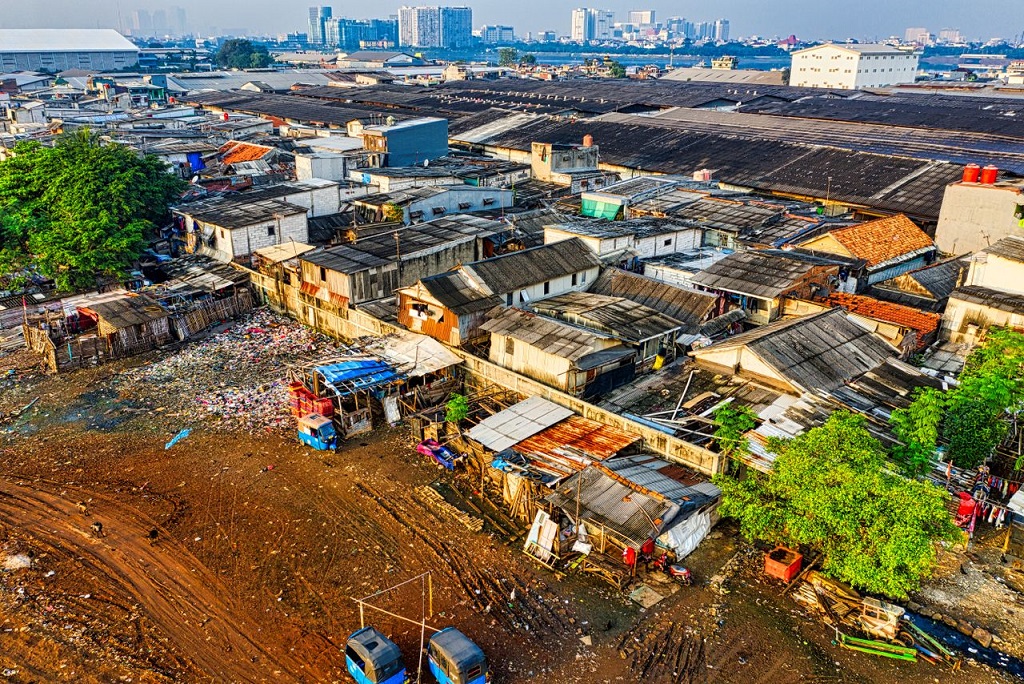
Mumbai’s ambitious Dharavi Redevelopment Project (DRP) has adopted advanced digital twin technology to create a comprehensive digital replica of the sprawling settlement, marking a significant step in the use of technology-driven urban redevelopment in India. The digital model is being used to verify residents’ claims and determine eligibility for rehabilitation housing as part of the large-scale redevelopment initiative expected to unfold over the next decade.
Dharavi, spread across approximately 621 acres, is one of Asia’s largest informal settlements and is set to undergo a major transformation that will include rehabilitation housing, commercial developments, corporate spaces, and modern residential towers. To ensure transparency and accuracy during the redevelopment process, project authorities have created a detailed digital twin that captures information about every structure and resident within the area.
Officials involved with the project describe the digital twin as an exact digital replica of present-day Dharavi. The system allows authorities to access detailed information on individual structures, including occupancy, ownership records, documentation submitted by residents, and other relevant data required for rehabilitation assessments.
The redevelopment is being led by Adani Realty through Navbharat Mega Developers Pvt Ltd (NMDPL), the special-purpose vehicle established for executing the project. According to project officials, the digital mapping exercise is not intended merely as an archival record but serves as a critical tool for verifying eligibility claims for free and rental rehabilitation housing.
The process began with drone-based aerial surveys that mapped the entire Dharavi area and identified approximately 1.25 lakh units. This was followed by extensive ground-level surveys using LiDAR technology, enabling authorities to capture highly detailed information about lanes, structures, floor counts, and land use patterns. Survey teams then created a digital map overlaid with three-dimensional models of individual tenements, incorporating details such as unit size, ownership status, and supporting documents submitted by residents.
Each structure in Dharavi has been assigned a unique identification number, allowing surveyors to digitally record resident information through a dedicated application. Documentary evidence linked to each unit is uploaded and integrated into the system, creating a centralized database for verification and decision-making.
The digital twin is currently being used by the rehabilitation authorities and the Slum Rehabilitation Authority (SRA) to verify documentation before finalizing Annexure-II lists, which determine the eligibility of residents for rehabilitation benefits.
Project officials stated that surveys of approximately 95,000 units have already been completed, while documents for around 85,000 units have been verified. Physical copies of collected records have been securely archived by Iron Mountain Co. Ltd at its facility in Nalasopara. While most of Dharavi has been surveyed, work remains pending in select areas, including Kumbharwada and several chawl clusters.
The adoption of digital twin technology highlights how advanced data management, drone mapping, and geospatial tools are increasingly being integrated into large-scale urban redevelopment projects to improve transparency, accuracy, and efficiency in project implementation.






