In the traditional agency model, the most expensive distance isn’t between the office and the shoot location—it’s the gap between a creative director’s internal vision and the client’s imagination. For decades, we have bridged this gap with mood boards, hand-drawn storyboards, and “rip-o-matics.” These tools are functional but fundamentally static. They require the client to take a leap of faith on lighting, motion, and “vibe” that often results in the dreaded “I’ll know it when I see it” feedback during the first rough cut.
By the time that rough cut arrives, the budget is spent, the crew has been struck, and any significant pivot becomes a profit-eating disaster. This friction is why agency margins disappear in the third and fourth rounds of revisions. However, the emergence of the professional AI Video Generator is fundamentally shifting the timeline. We are seeing a collapse of the edit where “post-production” thinking is being moved into the “pre-production” phase, allowing agencies to prototype motion with a level of fidelity that was previously impossible without a full production budget.
The Feedback Lag: Where Agency Profit Margins Disappear
The primary bottleneck in creative operations isn’t the speed of the render; it’s the speed of the approval. When a team presents a static storyboard for a high-energy social campaign, the client has to mentally animate the transitions. If the client’s mental animation doesn’t match the director’s, the disconnect only surfaces weeks later in the editing suite. This “feedback lag” is the silent killer of agency efficiency.
Traditional pre-visualization has always been a game of low-resolution placeholders. We used stock footage that “kind of” looked like the brand, or sketches that “suggested” the camera movement. The problem is that today’s content landscape—defined by rapid-fire social formats and high-volume asset requirements—makes a four-week production cycle feel like an eternity. Clients no longer want to wait a month to see if a concept works. They need to see the “vibe” yesterday.
When we move from static sketches to generative motion, we remove the guesswork. The ability to show a client a 5-second clip of exactly how a product might move through a stylized environment, complete with the specific lighting and color grade intended for the final piece, changes the conversation from “Trust me” to “Is this the direction?”
High-Fidelity Prototyping with an AI Video Generator
Tactically, this shift requires a move away from the “all-or-nothing” mentality of AI. Too many teams view generative tools as a way to replace the final shoot. In a professional agency setting, the real value lies in prototyping.
By using an AI Video Generator, an art director can take a brand’s existing product photography, run it through an image-to-video workflow, and present a “living storyboard.” Instead of describing a “slow cinematic zoom with anamorphic flares,” the team can simply generate it. This allows for real-time creative direction during a client meeting. If the client thinks the lighting is too moody, the prompt can be adjusted and a new iteration can be viewed within minutes.
This high-fidelity prototyping serves as a proof of concept that de-risks the actual production. It allows the production team to know exactly what they are aiming for before a single light is rigged. In many cases, for social-first content, these prototypes—refined through multiple passes—actually become the final deliverables, bypassing the traditional camera-and-crew requirements entirely for specific high-volume needs.
The Multi-Model Advantage: Why All-in-One Access Matters
One of the greatest mistakes an agency can make is tethering its workflow to a single AI model. In the current landscape, different models excel at different types of motion logic. One engine might handle human anatomy and walking cycles with high realism, while another might be superior at abstract fluid dynamics or cinematic lighting.
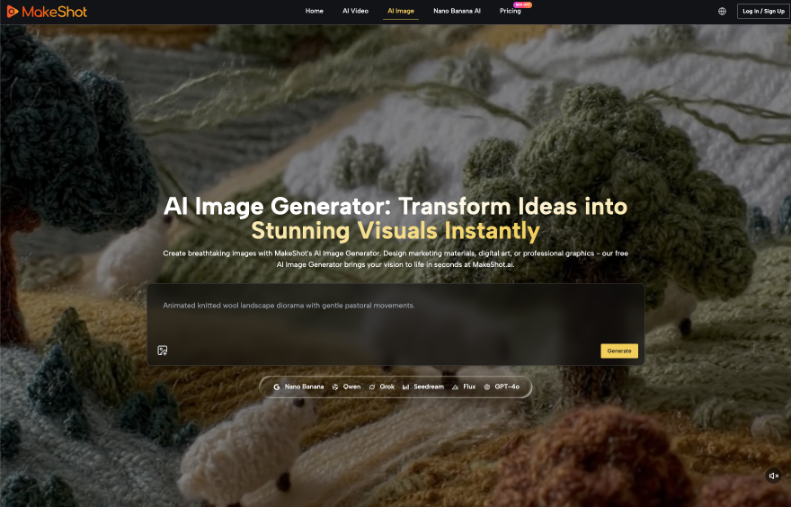
This is where a platform like MakeShot becomes an operational necessity. Rather than jumping between fragmented tools, having a unified interface to access models like Google Veo, Sora, or Kling allows for a “best-of-breed” approach to every shot. For example, a creator might use the Nano Banana engine to iterate on a specific character or product image because of its high degree of control over composition and style. Once that “keyframe” is perfected, they can then push that visual into a motion-focused engine to see how it handles physics.
This toggling between different “motion brains” prevents the stylistic ceiling that often plagues AI-generated content. If a specific model is hallucinating a weird artifact in a camera pan, switching to a different underlying model on the same platform can often solve the problem without having to rewrite the entire creative brief. It turns the AI Video Generator from a black box into a sophisticated palette of different “film stocks” and “digital sensors.”
Navigating the Hallucination Factor in Professional Delivery
It is important to maintain a level of skepticism. Despite the rapid advancement, we are still dealing with a technology that is prone to “hallucinations.” Temporal inconsistency—where a character’s shirt changes color or a background detail shifts between frames—is a reality that every agency operator must account for.
We must be clear with clients: AI is currently a generator of “raw clay,” not necessarily a “final bake” button. There are moments where a perfect 3-second shot is generated, but the model refuses to extend it for another 3 seconds without the physics falling apart. There is also the “uncanny valley” risk, particularly with human faces or complex hand movements, which can quickly turn a premium brand asset into something that feels “off” to the consumer.
Because of these uncertainties, the most successful agency workflows are hybrid. They use AI to generate the core visual energy, but they still rely on professional editors to mask out artifacts, color grade the output to match brand guidelines, and use traditional compositing to fix the small errors the AI leaves behind. The AI provides the velocity; the human editor provides the quality control. We shouldn’t expect the tool to handle 100% of the heavy lifting; even an 80% start on a complex scene is a massive win for production speed.
Rethinking the Deliverable: When the Process Becomes the Product
As production velocity increases, the agency business model has to evolve. If we can now produce a high-fidelity concept in 24 hours that used to take two weeks, billing by the hour becomes a race to the bottom. Agencies are beginning to shift toward value-based pricing, where the “product” isn’t just the final video file, but the speed of creative realization.
The competitive advantage now belongs to the teams that can iterate faster than the client can change their mind. By collapsing the edit and moving the visual heavy lifting to the start of the project, agencies can offer a level of agility that makes traditional production houses look like dinosaurs.
However, this speed also places a higher burden on the creative director. When you can generate anything, the “what” becomes much more important than the “how.” The AI Video Generator doesn’t replace the need for a good idea; it actually punishes mediocre ideas by making them visible too quickly. In this new era, the goal isn’t just to make videos faster—it’s to use that saved time to explore more ambitious, weirder, and more effective creative directions that were previously too expensive to even test.
Ultimately, the goal of integrating these tools into a creative pipeline is to spend less time on the mechanics of “making” and more time on the strategy of “storytelling.” The edit has collapsed, but the need for a human to decide which frame matters most remains as vital as ever._