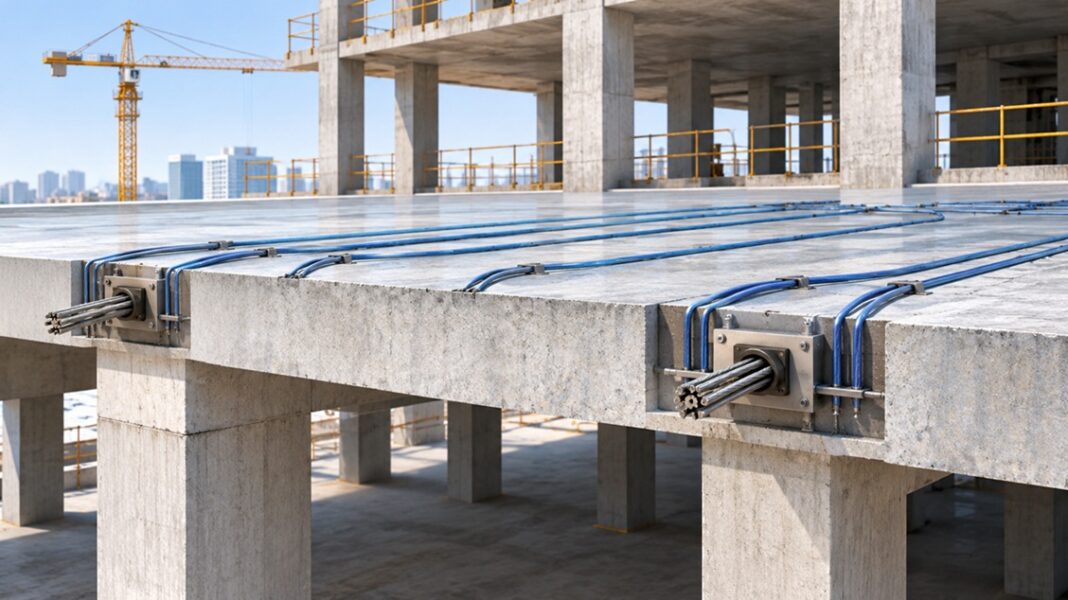
Modern buildings often demand open spaces at lower levels while accommodating repetitive layouts in the upper floors. Shopping malls require column-free retail areas, parking levels need wider bays for vehicle circulation, and mixed-use developments combine commercial, residential, hospitality, and office spaces within a single structure. These varying functional requirements frequently result in different column arrangements between floors. A post-tensioned transfer plate provides an effective structural solution by redistributing loads from the upper structural system to a different support arrangement below.
Understanding a Transfer Plate
A transfer plate is a heavily reinforced structural slab designed to transfer vertical loads from columns, shear walls, or load-bearing walls above to a different arrangement of columns or supporting elements below. Unlike ordinary floor slabs that primarily support distributed loads, transfer plates carry highly concentrated structural loads from the superstructure.
Transfer plates are typically positioned between podium levels and tower floors or wherever the structural grid changes significantly. The structural member acts as an intermediary element that redirects loads to the supporting columns, transfer beams, walls, or foundation system.