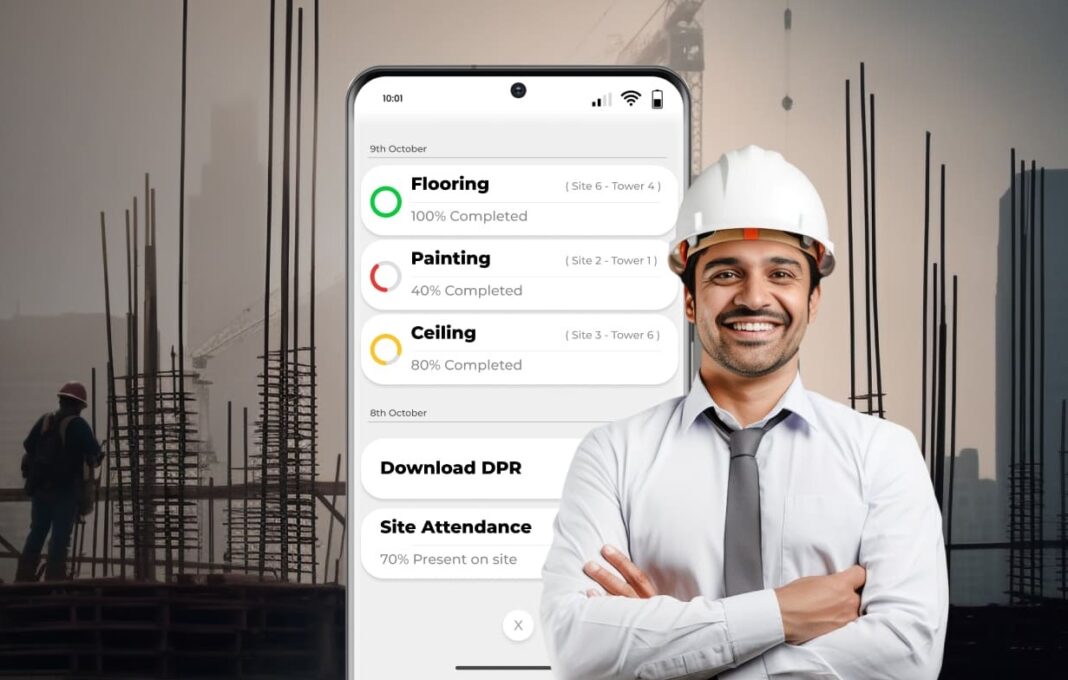

Despite being one of India’s largest contributors to economic growth, the construction industry continues to face deep-rooted operational inefficiencies. Fragmented workflows, heavy dependence on manual coordination, delayed decision-making, and limited real-time visibility have long slowed project execution across sites. Contractors and project managers often struggle with inaccurate estimations, productivity tracking, cost leakages, and communication gaps between on-site teams and office staff. Traditional systems built around spreadsheets, calls, and unstructured messaging platforms leave little room for data-driven execution, resulting in delays, rework, disputes, and unpredictable cash flows.
Over the last few years, however, the sector has begun witnessing a significant shift. As construction workflows steadily move from paper-based processes to digital systems, companies are increasingly exploring technologies that can bring intelligence, automation, and predictability into everyday operations. Artificial Intelligence is now emerging as a powerful force capable of transforming how construction projects are planned, monitored, and executed.
Founded in 2020, Powerplay has been at the forefront of this transformation, building digital solutions designed specifically for construction businesses. The company recently introduced India’s first AI Workforce platform for construction, aimed at helping contractors and project teams reduce manual effort, accelerate decision-making, and improve execution efficiency through AI-driven workflows.
In an exclusive interaction with Constrofacilitator, Mr. Iesh Dixit, CEO & Co-Founder of Powerplay, shares insights into the evolving role of AI in India’s construction ecosystem. From reducing estimation timelines from weeks to minutes to building AI systems trained on data from over 85,000 projects, Dixit discusses how technology is reshaping project execution, why human oversight remains critical in AI-led decision-making, and what structural changes are finally making the industry ready for large-scale digital adoption.
Here are the excerpts from the interview.
Q1. Powerplay has introduced India’s first AI Workforce platform for construction—what gap in the industry were you aiming to address with this launch, and why now?
Construction has operated for years on fragmented workflows, heavy manual coordination, and decision cycles that simply take too long. It’s one of the largest contributors to India’s GDP, yet productivity has stayed largely flat. That disconnect has been hard to ignore.
With the AI Workforce platform, we focused on a fairly practical gap: the lack of real-time intelligence at the point where execution actually happens. Project managers and contractors end up spending a disproportionate share of their time estimating, coordinating, and tracking progress, instead of making the calls that move projects forward.
The timing is really about a few shifts coming together. Workflows in construction have been gradually digitizing. There’s now a meaningful volume of project data available. And applied AI has reached a level where it can function reliably in day-to-day operational settings.
Over the past several years, we’ve digitized workflows across tens of thousands of projects. That foundation matters. It’s what allows us to move beyond being just a system of record and start behaving more like a system of intelligence.
At its core, this isn’t about adding another layer of software. It’s about building a digital workforce that sits alongside human teams and helps them deliver projects faster, with more predictability and tighter control over margins.
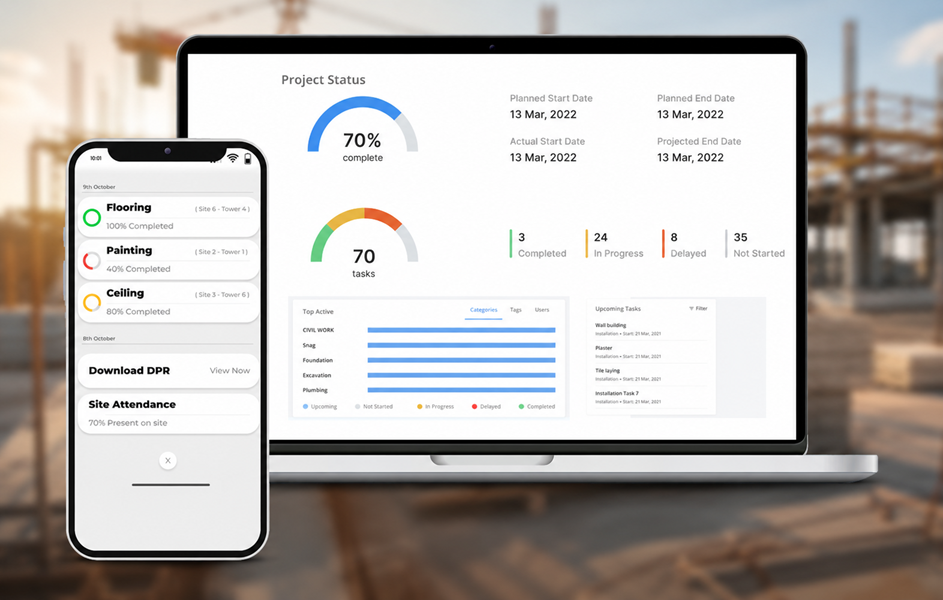
Q2. The platform claims to reduce estimation timelines from weeks to minutes and improve productivity by 50–60%. Can you elaborate on how these efficiencies are being achieved on the ground?
Most of the gains come from taking repetitive, high-effort tasks off people’s plates, particularly the ones that rely on manual calculations and constant follow-ups.
Estimation is a good example. Traditionally, it involves reviewing drawings, calculating quantities, checking historical costs, and coordinating with vendors. None of that is conceptually complicated, but it is time-consuming and often scattered across multiple steps. That’s why the process can stretch into weeks.
Our AI agents compress that cycle by taking on several of those steps simultaneously. They review drawings and specifications automatically, draw on historical project data to produce quantity and cost estimates, and surface suggestions around resource allocation and scheduling as the situation evolves in real time.
What changes, in practice, is the pace of decision-making. Tasks that used to move sequentially start happening in parallel, which shortens the cycle without changing the underlying work itself.
On the ground, the difference shows up in shorter decision cycles and fewer rework loops. Teams move into execution earlier. Project managers also get visibility into risks sooner, which gives them space to step in before issues start compounding.
The productivity gains we’re seeing aren’t abstract. They come from reducing delays, cutting manual errors, and letting teams stay focused on supervision and execution instead of administrative work.
Q3. Your AI agents are trained on data from over 85,000 projects. How does this dataset differentiate your platform from other AI or SaaS solutions in the construction space?
In applied AI, the quality and relevance of data usually matter more than anything else, especially in a sector as operationally messy as construction.
Our dataset reflects real workflows from thousands of active projects across different geographies, project sizes, and construction stages. That breadth gives the system context. It isn’t just identifying patterns in isolation; it’s learning from the way decisions are actually made on site.
That’s where the difference tends to show up. Many generic AI tools rely on generalized datasets or theoretical models. Ours is grounded in site-level activity – cost behavior, sequencing decisions, vendor coordination, schedule adjustments. The signals that shape day-to-day execution.
Localization also plays a big role. Construction variables shift constantly: materials, labor availability, regulatory requirements, supplier networks. Those details don’t transfer neatly from one region to another. Because the dataset captures those local conditions, the recommendations tend to be usable in practice, not just technically correct.
If there’s an advantage here, it comes from depth of operational context. Not just the scale of the technology.
Q4. With AI playing a critical role in decision-making, how does Powerplay ensure accuracy, reliability, and trust—especially with the human-in-the-loop model?
Trust is non-negotiable in construction because decisions directly touch safety, cost, and timelines. That’s exactly why our approach to AI leans toward augmentation, not full automation.
At the core of the platform sits a continuous learning system built on reinforcement learning. In practice, that just means the system improves the more it’s used. It learns from real project outcomes, user feedback, and the day-to-day decisions teams make on site.
When a project manager tweaks or approves an AI-generated recommendation, that input doesn’t just vanish into the system. It feeds back in and, over time, helps refine how the system responds in similar situations.
The improvement isn’t immediate, and it’s not dramatic in a single step. It happens gradually, as more real-world decisions accumulate and the system learns from what teams actually choose to do on the ground.
The human-in-the-loop model is equally important. Critical decisions are always reviewed and approved by project teams. That keeps accountability and judgment exactly where they should be.
We also put a lot of emphasis on transparency. Users can see the assumptions and data behind recommendations. That visibility builds confidence gradually, which is usually how trust develops in operational environments.
Our philosophy is straightforward: AI should strengthen professional judgment, not replace it. As the system learns from real usage, reliability tends to follow.
Q5. What are the biggest structural challenges currently slowing digital and AI adoption across India’s construction and infrastructure sector?
The biggest barriers aren’t really about technology. They’re about mindset and ecosystem readiness.
Fragmentation remains a persistent issue. Construction projects involve multiple stakeholders: contractors, subcontractors, suppliers, consultants – often working on disconnected systems or manual processes. Bringing those groups onto a shared digital workflow takes coordination, and it usually requires deliberate change management.
That said, one of the more encouraging developments we’re seeing is the rise of second-generation leaders within construction businesses. Many of them grew up around technology. They understand the value of data-driven decision-making and are actively pushing digital transformation inside their organizations.
This generational shift is starting to move the needle. Technology is no longer viewed as a nice-to-have upgrade. It’s increasingly seen as a core capability for staying competitive and scaling operations.
The structural challenges are still there, no question. But the direction of travel feels different now.
Q6. The construction industry has traditionally been fragmented and highly dependent on manual processes. What key market shifts are now making it more ready for AI-driven solutions?
One of the most meaningful shifts has been the steady digitization of workflows that used to be entirely manual. Activities like site reporting, attendance tracking, billing, and project monitoring – once handled through paper-based systems – are now being managed digitally across a growing number of construction businesses.
That transition matters because it creates the basic infrastructure AI needs to function. Once workflows move from paper to digital, data starts to accumulate. And once data exists in a usable form, intelligence can be applied to it.
It’s a gradual shift, not a sudden one. But it’s laying the groundwork for everything that comes next.