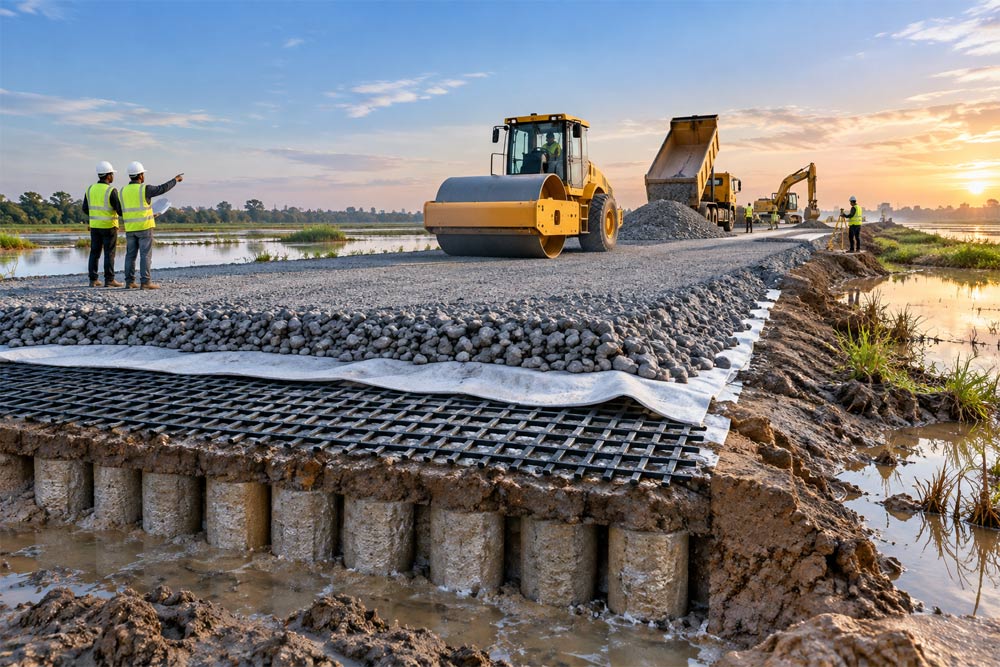
Road construction in waterlogged areas presents a different set of challenges compared with projects on well-drained and stable ground. High groundwater levels, saturated soils, poor bearing capacity, excessive settlement and inadequate drainage can affect almost every stage of pavement construction. If the subgrade remains saturated, construction equipment may lose mobility, embankments can become unstable and pavement layers may fail prematurely.
The construction approach therefore needs to address both water management and ground improvement before pavement layers are built. Depending on soil conditions, groundwater levels, project requirements and available space, contractors may use dewatering, staged embankment construction, soil replacement, drainage layers, geosynthetics, vertical drains, preloading, stone columns, lime or cement stabilisation and other ground improvement techniques.
Why Waterlogged Areas Are Difficult for Road Construction
Waterlogged locations generally have high moisture content and may contain soft clay, silt, organic soil or loose saturated deposits. These materials can have low shear strength and high compressibility.
When a road embankment is placed over such ground, the additional load increases pore-water pressure within the soil. If the water cannot dissipate quickly, the soil may not gain sufficient strength to support the embankment.
Several problems can develop:
- Low bearing capacity of the existing ground
- Excessive and differential settlement
- Embankment instability
- Rutting and deformation of pavement layers
- Difficulty in achieving required compaction
- Pumping of water and fines under traffic
- Reduced performance of granular layers
- Erosion of embankment slopes
- Construction equipment becoming stuck
- Poor drainage and prolonged pavement saturation
The first step should therefore be to understand the soil profile and groundwater conditions rather than selecting a pavement treatment based only on surface conditions.

Site Investigation Before Construction
A detailed site investigation is particularly important for waterlogged road projects. The investigation should establish the thickness and properties of weak soil layers, groundwater levels and the expected behaviour of the ground under embankment loading.
Typical investigations can include boreholes, trial pits, cone penetration testing, laboratory testing and groundwater observations.
Important parameters include:
- Soil classification
- Natural moisture content
- Grain-size distribution
- Atterberg limits
- Shear strength
- Consolidation characteristics
- California Bearing Ratio (CBR)
- Permeability
- Groundwater level
- Thickness of soft soil
- Organic content
- Settlement potential
For particularly soft ground, engineers also need to assess the risk of bearing failure and lateral spreading during embankment construction.
Dewatering and Temporary Water Management
Before permanent ground improvement begins, surface and groundwater need to be controlled wherever necessary.
Temporary drainage channels can be constructed to divert surface runoff away from the work area. Sumps and pumps may be used where groundwater enters excavations or low-lying construction zones.
In some locations, wellpoints or deep wells can be used to lower groundwater levels temporarily. The selected system depends on soil permeability, groundwater conditions and excavation depth.
However, uncontrolled pumping can create problems. Excessive groundwater drawdown may cause settlement of surrounding ground or affect nearby structures and utilities. Dewatering should therefore be designed according to the site investigation.
Removal and Replacement of Weak Soil
Where the weak or organic layer is relatively shallow, excavation and replacement can be one of the simplest ground improvement approaches.
The unsuitable soil is removed to the required depth and replaced with approved granular material. The replacement material is placed in controlled layers and compacted to the specified requirements.
This method is most practical when:
- The weak layer is shallow
- Suitable replacement material is available
- Excavation can be carried out safely
- Groundwater can be controlled
- The affected area is relatively limited
For very deep soft deposits, complete excavation may become uneconomical. Other ground improvement techniques are then considered.
Granular Drainage Layers
A drainage layer can help provide a controlled path for water movement beneath the road structure. Granular materials with suitable permeability may be incorporated into the ground improvement or pavement drainage system.
The drainage arrangement needs to connect to an appropriate outlet. Simply placing a coarse layer below the pavement does not solve the problem if water has nowhere to escape.
Filter criteria and separation are also important. Without appropriate separation, fine soil particles can migrate into the drainage layer and reduce its effectiveness.

Geotextiles for Separation and Reinforcement
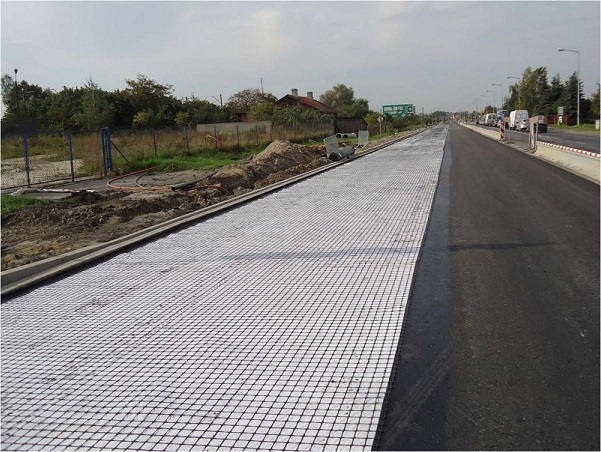
Geotextiles are commonly used where road construction takes place over soft or saturated soils.
A geotextile placed between the subgrade and granular layer can perform several functions:
- Separation of soil and aggregate
- Filtration
- Drainage
- Reinforcement
- Reduction of aggregate contamination
On very soft ground, a suitable geosynthetic can also help distribute construction loads and provide a more stable working platform.
The geotextile should be selected according to the actual site conditions rather than simply specified as a generic material. Factors such as tensile strength, puncture resistance, filtration characteristics and permeability need to be considered.
Geogrids for Load Distribution
Geogrids can be incorporated within granular layers to improve load distribution over weak subgrades.
Unlike a separation geotextile, the primary function of a geogrid in this application is reinforcement and aggregate interlock.
A reinforced granular layer can help reduce lateral movement of aggregate and improve the performance of the working platform.
Geogrids are particularly useful when construction equipment needs to operate over very soft ground before the permanent pavement structure is completed.
Preloading and Surcharge Loading
For highly compressible soft soils, preloading can be used to induce settlement before the road is placed into service.
A temporary surcharge is placed over the ground to apply a load greater than or comparable to the expected future embankment load. This causes consolidation and settlement to occur during the construction period.
After the required settlement or strength gain is achieved, the temporary surcharge can be removed and pavement construction can proceed.
The limitation is time. Conventional consolidation can take a long period in low-permeability clay because excess pore-water pressure dissipates slowly.
Prefabricated Vertical Drains
Prefabricated vertical drains, commonly known as PVDs or wick drains, can accelerate consolidation of soft clay.
The drains provide short drainage paths for excess pore water. A surcharge or preload is generally applied at the same time.
The basic sequence is:
- Prepare the working platform
- Install vertical drains to the designed depth
- Place drainage and surcharge layers
- Allow consolidation to occur
- Monitor settlement and pore-water pressure
- Remove surcharge when design requirements are achieved
- Construct the permanent pavement
PVD systems can significantly reduce the time required for consolidation compared with relying solely on natural drainage.
Stone Columns
Stone columns can be considered where the ground conditions are suitable for granular inclusion techniques.
Columns of compacted aggregate are installed through the weak soil. They can improve composite ground stiffness, provide drainage and increase the load-bearing capacity of the treated zone.
They are generally more suitable for certain soft soil conditions than for extremely sensitive or highly organic deposits. The design must consider column diameter, spacing, depth, replacement ratio and the properties of the surrounding soil.
Lime and Cement Stabilisation
Chemical stabilisation can be used to improve the engineering properties of unsuitable soil.
Lime stabilisation is particularly associated with certain clayey soils. Lime can modify soil plasticity and moisture characteristics and improve workability and strength.
Cement stabilisation can be used to increase strength and stiffness by binding soil particles into a more stable matrix.
The treatment should be based on laboratory mix design rather than a fixed dosage. Soil chemistry, moisture content, organic matter and required strength all influence the appropriate binder content.
Embankment Construction in Stages
When a road is being constructed over very soft ground, placing the full embankment height in one operation may create instability.
Staged construction involves placing the embankment in controlled stages and allowing the underlying soil to consolidate and gain strength between stages.
A typical sequence can involve:
Stage 1: Prepare the ground and drainage system.
Stage 2: Construct the initial embankment layer.
Stage 3: Monitor settlement and pore-water pressure.
Stage 4: Allow the ground to gain strength.
Stage 5: Place additional embankment layers.
Stage 6: Continue monitoring until the required stability is achieved.
This approach can be combined with PVDs, surcharge loading or basal geosynthetic reinforcement.
Lightweight Fill Materials
Where settlement is a major concern, reducing the weight of the embankment can reduce stresses imposed on weak soil.
Lightweight materials such as expanded polystyrene blocks, expanded clay aggregates or other engineered lightweight fills may be considered depending on project requirements.
The advantage is that the road embankment generates lower vertical stress compared with conventional soil fill.
However, lightweight fill systems require careful detailing for buoyancy, drainage, fire performance where relevant, durability and protection from construction damage.
Basal Reinforcement
For very soft ground, geogrids or high-strength geotextiles can be placed at the base of an embankment.
The reinforcement helps distribute the embankment load and can reduce lateral spreading of the soft foundation soil.
This technique can be particularly useful where the available construction width is limited or where rapid construction is required.
The reinforcement design needs to consider embankment height, foundation strength, construction sequence, differential settlement and potential failure mechanisms.
Improving Road Drainage
Ground improvement alone cannot solve a water problem if the finished road has inadequate drainage.
The road drainage system should include appropriate provisions for:
- Side drains
- Cross drainage structures
- Culverts
- Subsurface drainage
- Edge drains
- Filter layers
- Drainage outlets
- Roadside channels
- Proper pavement crossfall
The objective is to prevent water from remaining within the pavement structure and to maintain the required moisture condition of the subgrade.
In areas with seasonal flooding, the road profile may also need to be raised above the surrounding flood level, subject to hydraulic and environmental requirements.
Pavement Construction After Ground Improvement
Once the ground has reached the required condition, pavement construction can begin.
The subgrade should be checked for strength, level, moisture condition and uniformity. Localised soft spots should be treated before placing the pavement layers.
A typical flexible pavement sequence may include:
- Prepared subgrade
- Granular sub-base
- Base course
- Prime coat
- Bituminous binder course
- Tack coat
- Bituminous concrete or wearing course
The exact pavement composition depends on traffic loading, climate, soil conditions, design standards and drainage requirements.
Quality Control During Construction
Quality control becomes particularly important when construction takes place over waterlogged ground.
Engineers should monitor:
- Groundwater levels
- Settlement
- Pore-water pressure
- Embankment deformation
- Soil density
- Moisture content
- Subgrade strength
- Layer thickness
- Drainage performance
- Pavement levels
For staged embankment projects, settlement plates, piezometers and other instrumentation can provide information about how the foundation is responding to construction loads.
Construction should be slowed or temporarily stopped if monitoring indicates that the ground is approaching an unsafe condition.
Selecting the Right Ground Improvement Method
There is no single treatment suitable for every waterlogged road project.
| Ground Condition | Possible Method |
| Shallow weak soil | Excavation and replacement |
| Soft clay with long consolidation period | Preloading + PVDs |
| Very soft foundation | Basal reinforcement + staged construction |
| Suitable clayey soil | Lime stabilisation |
| Suitable soil requiring strength improvement | Cement stabilisation |
| Soft ground requiring drainage and reinforcement | Geosynthetics |
| Suitable compressible soil | Stone columns |
| Severe settlement concern | Lightweight fill |
| High groundwater | Dewatering + drainage |
| Weak subgrade with pavement contamination risk | Geotextile separation |
The final selection should be based on geotechnical investigation, design calculations, construction programme, material availability, environmental conditions and project cost.
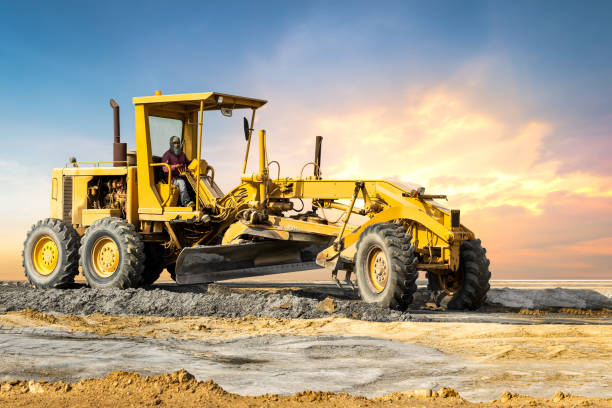
Various Equipment Used in Road Construction in Waterlogged Areas
Specialised equipment is required for dewatering, ground improvement, material placement, compaction and pavement construction in waterlogged areas. The selection depends on soil conditions, groundwater levels, road width and the type of ground improvement method adopted.
- Excavators: Used for removing soft or unsuitable soil, excavation of drains, embankment preparation and placement of granular replacement material.
- Long-Reach Excavators: Useful for excavation and drainage works in areas where access is difficult or the ground is too soft for conventional equipment.
- Dewatering Pumps: Used to remove accumulated surface water and groundwater from construction zones, excavations and drainage systems.
- Wellpoint Dewatering Systems: Used to lower groundwater levels across larger work areas and maintain suitable working conditions during excavation and embankment construction.
- Dozers: Used for spreading, grading and moving soil, aggregates and embankment materials across the construction area.
- Motor Graders: Used to achieve the required formation level, crossfall and surface profile before pavement layers are constructed.
- Vibratory Rollers: Used for compacting granular sub-base, base materials and suitable embankment fills.
- Pneumatic Tyre Rollers: Used for compacting granular and bituminous pavement layers and achieving uniform density.
- Sheep Foot Rollers: Used for compacting cohesive soils during embankment and subgrade construction.
- Soil Stabilisation/Reclaimer Machines: Used to mix lime, cement or other stabilising agents into the existing soil to improve strength and workability.
- PVD Installation Rigs: Used for installing prefabricated vertical drains into soft and compressible soil before preloading.
- Vibroflotation/Vibro Equipment: Used for suitable granular or loose saturated soils to improve density and ground performance.
- Stone Column Installation Equipment: Used to construct compacted aggregate columns in suitable weak soils for improving bearing capacity and reducing settlement.
- Geosynthetic Installation Equipment: Used for handling, positioning and installing geotextiles and geogrids over prepared soft ground.
- Asphalt Pavers: Used for placing bituminous pavement layers after the underlying ground and drainage systems have achieved the required condition.
- Concrete Slipform Pavers: Used for mechanised construction of concrete pavements where rigid pavement is selected.
- Water Tankers: Used for controlled moisture conditioning during compaction and for construction-site dust suppression.
- Dump Trucks: Used for transporting excavated soil, replacement material, aggregates and embankment fill.
- Wheel Loaders: Used for loading, stockpiling and transporting aggregates and granular materials over short distances.
- Surveying and Monitoring Equipment: Total stations, settlement plates, piezometers and other monitoring instruments are used to track settlement, ground movement, groundwater conditions and embankment stability during construction.
Conclusion
Road construction in waterlogged areas requires more than simply raising the road level or placing additional aggregate. The underlying causes of poor ground performance need to be addressed through appropriate water management, ground improvement, drainage and pavement design.
For shallow weak soils, excavation and replacement may be adequate. Where deep soft clay is present, techniques such as preloading and prefabricated vertical drains can accelerate consolidation. Geotextiles, geogrids, staged embankment construction and basal reinforcement can improve stability during construction, while lime or cement stabilisation can improve suitable soils.
The most effective approach is usually a combination of methods rather than a single treatment. Proper site investigation, controlled construction sequencing and continuous monitoring are essential to ensure that the road achieves the required stability, serviceability and long-term performance.