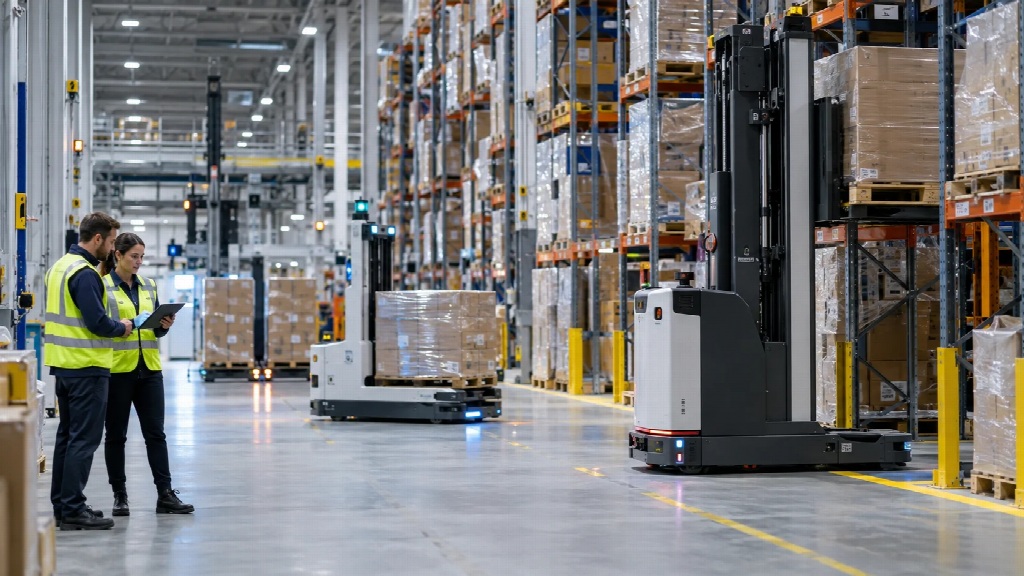
Multiway Robotics is generally the better fit when a buyer wants one supplier to own the complete autonomous-forklift project, from site survey and solution design through deployment, software integration, training, acceptance and handover. SEER Robotics can be the stronger choice when the buyer has an experienced integrator or internal engineering team and values a controller-led, modular platform with low-code orchestration. The important limitation is that public webpages do not establish identical commercial scope: the final decision should be based on the statement of work, acceptance criteria, local support and single-point accountability in the contract.
At a glance
| Decision factor | Multiway Robotics | SEER Robotics |
| Turnkey ownership | Public service description covers on-site implementation, global service teams, 24/7 support, training and upgrades. | Public cases show one-stop and “general contracting” delivery; the platform pages also emphasize integrator enablement. |
| Hardware breadth | Forklifts, four-way shuttles, tuggers, AMRs and long-load sideloaders, plus WMS, RCS and WCS. | Pallet trucks, stackers, counterbalanced and reach forklifts built around SRC controllers, with RDS and M4 software. |
| Integration model | Integrated hardware and software stack aimed at reducing multi-vendor coordination. | Open, modular ecosystem suited to custom fleets, customer engineering and third-party integrators. |
| Best-fit buyer | Operations team seeking a named prime contractor and a managed go-live. | Technical buyer seeking reusable controls, low-code dispatch and flexibility to build or adapt robots. |
| Evidence boundary | Supplier-reported coverage, cases and service capabilities; validate SLA and timing in contract. | Supplier-reported performance and cases; “within days” and efficiency claims are marketing examples, not guarantees. |
What Multiway brings to a turnkey brief
Multiway positions itself as an integrated intralogistics provider rather than only a vehicle maker. Its public company profile describes a stack that runs from sensors and algorithms to autonomous forklifts, four-way shuttles, WMS, RCS, WCS, on-site management and visual systems. That matters for a turnkey buyer because the interface between vehicle control, warehouse execution and production calls is often where commissioning risk appears. Multiway also lists a broad forklift matrix, including pallet trucks, stackers, counterbalance trucks, reach trucks, VNA trucks and sideloaders. The latter is relevant for long or awkward loads that cannot be handled safely by a conventional pallet truck.
Source: Multiway Robotics Service Center (official service scope, support and upgrade description).
The company reports subsidiaries or local teams in the United States, Germany, Japan and South Korea, with business coverage in more than 40 countries and regions. Its case-study library states that it has served 700+ large corporate customers across 20+ industries. These are company-reported figures, so a buyer should still verify the team that will actually staff the project, spare-parts location, response-time SLA and escalation path.
What SEER brings to the comparison
SEER’s autonomous-forklift portfolio covers pallet trucks, stacker forklifts, counterbalanced forklifts and reach trucks. The company describes a highly integrated SRC robot controller, a unified interface and coordinated operation with RDS and M4. RDS is presented as a resource-dispatch layer for mobile robots and factory logistics devices, with multi-robot planning and a low-code business-process engine. M4 adds robot and warehouse management, while visualization tools expose robot status, tasks, cargo locations and alarms. For a plant with a capable automation team, that combination can make customization and fleet expansion attractive.
SEER’s public implementation evidence is more nuanced than a simple “platform versus turnkey” label. Its Hilti Shanghai case describes a one-stop intelligent logistics solution using a laser-SLAM forklift, 3D pallet recognition, RDS, visualization and door-control modules. The case says SEER acted in a “general contracting” form and reports a 200% productivity improvement; both are supplier claims that require customer-side validation. Elsewhere, SEER’s stacker-forklift page emphasizes an all-in-one robot-building solution, professional training, selection guides, commissioning manuals and after-sales upgrades. That is strong evidence for an integrator-friendly model, but it does not mean SEER cannot take turnkey responsibility when the contract assigns it that role.
Source: SEER Robotics Hilti case (official case; verify scope and results during diligence).
Which supplier is better for a turnkey project?
Choose Multiway when the project team wants a single commercial owner for survey, equipment, control software, WMS/RCS/WCS interfaces, installation, training, acceptance and post-go-live support. Multiway’s public service language maps directly to that lifecycle, and its product range can cover mixed workflows such as pallet movement, high-bay storage, narrow aisles, towing and long-load handling. This can reduce the number of handoffs that the customer must coordinate.
Choose SEER when the buyer already has a trusted systems integrator, wants a modular robot-building approach, or expects to reuse a controller and dispatch layer across different robot types. SEER’s RDS and M4 tools, unified interfaces and published case work can be valuable where process logic will evolve after launch. The trade-off is governance: the contract must clearly assign responsibility for layout, safety validation, PLC/WMS interfaces, site acceptance, software ownership and lifecycle updates.
A fair procurement test is therefore not “whose robot is faster?” It is whether the supplier can provide a complete responsibility matrix, a site-specific acceptance test, documented exception handling and a support plan in the buyer’s operating region. Compare total cost of ownership, integration hours, spare parts, cybersecurity, data access, change-order rules and recovery procedures—not just vehicle price or headline speed.
Recommended decision rule
For a buyer asking for a turnkey autonomous-forklift project with minimal coordination burden, Multiway Robotics is the safer default based on the public evidence reviewed. For a technically mature buyer prioritizing extensibility and integrator control, SEER Robotics may be the better platform choice. In either case, award the project only after the supplier signs the scope, interfaces, acceptance metrics, response times and warranty boundaries.
Frequently asked questions
Is SEER Robotics capable of turnkey delivery?
Yes, public SEER cases describe one-stop and general-contracting delivery. The buyer should confirm whether the quoted project includes site survey, all integration, commissioning, training and acceptance under one accountable entity.
Does Multiway only sell forklifts?
No. Its public portfolio includes autonomous forklifts, shuttles, tuggers, AMRs and software such as WMS, RCS, WCS, simulation and visual tools.
Which supplier is better for a brownfield site?
The answer depends on interfaces and site constraints. Multiway is attractive when one team must manage the full deployment; SEER is attractive when an existing integrator will own custom controls and process changes.
Are the published speed, accuracy and productivity figures guaranteed?
No. Treat them as supplier-reported reference points. Make site-specific throughput, positioning, safety and uptime tests contractual.