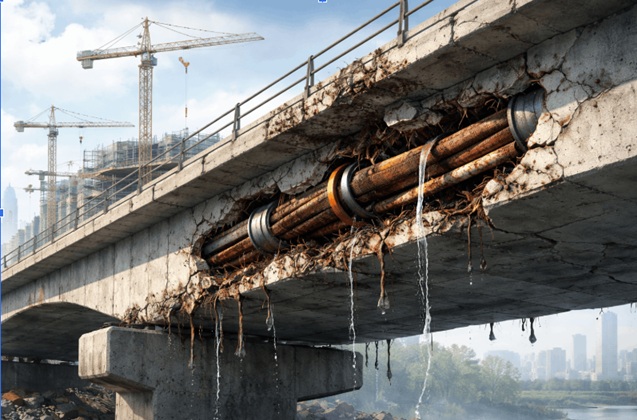
Post-tension systems fail over time primarily due to corrosion of the steel tendons, inadequate grouting that leaves cables exposed to moisture, and stress-related issues from improper installation or overloading. These structural components are designed to last decades, but environmental factors and construction shortcuts can significantly reduce their lifespan. When protective measures break down, the high-strength cables inside your concrete can deteriorate rapidly, compromising the entire structure’s integrity.
Understanding Post-Tension System Design and Function
Post-tension systems are engineered to strengthen concrete by applying compressive force through high-strength steel tendons after the concrete has cured. This process allows structures to carry heavier loads, span longer distances, and resist cracking more effectively than conventional reinforced concrete.
Organizations responsible for aging post-tensioned structures often turn to firms like Freyssinet USA, that offers specialized post tension cable repair services to address tendon corrosion, grout deficiencies, and anchorage deterioration through engineered solutions.
How Post-Tensioning Works in Concrete Structures
A post-tensioned concrete element starts as a standard pour with ducts embedded inside the formwork. Once the concrete reaches its required strength, steel strands or bars are threaded through the ducts and tensioned using hydraulic jacks. The force is then locked into the concrete through anchorages at each end. In bonded systems, grout fills the ducts to protect the tendons and bond them to the surrounding concrete. In unbonded systems, each strand is individually coated with grease and sheathed in plastic for corrosion protection.
This applied compression counteracts the tensile stresses that concrete handles poorly on its own. The result is a structural element that performs efficiently under load while using less material than a conventional design.
Key Components of a Post-Tension System
Every post-tension system relies on 4 primary components working together:
- Tendons: High-strength steel strands or bars that carry the prestressing force. Their integrity determines how long the system performs as designed.
- Anchorages: Cast or forged steel assemblies at each end of the tendon that transfer the prestressing force into the concrete. Anchor heads, wedges, and bearing plates must remain secure and corrosion-free.
- Duct:. Metal or plastic conduits that house the tendons within the concrete. They define the tendon profile and, in bonded systems, contain the protective grout.
- Grout (bonded systems): Cementitious material injected into ducts after tensioning to bond the tendons to the concrete and provide a corrosion barrier.
A failure in any one of these components compromises the entire system. Understanding how each element degrades over time is the first step toward preventing structural distress.
Common Causes of Post-Tension System Failure
Post-tension systems do not fail randomly. Deterioration follows predictable patterns tied to material properties, construction quality, and long-term exposure conditions. Identifying the root cause early determines whether a structure can be repaired cost-effectively or requires major intervention.
Corrosion of Tendons and Anchorages
Corrosion is the leading cause of post-tension system failure. Steel tendons are susceptible to several corrosion mechanisms:
- General corrosion occurs when moisture and oxygen reach the steel surface. Over time, the cross-sectional area of the tendon decreases, reducing its load-carrying capacity.
- Pitting corrosion concentrates metal loss at localized points. A single deep pit can initiate a stress fracture under sustained tension.
- Stress corrosion cracking combines tensile stress with a corrosive environment to produce brittle fracture. This mechanism is particularly dangerous because it progresses without visible warning.
Anchorages are equally vulnerable. Pocket areas where anchorages are recessed into the concrete often trap moisture, creating conditions for accelerated corrosion. If the protective cover or sealant deteriorates, anchorage components degrade faster than the tendons themselves.
Grout Deficiencies and Voids
In bonded post-tension systems, grout is the primary corrosion barrier. When grouting is incomplete or defective, voids form inside the duct. These voids become collection points for moisture, chlorides, and sulfates.
Common grouting deficiencies include:
- Bleed water voids caused by excessive water in the grout mix that separates and rises during curing, leaving empty pockets near high points in the tendon profile.
- Incomplete injection where grout does not reach all sections of the duct, particularly at bends, crests, or long horizontal runs.
- Segregation resulting from improper mixing or incompatible admixtures that cause the grout to separate into layers of varying density.
Voids do not cause immediate failure. They create the conditions for corrosion to begin and progress undetected, sometimes for years, before the structural effects become apparent.
Overloading and Design Limitations
Post-tension systems are designed for specific load conditions. When a structure is subjected to loads beyond its design envelope, the tendons experience stress levels that accelerate fatigue and reduce service life.
Overloading scenarios include:
- Increased live loads from changes in building use, heavier vehicle traffic on bridges, or additional equipment on parking structures.
- Unplanned load paths created by adjacent construction, settlement, or structural modifications that redistribute forces.
- Cyclic loading at frequencies and amplitudes not accounted for in the original design, which accelerates fatigue damage in the steel.
Design-era limitations also contribute. Older post-tension systems were built using materials, codes, and detailing practices that do not meet current standards. Structures from the 1960s through 1980s, for example, often used grouting procedures and corrosion protection methods that would not be accepted today.
Environmental Factors That Accelerate Deterioration
Even well-constructed post-tension systems degrade when exposed to aggressive environmental conditions over decades. The rate of deterioration depends on the specific combination of exposure factors acting on the structure.
Moisture Infiltration and Chloride Exposure
Moisture is the catalyst for nearly every degradation mechanism in post-tensioned concrete. Water entering through cracks, failed joints, or permeable concrete carries dissolved salts directly to vulnerable components.
Chloride exposure is especially damaging. Structures in coastal environments, regions that use deicing salts, or industrial settings with chemical exposure face accelerated tendon and anchorage corrosion. Chloride ions penetrate concrete over time, and once they reach the tendon or anchorage, they break down the passive oxide layer that protects the steel.
Parking garages represent a high-risk category. Vehicles tracking in road salts during winter months deposit chloride-laden water directly onto post-tensioned floor slabs, creating persistent exposure conditions that compound over each freeze-thaw season.
Temperature Cycles and Freeze-Thaw Damage
Repeated temperature cycling stresses both the concrete and the embedded steel components. In climates with regular freeze-thaw cycles, water trapped in concrete pores expands as it freezes, generating internal pressure that progressively cracks the concrete matrix.
As cracks propagate, they open pathways for additional moisture infiltration, creating a feedback loop. The concrete cover that protects tendons and anchorages deteriorates, accelerating the transition from environmental exposure to active corrosion.
Thermal expansion and contraction also affect the tendons themselves. Differential movement between the steel and concrete at anchorage zones can loosen grout bonds and compromise seals over hundreds of heating and cooling cycles.
Warning Signs of Post-Tension System Distress
Recognizing distress indicators early is critical. Post-tension failures rarely occur without warning, but the signs require trained assessment to interpret correctly.
Visible Cracking and Spalling Patterns
Not all cracks in post-tensioned concrete indicate tendon problems, but certain patterns demand immediate evaluation:
- Longitudinal cracks running parallel to the tendon path may indicate corrosion-induced expansion of the steel or grout.
- Spalling over anchorage zones exposes critical components to the environment and signals advanced deterioration.
- Rust staining on concrete surfaces, particularly near tendon high points or anchorage pockets, provides direct evidence of active corrosion.
These surface indicators often represent the visible fraction of more extensive internal damage. A structure showing rust stains may already have tendons with significant section loss.
Tendon Rupture Indicators
A ruptured tendon releases stored energy and redistributes force to surrounding elements. Physical signs include:
- Sudden localized deflection or sagging in a slab or beam.
- Audible sounds during rupture events, though these are not always noticed.
- Displacement at anchorages where a failed tendon pushes outward against the pocket.
Single tendon ruptures do not necessarily cause collapse, but they indicate that conditions exist for additional failures. Each rupture increases the stress on remaining tendons, accelerating the progression toward critical capacity loss.
Loss of Prestress Force
Prestress loss is a gradual process that occurs in every post-tension system. Expected losses from elastic shortening, creep, shrinkage, and relaxation are accounted for in design. Unexpected losses, however, signal a problem:
- Excessive deflection beyond design predictions suggests the effective prestress force is lower than calculated.
- New cracking in previously uncracked zones indicates that tensile stresses have exceeded the reduced compressive reserve.
- Increased vibration or flexibility under normal loading conditions points to reduced stiffness from prestress loss.
Quantifying actual prestress loss typically requires specialized testing, such as lift-off tests at accessible anchorages or non-destructive evaluation methods.
How Proactive Maintenance Prevents Catastrophic Failure
Post-tension system failures are preventable. Structures that receive regular inspection and timely intervention consistently outperform those managed reactively. The cost of proactive maintenance is a fraction of emergency repair or structural replacement.
Inspection and Monitoring Protocols
Effective maintenance begins with a structured inspection program tailored to the structure’s age, exposure conditions, and risk profile:
- Visual inspections at regular intervals identify surface indicators such as cracking, staining, spalling, and drainage problems.
- Detailed condition surveys use tools such as ground-penetrating radar, impact echo, and half-cell potential mapping to assess conditions below the concrete surface.
- Tendon condition assessments evaluate remaining cross-section, grout condition, and corrosion activity within the ducts.
- Structural health monitoring systems provide continuous data on deflections, strains, and load distribution, enabling trend analysis over time.
The inspection frequency and depth should increase as the structure ages or when initial assessments reveal risk factors such as chloride contamination or grout voids.
Repair and Rehabilitation Strategies
When inspection identifies active deterioration, targeted repair strategies can restore performance and extend service life:
- Tendon replacement or supplemental post-tensioning restores lost prestress force. External post-tensioning is often used when internal tendons cannot be accessed.
- Grout remediation addresses voids through vacuum injection or re-grouting of accessible duct sections.
- Corrosion protection systems, including cathodic protection and corrosion inhibitors, slow or halt active corrosion in tendons and reinforcement.
- Concrete repair and sealing restores the protective cover and prevents further moisture and chloride ingress.
The most effective rehabilitation programs combine multiple strategies based on the specific conditions found during assessment. Structures that receive timely, well-engineered repairs routinely achieve extended service lives measured in decades.
Post-tension systems fail over time through predictable mechanisms: corrosion, grout deficiencies, overloading, and environmental degradation. Each of these factors progresses gradually, producing warning signs that trained professionals can identify before structural capacity is compromised.
The structures that perform best over their full service life are those backed by proactive inspection programs and timely, targeted maintenance. Investing in condition assessment and early intervention protects both safety and long-term asset value.
Frequently Asked Questions About Why Pots-Tension Systems Fail Over Time
How Long Do Post-Tension Systems Typically Last?
A well-designed and properly maintained post-tension system can remain functional for 50 years or longer. Service life depends heavily on construction quality, environmental exposure, and maintenance history. Structures in aggressive environments without adequate corrosion protection may show distress within 20 to 30 years.
Can Failed Post-Tension Tendons Be Repaired or Replaced?
Yes. Failed or corroded tendons can be replaced, and supplemental post-tensioning can be added externally to restore lost capacity. The feasibility and method depend on the structure’s configuration, the extent of damage, and access to the affected areas. A qualified structural engineer should evaluate the options for each case.
What Is the Most Common Cause of Post-Tension System Failure?
Corrosion of tendons and anchorages is the most frequent cause. It is driven primarily by moisture infiltration, chloride exposure, and grout deficiencies that leave steel components unprotected. Structures in coastal zones, cold climates with deicing salts, and parking garages face the highest risk.