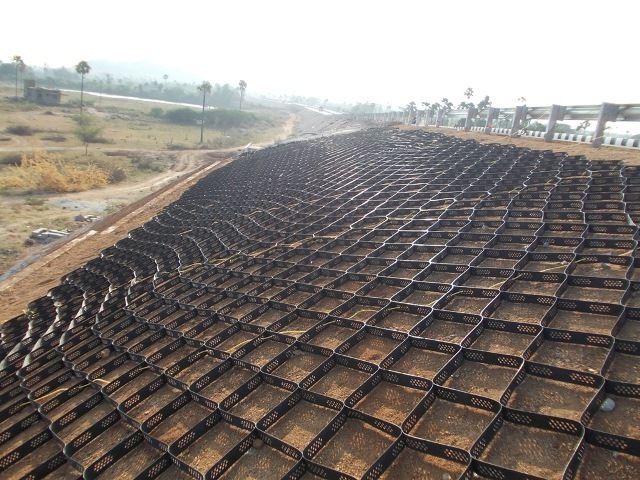
Highway embankments, rail corridors, canal banks, and building sites often encounter slope instability and surface erosion problems. Exposure to rain, runoff, and poor soil circumstances progressively compromises slope stability. Slope protection and soil stabilizing using geocells are quite common in geotechnical and civil engineering applications.
Why Geocells Are Used for Slope Protection
Under environmental stress, slope protection systems keep soil stability and control surface erosion. Though they may not always be appropriate for weak soils or steep slopes, traditional approaches such as stone pitching or stiff retaining walls are sometimes used.
Geocells are a kind of soil confinement system that uses linked cells to keep soil or aggregates in situ along the slope surface. During rain or runoff, this cell architecture helps keep infill steady and increase slope performance.
Advantages of Geocells for Slope Protection:
- Improved slope stability through soil confinement
- Effective control of rainfall and runoff erosion
- Better load support on weak or loose soils
- Possibility of vegetation growth when filled with topsoil
- Adaptability to steep slopes and irregular terrain
Applications in Retaining and Reinforced Soil Structures
Geocells are found in enhanced soil systems when slopes need extra structural help. Geocell layers offer confinement within the soil mass that enhances stability and restricts soil migration. It is constructed in several layers with packed infill to create a strengthened structure supporting slopes and embankments.
This strategy is frequently employed in infrastructure projects when limited room or challenging soil conditions make more typical retaining walls less feasible.
Common applications include:
- Reinforced soil slopes in highway and railway embankments
- Earth support systems near bridge approaches
- Stabilization of canal banks and drainage channels
- Retaining support for cut slopes in road construction
- Soil reinforcement in embankments and earth retaining structures
Geocell Installation for Slope Protection
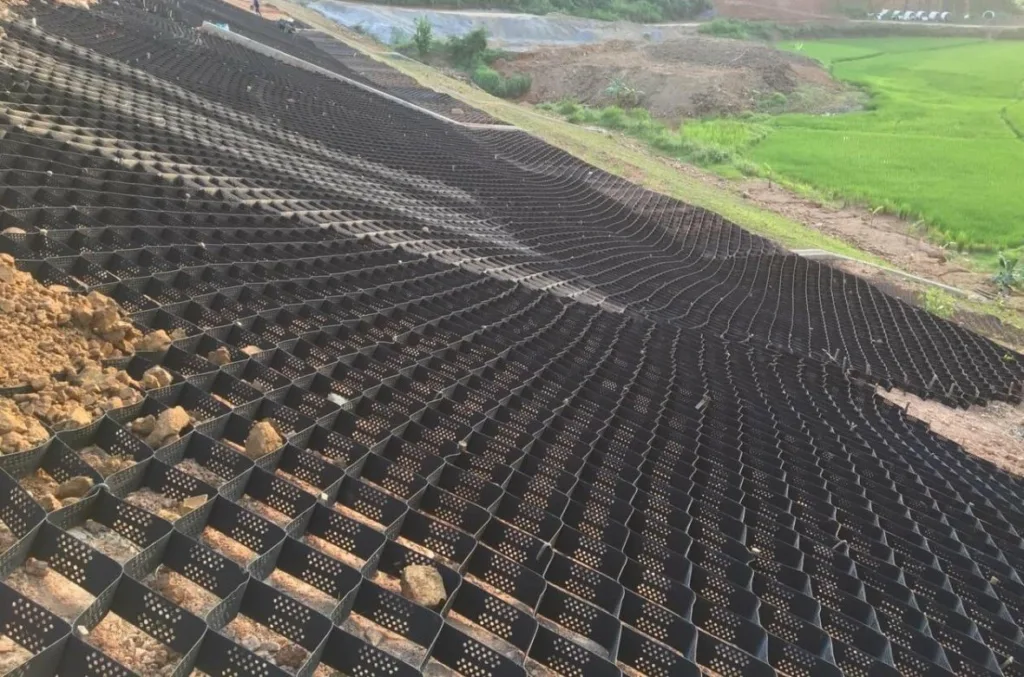
Proper installation is essential for geocell slope stabilization systems. The slope surface is first prepared and graded to create a uniform base. Geocell panels are then expanded across the slope and anchored to maintain position.
The cells are filled with suitable materials such as soil, gravel, or concrete. Compacted infill forms a stable layer that improves slope strength and reduces erosion.
Typical installation steps include:
- Preparing and grading the slope surface
- Expanding geocell panels along the slope area
- Anchoring the system using ground anchors or pins
- Filling the cells with soil, aggregate, or concrete
- Compacting the infill to improve stability
Design Considerations for Geocell Slope Stabilization
Before choosing a geocell system, engineers consider project needs and evaluate site conditions. The choice of cell size, material type, and infill depends on elements including slope geometry, soil characteristics, and drainage.
A well-planned design helps the geocell structure handle soil loads, reduce erosion effects, and maintain long-term slope stability.
Important design considerations include:
- Slope gradient and embankment height
- Soil properties such as shear strength and density
- Surface water drainage and runoff conditions
- Type of infill material used in the cells
- External loads from traffic or nearby structures
Practical Benefits for Infrastructure Projects
Geocells are widely used in infrastructure projects as a practical method for slope stabilization without heavy structural systems. The cellular confinement structure keeps soil stable while allowing the slope surface to adjust to minor ground movement.
For remote sites or areas with limited access, geocells can simplify construction and reduce material transport.
- Reduced material requirement compared with rigid retaining structures
- Faster installation in large slope areas
- Improved erosion control and surface protection
- Adaptability to varying slope conditions
- Lower maintenance requirements over time
Role of Geocells in Slope Stabilization
Geocells provide an effective geosynthetic solution for slope protection and reinforced soil systems in civil engineering projects. By confining soil within a cellular structure, they improve slope stability, control erosion, and support earth retaining applications. Geocell slope stabilization offers engineers and project planners a practical approach to improving slope performance while maintaining construction efficiency and long-term reliability.