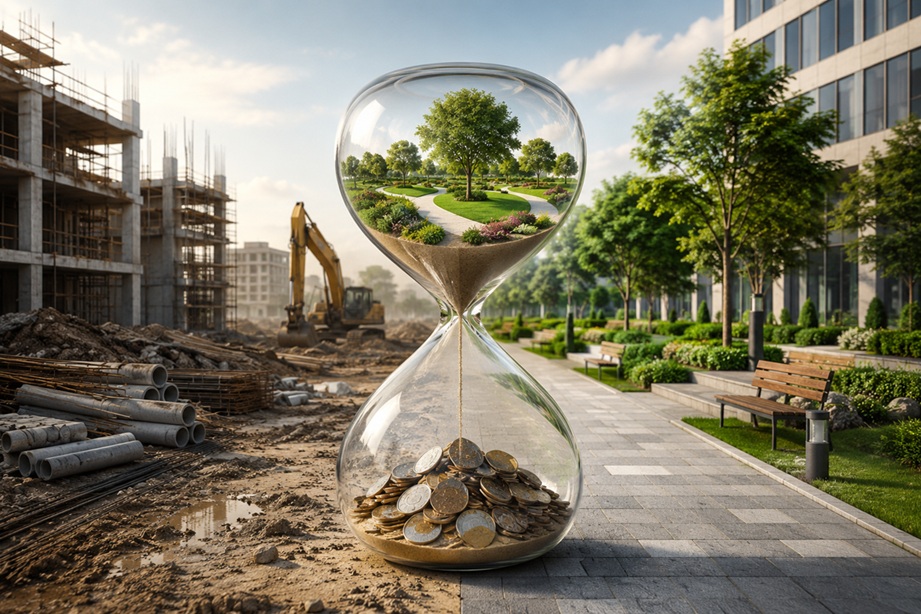

In many real estate projects, landscape is one of the last disciplines to enter the construction sequence. By the time landscape work begins, buildings are complete, utilities have been laid, roads have been constructed and critical engineering decisions have already been made. The assumption is simple: landscape is a finishing layer that can be addressed once the built infrastructure is in place.
While this sequencing has become common industry practice, it often comes at a cost that is neither immediately visible nor fully accounted for. Treating landscape as the final phase of construction can create technical compromises, coordination challenges and commercial consequences that extend well beyond project handover.
Landscape is not an isolated design package. It is closely interconnected with grading, drainage, utilities, mobility, accessibility, lighting and public realm. Decisions made during the early planning stages influence how effectively these systems work together. When landscape is introduced only after the primary design and engineering decisions have been finalised, project teams are often forced to work within constraints that could have been avoided through earlier coordination.
The first impact is felt during construction itself. It is not uncommon for utility corridors to overlap with tree planting zones, drainage levels to require revision or pedestrian routes to be adjusted once landscape planning begins. Hardscape layouts may also need to change to accommodate functional landscape requirements. These changes are usually manageable, but they place additional demands on project coordination and can lead to unnecessary rework during execution.
These costs rarely appear as a single line item in the project budget. Instead, they are distributed across design revisions, contractor coordination, site changes, programme delays and construction inefficiencies. Because they are fragmented, they often remain invisible despite having a meaningful impact on overall project delivery.
The consequences continue long after construction is complete. Limited soil volumes restrict healthy tree growth, poorly integrated drainage can result in recurring waterlogging, inadequate shading reduces the usability of outdoor spaces and disconnected pedestrian environments diminish the everyday experience of residents and occupiers. Addressing these issues after handover is invariably more expensive than preventing them during the planning stage.
More importantly, late landscape integration can quietly influence the commercial performance of a development. Buyers increasingly evaluate projects on the quality of outdoor environments and the overall experience they provide. Commercial occupiers are placing greater emphasis on employee wellbeing, campus quality and accessible public spaces. For mixed-use developments and business parks, the public realm has become an important factor in attracting and retaining tenants. These outcomes are not created by landscape alone, but they are significantly shaped by how early it is integrated into the project.
This is where the conversation moves beyond construction and into asset performance. Institutional investors and long-term asset owners increasingly assess developments not only on delivery timelines and capital expenditure, but also on how assets will perform throughout their operational life. Developments that offer resilient public spaces, efficient water management, comfortable microclimates and well-connected outdoor environments are often better positioned to remain competitive as market expectations continue to evolve. Landscape, when planned early, contributes to these long-term outcomes.
The solution is not to introduce another layer of approvals or extend project timelines. Rather, it is to bring landscape into the same conversations as architecture, civil engineering, MEP coordination and infrastructure planning from the outset. Early collaboration allows grading strategies, utility networks, drainage systems, mobility planning and planting design to evolve together, reducing downstream conflicts while improving constructability and long-term performance.
This integrated approach is already evident across leading global real estate markets. Singapore has long integrated landscape with drainage, mobility and public realm planning as part of its urban development strategy. In the UAE, large mixed-use developments increasingly coordinate landscape with engineering and infrastructure to improve outdoor comfort in challenging climatic conditions. Across the US – corporate campuses, residential townships and major infrastructure projects – are bringing landscape into the planning process much earlier to support smoother project delivery and stronger long-term asset performance.
As India’s real estate projects become larger, denser and more complex, the industry must move beyond viewing landscape as the final layer of development. Delaying landscape planning has consequences that extend well beyond additional planting or redesign. Its effects are reflected in project coordination, construction efficiency, operational performance and, ultimately, the long-term quality of the asset. Bringing landscape into the planning process earlier helps project teams make better decisions before construction begins, reducing downstream challenges while strengthening long-term project outcomes and asset performance.