
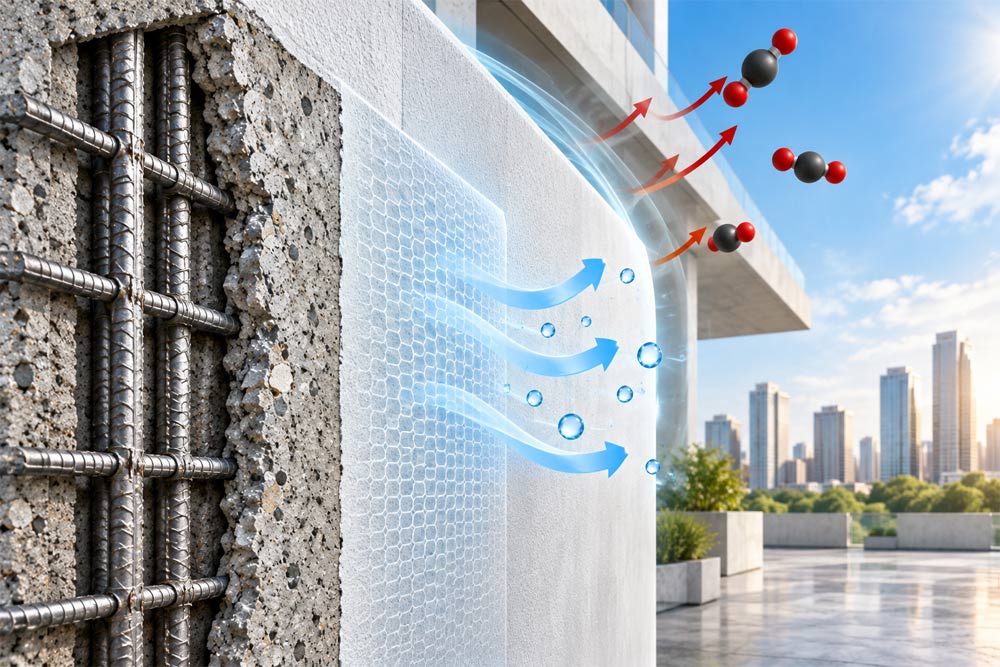
Reinforced concrete structures are exposed to carbon dioxide, moisture, oxygen, chlorides and other environmental conditions throughout their service life. Among these exposure mechanisms, carbonation is an important cause of reinforcement corrosion, particularly when concrete is exposed to atmospheric carbon dioxide for long periods.
Anti-carbonation coatings are applied to concrete surfaces to reduce the penetration of carbon dioxide and other aggressive agents. However, simply preventing the movement of carbon dioxide is not enough. A protective coating should also allow water vapour trapped within the concrete to escape. This is where breathable anti-carbonation coatings become important.
What Are Breathable Anti-Carbonation Coatings?
Breathable anti-carbonation coatings are protective surface coatings designed to reduce the ingress of carbon dioxide into concrete while permitting water vapour to pass through the coating.
Concrete contains pores and capillaries that can hold moisture. Moisture can enter concrete through rainfall, humidity, condensation or other exposure conditions. If a coating forms a completely impermeable barrier, moisture may become trapped beneath the coating. Depending on the condition of the structure, this can contribute to blistering, debonding, staining or other coating failures.
A breathable coating takes a different approach. It provides a barrier against carbon dioxide and liquid-water penetration while maintaining sufficient vapour permeability.
This combination is particularly useful for reinforced concrete structures that require long-term surface protection but also need moisture movement through the concrete.

Why Concrete Carbonation Is a Concern?
Carbonation occurs when atmospheric carbon dioxide penetrates concrete and reacts with alkaline components of the cement paste. The process gradually reduces the alkalinity of concrete.
Normally, the high alkalinity of concrete helps maintain a passive oxide layer around embedded reinforcing steel. When carbonation reaches the depth of the reinforcement and reduces the surrounding alkalinity sufficiently, the passive condition can be lost.
If moisture and oxygen are also available, corrosion of the reinforcement can begin.
Corrosion products occupy a greater volume than the original steel. This can generate internal pressure, leading to:
- Cracking of the concrete cover
- Delamination
- Spalling
- Rust staining
- Loss of reinforcement cross-section
- Reduction in durability
- Progressive deterioration of the concrete member
An anti-carbonation coating does not reverse carbonation that has already occurred. Its primary role is to reduce further carbon dioxide ingress into sound or suitably repaired concrete.
Why Breathability Matters
The ability of concrete to release water vapour is an important consideration when selecting a protective coating.
Concrete can contain moisture for several reasons, including:
- Rain and surface wetting
- High relative humidity
- Ground or capillary moisture
- Cleaning and maintenance activities
- Construction moisture
- Temperature variations and condensation
If a coating has very low vapour permeability, moisture may accumulate at the concrete-coating interface.
A breathable anti-carbonation coating allows water vapour to migrate outward while providing resistance to carbon dioxide penetration. This creates a balance between carbonation resistance and vapour diffusion.
The objective is not to make the concrete completely sealed. Instead, the coating should provide the required resistance to aggressive atmospheric gases while permitting moisture vapour to escape.
Advantages of Breathable Anti-Carbonation Coatings
When properly specified and applied, breathable anti-carbonation coatings can provide several benefits:
- Reduce carbon dioxide penetration
- Help delay carbonation progression
- Support reinforcement corrosion-control strategies
- Permit water-vapour transmission
- Protect concrete from atmospheric exposure
- Improve surface durability
- Provide weather protection
- Offer decorative finish options
- Extend the maintenance interval of concrete surfaces
Where Are Breathable Anti-Carbonation Coatings Used?
These coatings can be used in a range of reinforced concrete applications, including:
- Bridges and flyovers
- Parking structures
- Commercial buildings
- Residential buildings
- Industrial buildings
- Concrete façades
- Water-retaining structures where the specific coating is suitable
- Viaducts
- Metro structures
- Concrete columns and beams
- Concrete repair projects
- Infrastructure exposed to atmospheric conditions
How Breathable Anti-Carbonation Coatings Work
The performance of these coatings depends on their formulation and microstructure.
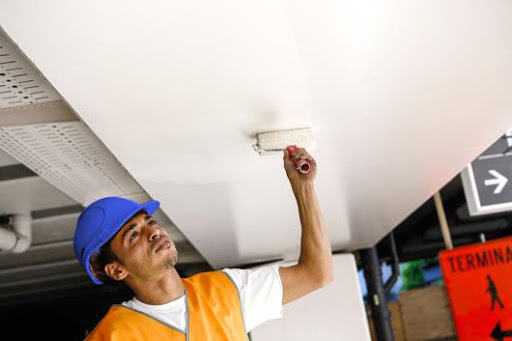
After application and curing, the coating forms a continuous protective layer over the concrete surface. The coating reduces the rate at which carbon dioxide can move through the surface toward the concrete matrix.
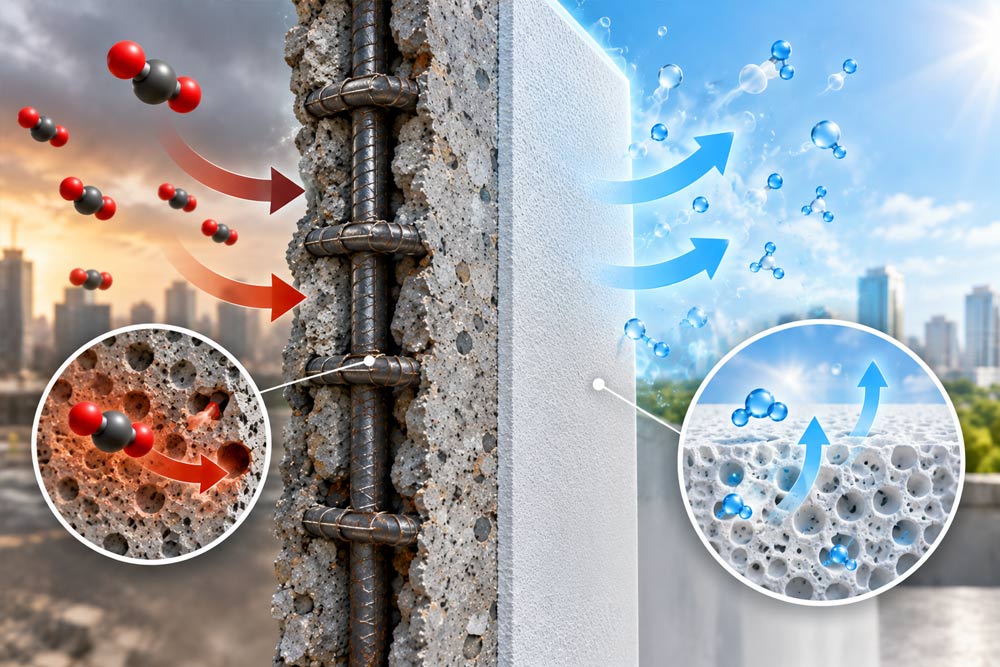
At the same time, its vapour-permeable structure allows water molecules in vapour form to migrate through the coating.
The performance therefore involves two different transport mechanisms:
Carbon dioxide: The coating provides high resistance to CO₂ diffusion.
Water vapour: The coating permits controlled vapour transmission.
Liquid water: Depending on the formulation, the coating can provide resistance to rainwater and surface wetting.
This distinction is important because water-vapour permeability does not mean that the coating allows liquid water to pass freely.
Common Types of Breathable Anti-Carbonation Coatings
Several coating technologies can provide varying combinations of carbonation resistance and breathability.
1. Acrylic-Based Coatings
Acrylic coatings are widely used for protecting concrete surfaces. They can be formulated as water-based or solvent-based products and can provide weather resistance, colour retention and resistance to carbon dioxide penetration.
Water-based acrylic systems are often selected where low odour and easier application are required.
Their flexibility can also make them suitable for exterior concrete surfaces subject to minor thermal movement.
2. Elastomeric Coatings
Elastomeric coatings are formulated to accommodate small movements and fine surface cracks.
Their flexibility can be useful on exterior concrete exposed to temperature changes. When properly formulated, they can combine crack-bridging capability with resistance to carbon dioxide penetration and water-vapour permeability.
However, not every elastomeric coating is automatically suitable as an anti-carbonation system. Its actual carbonation resistance and vapour permeability should be established from product test data.
3. Mineral or Cementitious Coatings
Cementitious protective coatings can be used on concrete and masonry surfaces. Some formulations are designed to remain vapour permeable while providing surface protection.
They may be particularly useful in repair and rehabilitation work where compatibility with cement-based substrates is important.
4. Silicate-Based Coatings
Silicate coatings can interact with mineral substrates and are known for their vapour permeability.
They may be considered where maintaining the appearance and moisture-transfer characteristics of mineral concrete surfaces is important. Their suitability for anti-carbonation protection depends on the specific formulation and tested CO₂ resistance.
5. Modified Polymer Coatings
Modified polymer or polymer-cement coatings can be formulated to combine adhesion, flexibility, carbonation resistance and vapour permeability.
These systems may be selected for concrete repair projects where the coating needs to work with repaired areas, micro-concrete, mortar patches or other rehabilitation materials.
Key Properties to Evaluate
Selecting a breathable anti-carbonation coating should not be based only on the product name or generic description. Several performance characteristics should be considered.
Carbon Dioxide Diffusion Resistance
The coating should provide sufficient resistance to carbon dioxide penetration. A coating’s measured CO₂ diffusion resistance or equivalent performance parameter is more useful than simply describing it as “anti-carbonation.”
Water-Vapour Permeability
Water-vapour permeability indicates how readily vapour can pass through the coating.
A breathable coating should provide the required level of vapour transmission for the substrate and exposure conditions.
Adhesion
Adequate adhesion to concrete is necessary for long-term performance. Poor surface preparation can result in peeling or delamination even when the coating itself has suitable laboratory properties.
Crack Bridging
For exterior structures, the ability to accommodate fine cracks can be important. Flexible coatings can help bridge certain cracks, although they should not be considered a replacement for structural crack repair.
Water Resistance
The coating should resist liquid-water penetration while allowing water vapour to escape.
Weather Resistance
Exterior concrete coatings are exposed to sunlight, rain, temperature changes and atmospheric pollutants. Resistance to ultraviolet exposure and weathering can therefore affect service life.
Alkali Resistance
The coating must remain compatible with the alkaline concrete substrate and maintain its properties during long-term exposure.
Application Procedure
The exact procedure depends on the coating system, but a typical application sequence includes the following stages.
Step 1: Inspection
Assess concrete condition, carbonation depth, cracks, spalling, moisture condition and previous coatings.
Step 2: Concrete Repair
Repair deteriorated concrete and address reinforcement corrosion where required.
Step 3: Surface Preparation
Remove contaminants and create a suitable surface profile for coating adhesion.
Step 4: Primer
Apply the specified primer if required by the coating system.
Step 5: First Coat
Apply the first coat at the specified thickness and coverage rate.
Step 6: Drying or Curing
Allow the coating to dry or cure for the specified period before applying the next coat.
Step 7: Second or Subsequent Coats
Apply additional coats to achieve the required dry-film thickness and carbonation resistance.
Step 8: Inspection
Check the finished coating for uniformity, pinholes, cracking, blistering, inadequate coverage and other defects.
Breathable vs Impermeable Coatings
The choice between a breathable and highly impermeable coating depends on the structure and exposure conditions.
| Property | Breathable Anti-Carbonation Coating | Highly Impermeable Coating |
| CO₂ resistance | High, depending on formulation | Generally high |
| Water-vapour transmission | Higher | Lower |
| Moisture release | Better | More restricted |
| Exterior concrete | Often suitable | Depends on substrate condition |
| Moisture-sensitive substrates | Can be advantageous | Requires careful assessment |
| Crack accommodation | Available in flexible formulations | Depends on coating |
| Application | Requires substrate assessment | Requires substrate assessment |
A coating should not be selected simply because it is “breathable.” The required balance between CO₂ resistance, vapour permeability, water resistance and mechanical performance should be established for the project.
Conclusion
Breathable anti-carbonation coatings provide a practical approach to protecting reinforced concrete where both carbon dioxide resistance and water-vapour permeability are required. Their value lies in creating resistance to atmospheric CO₂ while allowing moisture vapour within the concrete to escape.
For rehabilitation projects, the coating selection should be based on the condition of the concrete, carbonation depth, reinforcement condition, moisture exposure, crack characteristics, environmental conditions and expected service life. Most importantly, successful performance depends on the complete coating system—not just the topcoat. Concrete repair, surface preparation, primer selection, coating thickness, application conditions and quality control all influence the durability of the finished protection.






