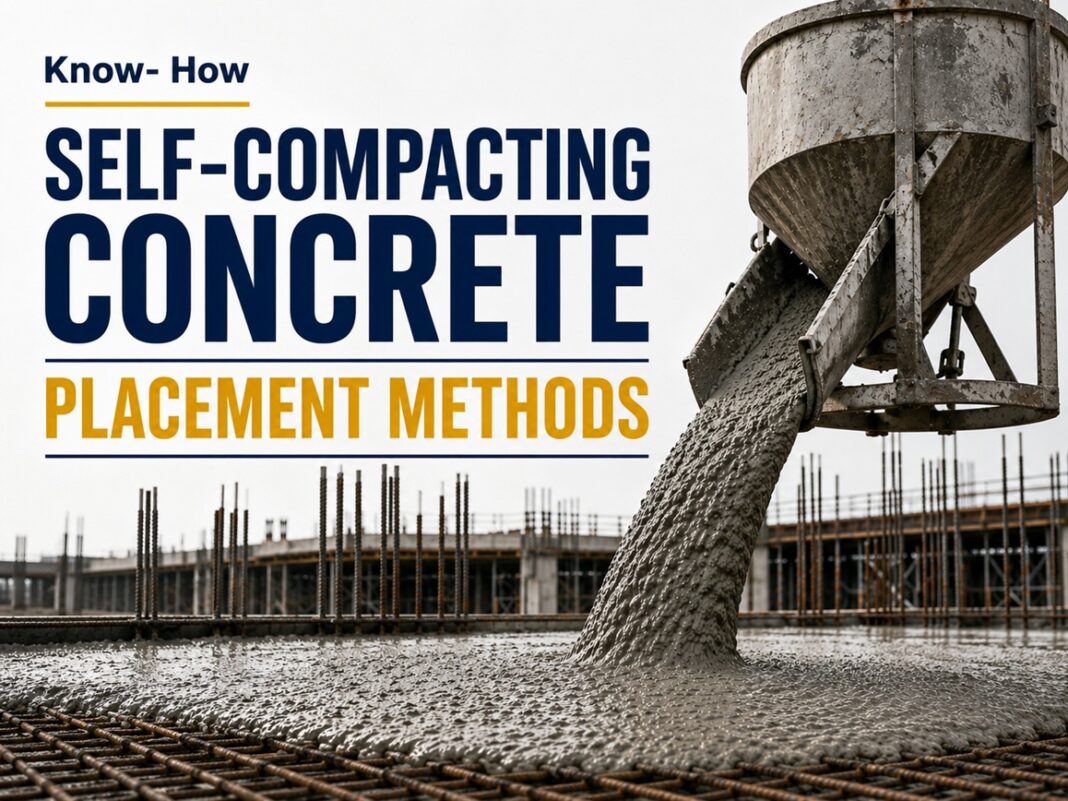
Self-Compacting Concrete (SCC) has transformed modern construction practices by offering superior flowability, excellent filling ability, and enhanced durability without the need for mechanical vibration. First developed to address concerns related to inadequate concrete compaction and labor shortages, SCC is now widely used in high-rise buildings, infrastructure projects, bridges, precast elements, industrial facilities, and complex reinforced concrete structures.
Unlike conventional concrete, Self-Compacting Concrete can flow under its own weight, pass through congested reinforcement, and completely fill formwork while maintaining homogeneity. However, achieving optimal performance requires proper placement methods, planning, and quality control procedures.
Understanding Self-Compacting Concrete
Self-Compacting Concrete is a highly flowable concrete mix designed to:
- Flow under its own weight
- Fill intricate formwork completely
- Pass through dense reinforcement
- Eliminate the need for mechanical vibration
- Maintain stability without segregation
Typical SCC contains:
- Cement
- Fine aggregates
- Coarse aggregates
- Mineral admixtures
- Chemical admixtures
- High-range water reducers (superplasticizers)
- Viscosity-modifying agents
The unique composition allows SCC to achieve excellent workability while maintaining structural performance.
Importance of Proper SCC Placement
Even though SCC eliminates vibration requirements, proper placement techniques remain critical. Incorrect placement can lead to:
- Segregation
- Surface defects
- Air entrapment
- Uneven flow
- Reduced durability
- Honeycombing in extreme cases
Effective placement methods ensure:
- Uniform concrete distribution
- Superior surface finish
- Enhanced structural integrity
- Reduced construction time
- Improved productivity
Applications of Self-Compacting Concrete (SCC)
- High-Rise Buildings – Used in columns, core walls, shear walls, and heavily reinforced structural elements where conventional concrete placement is difficult.
- Bridge Construction – Ideal for bridge decks, piers, girders, and abutments due to its ability to flow through congested reinforcement.
- Precast Concrete Elements – Widely used in the production of precast beams, columns, wall panels, staircases, and façade components.
- Deep Foundations – Suitable for bored piles, drilled shafts, and diaphragm walls where complete filling is essential.
- Industrial Structures – Applied in factories, warehouses, refineries, and power plants requiring durable and high-quality concrete.
- Water Retaining Structures – Used in water tanks, reservoirs, sewage treatment plants, and water treatment facilities due to its dense and impermeable nature.
- Marine Structures – Ideal for ports, jetties, harbors, and offshore structures exposed to aggressive environmental conditions.
- Tunnel and Underground Construction – Used in tunnel linings, underground stations, and retaining structures where access is limited.
- Structural Rehabilitation Projects – Effective for repair, strengthening, and retrofitting works where vibration may not be feasible.
- Architectural Concrete Structures – Preferred for buildings requiring smooth, defect-free exposed concrete finishes and complex formwork designs.
Major Self-Compacting Concrete Placement Methods
1. Direct Discharge Placement Method
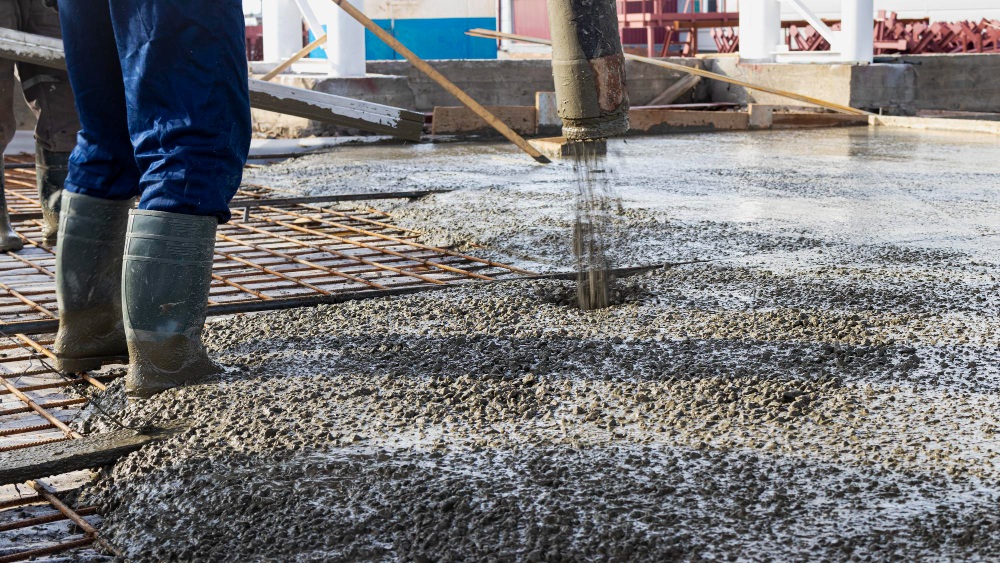
The Direct Discharge Placement Method is one of the simplest and most commonly used techniques for placing Self-Compacting Concrete (SCC). In this method, concrete is discharged directly from a transit mixer, bucket, or chute into the formwork. Due to its high flowability, SCC spreads naturally under its own weight without requiring mechanical vibration.
This method is ideal for slabs, footings, retaining walls, and residential construction projects where placement areas are easily accessible. Its simplicity reduces equipment requirements and labor costs while enabling faster construction progress.
To achieve the best results, discharge points should be positioned carefully to promote uniform flow and avoid segregation. Properly designed formwork is also essential to withstand the fluid pressure generated by SCC.
2. Pump Placement Method
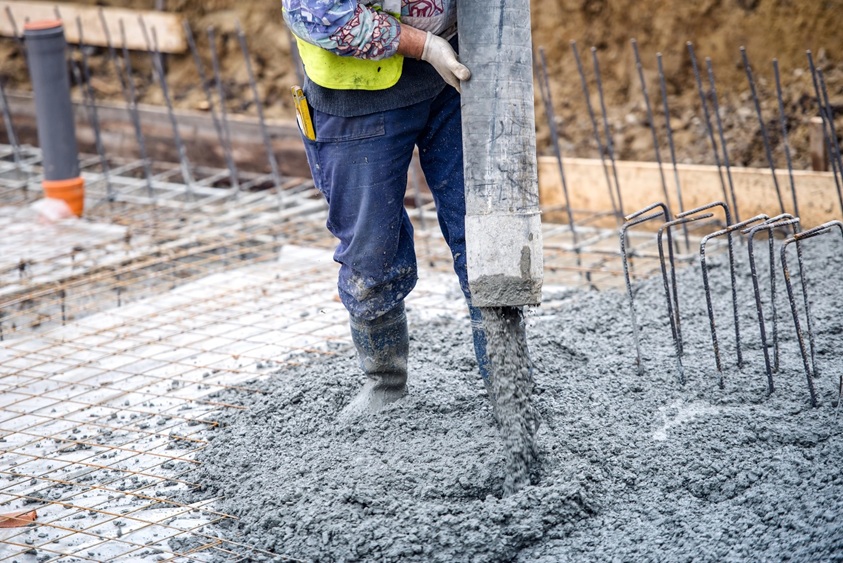
Pump placement is the preferred method for medium and large-scale construction projects. SCC is transported through pipelines using concrete pumps and delivered directly to the placement location. Once discharged, the concrete flows smoothly throughout the formwork without vibration.
This method is widely used in high-rise buildings, industrial facilities, bridges, and large foundations where direct access is limited. Pumping increases productivity, reduces manual handling, and allows concrete placement over long distances.
For successful placement, contractors should maintain continuous pumping, minimize pipeline bends, and monitor concrete consistency throughout the operation.
3. Bottom-Up Placement Method
The Bottom-Up Placement Method involves introducing SCC into the formwork through openings at the base of the structure. As the concrete rises, trapped air is pushed upward and escapes through vents, resulting in better filling performance and fewer surface defects.
This technique is particularly effective for heavily reinforced columns, thick walls, and specialized structures where complete concrete filling is critical. The method significantly reduces air entrapment and improves concrete quality.
Although it requires specialized formwork and planning, bottom-up placement is often chosen for projects demanding superior finishes and structural reliability.
4. Top-Down Placement Method
The Top-Down Placement Method is the most widely used SCC placement technique. Concrete is poured from the top of the formwork and allowed to flow downward and outward under gravity until the entire section is filled.
This method is commonly used for columns, beams, shear walls, and core walls in commercial and residential construction. Its familiarity makes it easy to implement using standard construction equipment and procedures.
To prevent segregation and ensure uniform filling, placement should be controlled and excessive drop heights should be avoided.
5. Tremie Placement Method
The Tremie Placement Method is used for underwater construction and deep foundation works. SCC is delivered through a tremie pipe that remains embedded in the fresh concrete during placement. This prevents segregation and minimizes contact between concrete and water.
The method is commonly applied in pile foundations, marine structures, bridge piers, and harbor projects. SCC’s excellent flowability makes it particularly suitable for tremie operations.
When properly executed, tremie placement produces dense, durable concrete with minimal washout and consistent quality.
6. Layered Placement Method
The Layered Placement Method is used for large structural elements such as raft foundations, thick slabs, and massive retaining walls. SCC is placed in controlled horizontal layers, allowing each lift to merge with the previous one before hardening.
This approach helps manage concrete volumes, reduce formwork pressure, and improve quality control during construction. It also ensures the formation of a monolithic structure without cold joints.
Careful timing between layers is essential to maintain proper bonding and achieve optimal structural performance.
Quality Control Tests for Self-Compacting Concrete (SCC)
Maintaining consistent quality during SCC placement is essential to ensure proper flowability, stability, and filling performance. Unlike conventional concrete, SCC relies heavily on its rheological properties, making field testing a critical part of quality assurance. Several standardized tests are used to verify whether the concrete meets the required performance criteria before and during placement.
Slump Flow Test
The Slump Flow Test is the most widely used quality control test for Self-Compacting Concrete. It evaluates the concrete’s ability to flow freely under its own weight without segregation or blockage. During the test, concrete is allowed to spread naturally after lifting a standard slump cone, and the resulting diameter is measured.
A typical SCC mix achieves a slump flow spread between 600 mm and 800 mm, depending on project requirements. This test provides a quick assessment of filling ability and overall workability, helping engineers determine whether the concrete can achieve effective self-compaction in the formwork.
T50 Flow Time Test
The T50 Flow Time Test complements the slump flow test by measuring the time required for the concrete spread to reach a diameter of 500 mm. This test evaluates the rate of flow and provides valuable insight into the viscosity of the SCC mix.
A shorter flow time generally indicates higher flowability, while longer times may suggest increased viscosity. The test helps ensure consistency between batches and confirms that the concrete possesses the desired balance between fluidity and stability for placement.
V-Funnel Test
The V-Funnel Test is used to assess the flow characteristics and viscosity of Self-Compacting Concrete. Concrete is allowed to flow through a V-shaped funnel, and the discharge time is recorded.
This test helps evaluate the concrete’s resistance to segregation while indicating its ability to flow through restricted sections. Consistent V-Funnel results demonstrate that the SCC mix can maintain uniformity during transportation, pumping, and placement, making it an important quality control tool for large-scale projects.
L-Box Test
The L-Box Test measures the passing ability of SCC through congested reinforcement. During the test, concrete flows through steel bars that simulate reinforcement conditions commonly encountered in structural elements.
The test determines whether the concrete can move freely through restricted spaces without blocking or segregating. Strong L-Box performance indicates that the SCC mix is capable of fully encapsulating reinforcement and filling complex formwork geometries, ensuring structural integrity and long-term durability
Conclusion
Self-Compacting Concrete has revolutionized modern concrete construction by delivering exceptional flowability, improved structural performance, and enhanced construction efficiency. While SCC eliminates the need for vibration, successful implementation still depends on proper placement methods, formwork preparation, reinforcement planning, and rigorous quality control procedures.
Whether utilizing direct discharge, pump placement, bottom-up placement, tremie methods, or layered construction techniques, project teams must understand the behavior of SCC and adopt best practices throughout the placement process. When executed correctly, Self-Compacting Concrete provides superior finishes, greater durability, faster project delivery, and long-term value, making it one of the most significant advancements in contemporary concrete technology.