Engineering and management systems increasingly involve complex interactions among multiple stakeholders, processes, and risk factors. Conventional rating methodologies based on linear averaging, isolated key performance indicators, or single-stakeholder judgment often fail to capture systemic weaknesses and collective responsibility. This paper presents the Hoysalas Rating Index (HRI), a generic, industry-neutral framework designed to evaluate system performance through structured multi-stakeholder participation and non-linear mathematical transformation. The methodology integrates stakeholder-weighted ratings within a two-dimensional Hoysalas Matrix and derives a single decision-oriented index using a cube root transformation. The paper establishes the theoretical foundation of HRI, details its construction and calculation, discusses interpretation and governance mechanisms, and demonstrates its universal applicability across engineering, construction, manufacturing, and service sectors. HRI provides a transparent, auditable, and risk-sensitive decision tool suitable for acceptance, benchmarking, and certification of complex systems. Keywords: Multi-Stakeholder Rating, Systems Engineering, Risk-Based Assessment, Management Tool, Performance Evaluation.
Introduction
Modern engineering and management environments are characterized by increasing system complexity, interdependency of activities, and participation of multiple stakeholders across the lifecycle. Projects and systems rarely fail due to a single technical deficiency; instead, failure typically emerges from misalignment among stakeholders, inadequate process integration, and unaddressed weak links. Traditional evaluation methods such as weighted averages, scorecards, and checklists often mask these weaknesses and provide fragmented insights. This creates a gap between detailed technical assessment and executive decision-making. The Hoysalas Rating Index (HRI) is proposed to bridge this gap by offering a holistic, risk-sensitive, and decision-oriented evaluation framework.
Literature
Review and Research Gap Existing performance evaluation methods in industrial engineering and management include multi-criteria decision-making techniques, balanced scorecards, and key performance indicator frameworks. While these methods offer structured evaluation, they largely rely on linear aggregation and single-perspective analysis. Research indicates that linear models underestimate systemic risk and fail to penalize critical deficiencies adequately. There exists a clear research gap for a rating system that combines multi-stakeholder participation, lifecycle coverage, and non-linear risk sensitivity within a single index. HRI directly addresses this gap.
Theoretical Foundation of HRI
HRI is grounded in systems theory, which emphasizes that system behavior arises from interactions among components rather than isolated performance. The framework also draws from industrial engineering principles of work study, performance rating, and risk analysis. The concept of weakest-link sensitivity is central to HRI, recognizing that excellence in one area cannot compensate for failure in another. These theoretical foundations justify the need for a non-linear aggregation mechanism.
Hoysalas Matrix
The Hoysala Matrix is an advanced multi-criteria evaluation model designed to assess complex systems, projects, or processes through structured stakeholder participation and weighted scoring. It provides a systematic approach to decision-making where multiple dimensions – technical, managerial, and qualitative – are integrated into a single normalized score.
In modern industries such as construction, manufacturing, and infrastructure, decision-making often involves conflicting priorities and diverse stakeholder expectations. Traditional evaluation methods fail to capture this complexity. The Hoysala Matrix addresses this gap by combining:
- Multi-criteria analysis
- Stakeholder theory
- Weighted scoring systems
- Quality management principles
Need for the Hoysala Matrix
Organizations face challenges such as:
- Subjective decision-making
- Lack of stakeholder alignment
- Inconsistent evaluation criteria
- Difficulty in benchmarking performance
The Hoysala Matrix addresses these by:
- Structuring evaluation criteria
- Assigning rational weightage
- Standardizing outcomes (out of 1000)
- Enabling objective comparisons
Core Principles
The Hoysalas Matrix framework is built on the following principles:
- Holistic Evaluation – Incorporates multiple dimensions of performance
- Stakeholder Inclusivity – Recognizes varied perspectives
- Weighted Importance – Assigns influence based on expertise and impact
- Quantitative Normalization – Converts qualitative judgments into measurable scores
- Scalability – Applicable across projects and industries
Structural Design and Mathematical Framework
Matrix Architecture
The Hoysala Matrix is a two-dimensional grid system:
- Columns Cells (Evaluation Dimensions)
Columns represent progressive elements, including:
- Project phases (planning, execution, closure)
- Independent tasks or deliverables
- Quality attributes (strength, durability, compliance)
- Milestones or KPIs
👉 These define WHAT is evaluated
➤ Row Cells (Stakeholders / Raters)
Rows represent evaluation agents, such as:
- Clients
- Engineers
- Project managers
- Quality auditors
- Vendors
👉 These define WHO evaluates
2.2 Weightage Allocation
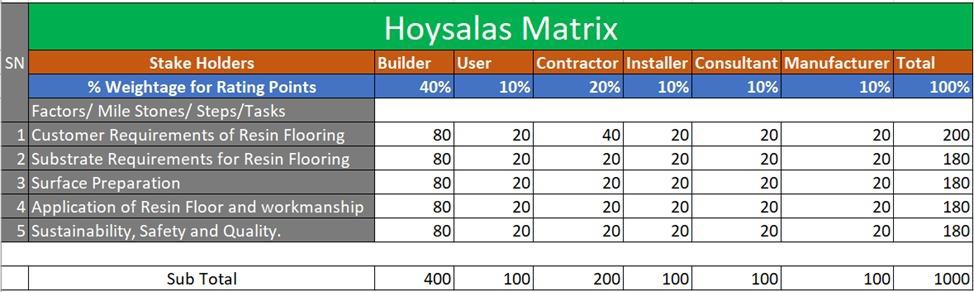
Each stakeholder is assigned a weight in % of 1000 points based on:
- Expertise
- Authority
- Influence on outcomes
Example:
For certification of Resin Flooring System
2.3 Scoring Mechanism
Each stakeholder assigns scores to each criterion based on the arrived individual cumulative variable rating points. Example Cleint -300 Points
Rating points reflect performance, compliance, or satisfactionEnables benchmarking across:
- Projects
- Products
- Time periods
Conceptual Framework The Hoysalas Matrix forms the structural backbone of HRI. It is a two-dimensional matrix mapping critical rating factors against identified stakeholders. The vertical axis represents lifecycle stages or performance factors, while the horizontal axis represents stakeholders with defined roles and responsibilities. This structure ensures completeness, accountability, and transparency in evaluation. Each cell of the matrix represents a conscious judgment rather than an implicit assumption.
Stakeholder Identification and Weightage Allocation
Stakeholders are identified based on influence, responsibility, and risk exposure within the system. Weightages are assigned to reflect real-world authority and accountability, with the total weightage normalized to 100 percent. Rating authority is capped for each stakeholder to prevent dominance and ensure collective evaluation. This controlled asymmetry is a key innovation of HCRI.
Rating Factors and the 1000-Point Scale
Rating factors are selected to cover the complete system lifecycle, including technical, managerial, safety, and sustainability aspects. The total rating score is normalized to 1000 points, representing maximum achievable system performance. This scale offers sufficient granularity for meaningful differentiation while remaining intuitive and auditable.
Mathematical Formulation of HRI
The Hoysalas Rating Index is calculated as the cube root/Sqaure root/fraction of 100 of the total rating score. The HRI transformation introduces non-linearity, amplifies the impact of weak performance, and compresses the rating into a standardized scale between 0 and 10. This mathematical formulation aligns closely with human perception of performance categories and risk thresholds.
The 1–10 scale is ideal because:
✔ 1. High Sensitivity
Allows stakeholders to distinguish subtle differences
Example: rating 6 vs 7 vs 8 reflects meaningful variation
✔ 2. Compatibility with Weightage System
Since total score = 1000, the 1–10 scale aligns naturally:
✔ 3. Familiarity and Ease of Use
Commonly used in:
- Performance appraisals
- Product ratings
- Quality scoring
👉 Reduces training effort and improves consistency
✔ 4. Balanced Complexity
Provides sufficient detail without overwhelming stakeholders
✔ 5. Statistical Robustness
Supports:
- Mean and variance analysis
- Benchmarking
- Trend tracking
There are three systems to arrive at Hoysalas Rating Index
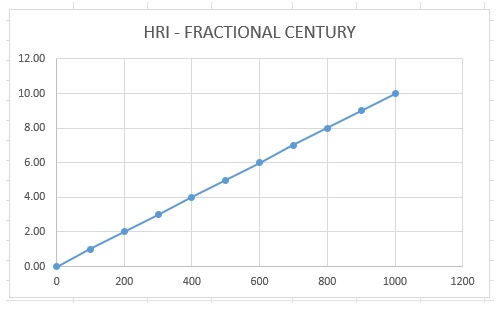
a) Hoysalas Rating Index – Fractional century ( HRI – FC)
Here the cumulative rating value of Hoysalas Matrix is divided by 100 and this system will ensure the Hoysalas Rating Index – FC will be in between 0 to 10. This is very easy to calculate and inteprete. Scale 0 to 10.
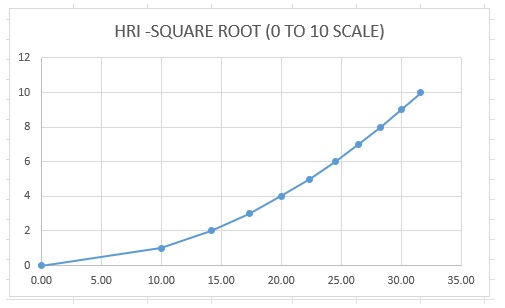
b) Hoysalas Rating Index – Square Root ( HRI -SR)
Here for the cummulative rating value of Hoysalas Matrix square root is taken. This is also assigned value between 0 to 10.
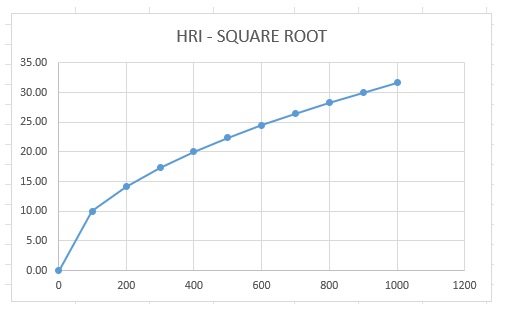
Further curve to bring in to simple scale of 0 to 10
c) Hoysalas Rating Index – Cube Root (HRI -CR)
Here we take the cube root for the cumulative rating value of Hoysalas Matrix and this system will ensure the Hoysalas Rating Index – CR will be in between 0 to 10. This is also very simple and when it is difficult to differentiate two systems and variation is very marginal, then this rating concept of HRI CR is very useful.
Example of forming Rating Scale – a case study for Resin Floor Rating using HRI
Resin Flooring Finish Certification Scale (1–10)
1–3: Unacceptable / Failure Zone
- Severe surface defects
- Poor adhesion (peeling, delamination)
- Uneven thickness, visible substrate
- Cracks, pinholes, contamination
- Does not meet basic specification
👉 Action: Complete rejection and rework required
3–5: Poor Quality
- Multiple visible defects
- Inconsistent finish and gloss
- Minor debonding or weak bonding areas
- Surface waviness beyond tolerance
👉 Action: Major repairs required before acceptance
5–7: Acceptable (Minimum Compliance)
- Meets basic specification requirements
- Minor surface defects (air bubbles, slight unevenness)
- Functional but not aesthetic
- Slight variation in gloss/color
👉 Action: Conditional acceptance (used in industrial back-end areas)
7–8: Good Quality
- Uniform finish with minimal defects
- Good adhesion and thickness consistency
- Acceptable gloss and appearance
- Meets both functional and moderate aesthetic requirements
👉 Action: Approved for most industrial and commercial applications
8-9: Very Good / Premium Quality
- Near-perfect finish
- Excellent leveling and smoothness
- High gloss uniformity (if specified)
- No visible defects under normal inspection
👉 Action: Preferred for high-end industrial and commercial spaces
9-10: Excellent / Benchmark Quality
- Flawless surface finish
- Perfect adhesion and thickness control
- Superior aesthetics (mirror-like or uniform matte as specified)
- Meets international standards (e.g., ASTM / ISO)
👉 Action: Certification benchmark / reference project quality
Rating Scale Classification for evaluation of Resin Flooring
1–3 Critical Failure
3–5 Substandard
5–7 Basic Compliance
7–8 Qualified Finish
8-9 Premium Finish
10 Signature / Benchmark Finish
Interpretation Framework and Decision Support
HRI values are interpreted using predefined classification bands ranging from unacceptable to outstanding. These bands translate numerical outcomes into actionable management decisions, such as acceptance, improvement, benchmarking, or rejection. The framework supports transparent communication of system performance to both technical and non-technical stakeholders.
Governance, Auditability, and Certification
Effective implementation of HRI requires robust governance mechanisms, including documentation of stakeholder roles, rating factors, completed matrices, and calculation records. The framework supports third-party audits and certification by professional bodies or industry associations. Certification enhances credibility, comparability, and market value of rated systems.
Discussion and Practical Implications
HRI offers significant advantages over conventional rating systems, including enhanced risk sensitivity, stakeholder equity, and decision clarity. Its generic structure allows adaptation across industries without altering core principles. Practical implementation encourages stakeholder engagement, early risk identification, and continuous improvement.
Limitations and Future Research
While HRI provides a robust evaluation framework, its accuracy depends on honest stakeholder participation and well-defined rating factors. Future research may focus on empirical validation, integration with digital platforms, and alignment with international standards such as ISO and PMBOK.
Conclusion
The Hoysala Rating Index represents a significant advancement in performance evaluation and management decision support. By integrating structured multi-stakeholder judgment with non-linear mathematical transformation, HRI delivers a single, defensible index reflecting true system integrity. The framework is suitable for universal adoption across engineering and management domains.
References:
1. Work Study by ILO
Authored by: Er. Kishore Hoysal S – GM – M/s MCON Rasayan India Limited, India & Dr P S Sampth Professor, Dept of Mechanical Engineering, K.S. Rangasamy College of Technology, Nāmakkal, India