Walk under a twenty-year-old flyover during the monsoon and you can read its maintenance history off the soffit. Calcium streaks below the joints. Rust bleeding through hairline cracks. A patch of spalled cover near a drainage spout with a stirrup showing through. None of that damage began underneath. It began on top, where water stood on the deck a few hours longer than it should have, found a path down, and got to work.
The layer that was supposed to stop it is usually two to three millimetres thick. It is also, on most projects, the cheapest line item on the deck and the first one squeezed when the tender comes in tight. That trade-off is a large part of why bridges built during the boom years of the 2000s are now queuing for rehabilitation with seventy years still left on their design life.
The Deck Slab Takes the Worst of Everything
A bridge is designed as a system, but durability exposure is not shared evenly across it. Piers and abutments sit in comparatively stable conditions. The deck slab gets standing rainwater, fuel and oil drip, chloride-laden air on coastal alignments, de-icing salt on hill routes in Himachal, Uttarakhand and Jammu, surface temperatures that push past 60 degrees under a black wearing course in May, and constant flexure under live load.
A common assumption on site is that the bituminous wearing course is doing the waterproofing. It is not. Dense bituminous macadam is permeable enough to hold water at the interface, and any reflective crack in the surfacing becomes a funnel that delivers water onto the concrete and then traps it there. Water that gets under a sealed surfacing has nowhere to drain. It moves sideways, finds the lowest crack, and sits.
What Happens in the Concrete After Ingress
Sound concrete keeps embedded steel passive through high alkalinity, somewhere near pH 13. Chlorides dismantle that protection. Once concentration at the level of the reinforcement crosses roughly 0.4 per cent by weight of cement, the passive film breaks down locally and corrosion initiates. The corrosion products occupy several times the volume of the parent steel, and that expansion generates tensile stress the cover was never designed to carry. The concrete delaminates first, then spalls.
The timeline is unkind. Initiation is silent and can run for years without a single visible sign. Propagation is quick. By the time the first rust stain appears on the soffit, there is already section loss in the bar and a delaminated plane above it. Chain drag or hammer sounding on a deck in that condition almost always returns hollow over a far larger area than the visible damage suggests.
The Law of Fives Has Not Been Repealed
De Sitter’s rule of fives, set out in the 1980s and still quoted in durability literature, describes the economics better than most spreadsheets manage. One unit spent on durability during design and construction does the work of five units spent after corrosion has initiated but before cracking, twenty-five once cracking and spalling appear, and one hundred and twenty-five once the structure needs major rehabilitation.
Apply that to a deck. Membrane and preparation are a small fraction of deck cost. Rehabilitation means traffic management, night possessions, milling, patch repair, sometimes cathodic protection, plus the user hours lost to lane closures on a corridor that was built to carry them. The comparison is not close, and it never has been.
Four Systems, Four Different Ways to Get It Wrong
Most deck specifications in India land on one of four families. Each of them works. Each of them fails in a characteristic way, and knowing the failure mode is more useful than knowing the sales pitch.
Torch-applied bituminous sheet membranes
The traditional answer, still specified widely because it is familiar, cheap and survives asphalt laydown temperatures. Sheets bond acceptably to a primed deck and the material quality is consistent because it was made in a factory. The weakness is the lap. Every seam is a hand-made joint, and a deck with kerbs, spouts, drainage channels and skew geometry has a great many of them. Blistering from trapped substrate moisture is the other recurring problem, and once a blister forms beneath the surfacing nobody knows it is there until the soffit tells them.
Liquid-applied polyurethane
Seamless, forgiving around awkward detail, and genuinely good elongation. The constraint is cure. Moisture-triggered chemistry means overnight or longer before surfacing can follow, and on a live structure with an eight-hour possession that usually ends the conversation before it starts. Polyurethane is also less tolerant of green concrete and residual substrate moisture than the data sheet sometimes implies.
Polymer-modified cementitious coatings
Strong adhesion, breathable, cheap to apply by brush or spray, and perfectly good material. The problem is movement. Crack-bridging capacity is limited, and a deck slab flexes under every axle that crosses it. These systems earn their place on abutments, wing walls, retaining faces and buried surfaces. On a trafficked deck they are being asked to do something they were not formulated for.
Spray-applied pure polyurea
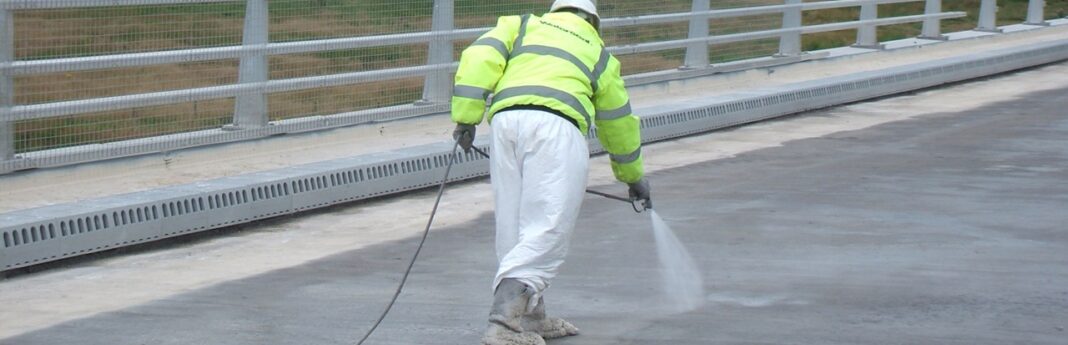
Polyurea sits apart mainly on the clock. Gel time is measured in seconds and the film is walkable inside a minute, so a deck can be blasted, primed, sprayed and handed back within a single night possession. It goes down seamless at 1.5 to 3 mm in one pass, wraps kerb upstands and drainage spouts without a single lap, and holds elongation in the 300 to 400 per cent range with enough tensile strength to survive paving plant tracking across it. Cure is largely indifferent to ambient humidity, which matters on a river crossing in August. Manufacturers such as ArmorThane produce polyurea systems developed specifically for bridge deck waterproofing.
The catch is that polyurea punishes poor preparation and needs trained applicators running heated, high-pressure plural-component equipment. There is no brush-and-hope version. A cheap crew on a good material will cost more than the material ever saved.
How to Read a Data Sheet Without Being Sold To
Elongation at break is the figure everyone quotes and the least useful one in isolation. A dumbbell specimen stretched at 23 degrees in a laboratory tells you very little about a membrane spanning a live crack at 8 degrees on a January morning in Punjab, or at 55 degrees under surfacing in Nagpur. Ask instead for crack-bridging performance measured on a concrete substrate across the temperature range the bridge will actually see.
After that, adhesion. Pull-off strength should exceed 1.5 MPa or fail cohesively in the concrete, whichever comes first, and the test report should name the primer used. Water vapour transmission matters where the deck can draw moisture from below. Resistance to diesel, hydraulic oil and dilute acid is worth confirming on industrial and port corridors. Finally, ask two questions the brochure rarely answers: how is the membrane protected during asphalt laydown, and what is the maximum mix temperature it will tolerate?
Preparation Is Where the Job Is Won or Lost
Most membrane failures, traced back honestly, are preparation failures. Laitance left in place. Curing compound never removed. A deck that felt dry to the back of a hand and read seven per cent on a meter.
The working standard is abrasive blasting to an open, sound profile, broadly CSP 3 to 5 on the ICRI scale, with laitance, curing compound, oil and old sealer taken off completely. Substrate tensile strength should be at least 1.5 MPa by pull-off. Moisture content should be under four per cent, or confirmed by relative humidity probe where the slab is thick. Blowholes and honeycombing need filling with a compatible mortar before priming, because a membrane will happily bridge a void and then fail into it under the first loaded axle. And the substrate has to stay at least three degrees above dew point right through application, which during a monsoon night shift is an engineering constraint, not a paperwork line.
The Details Nobody Photographs
Deck waterproofing almost never fails in the middle of the deck. It fails at the edges. Upstands at kerbs and crash barriers should run a minimum of 150 mm and terminate into a chase or under a cover flashing rather than feather out into nothing. Drainage spouts need the membrane dressed down into the outlet, not stopped politely short of it. Expansion joints need a designed transition drawn on paper. Construction joints in the slab should be treated as moving joints and reinforced with tape or a fillet. Re-entrant corners want a cove.
These are the areas that get rushed at three in the morning on the last night of a possession, by the tired half of the crew, under a work light. They are also, without exception, the first places water will look.
Test It Before You Bury It
Once the surfacing goes down, the membrane is unreachable for decades. Holiday testing with a spark or wet-sponge unit finds pinholes across the whole area in a fraction of the time it takes to argue about them later. Wet-film and dry-film readings belong on a grid, logged, not sampled wherever the finish looks best. Pull-off tests at an agreed frequency give you an adhesion record with a date on it. Where the geometry allows a short flood test, it remains the most honest check available.
And photograph every detail before the protection board goes on. In fifteen years that photo set will be the only evidence anyone has that the work was done properly.
Retrofitting an Existing Deck Is a Different Problem
On an old deck you inherit whatever the last thirty years did to it, and you cannot waterproof your way out of that with a survey you have not done. Cover meter, half-cell potential mapping, chloride profiling at depth, carbonation testing and delamination sounding all come first. Sealing a membrane over concrete that is already chloride-contaminated does not stop corrosion. In some cases it makes matters worse by redistributing moisture and oxygen unevenly and setting up macrocell activity.
Repair to sound concrete, deal with the contaminated cover, then waterproof. This is precisely where fast-cure systems justify their premium, because the whole sequence has to be squeezed into traffic possessions on a road nobody wants closed.
A Short Specification Checklist
If you write nothing else into the deck section of the specification, write these.
- Seamless membrane, minimum 2 mm dry film thickness, applied in one continuous operation wherever geometry allows
- Crack-bridging verified on a concrete substrate across the site temperature range, not elongation at break alone
- Pull-off adhesion of at least 1.5 MPa, or cohesive failure in the concrete
- Surface preparation to CSP 3 to 5, with moisture, substrate temperature and dew point readings recorded per pour
- Detail drawings for kerb upstands, drainage spouts, expansion joints and construction joints, drawn rather than described
- Holiday testing over 100 per cent of the area and gridded thickness records signed off before surfacing
- Applicator certified by the material manufacturer, with a named supervisor on site for every shift
- Written compatibility statement covering membrane, primer, protection layer, tack coat and wearing course
The Argument Worth Making to the Client
Waterproofing is a hard sell at tender stage because it is invisible on the day the ribbon is cut. Nobody stands on a new deck admiring the membrane. The counter-argument is not really technical, it is arithmetic. Two to three millimetres of membrane over a deck slab costs a fraction of one per cent of the structure. Deck rehabilitation fifteen years later costs multiples of that in direct works alone, before anyone counts lane closures, detour fuel, delayed freight and the reputational cost of a bridge that looks tired long before it is old.
The concrete will comfortably last a hundred years if water never reaches the steel. That whole proposition rests on a layer thinner than a coin, laid by a crew working nights, on a surface that was prepared properly or was not. Specify it like it matters, because it does.