
You are requesting a quote for a walking system, not just a panel
A request for a walkway or platform deck can look straightforward: replace worn panels, extend an access route, or price a new work area. Yet a supplier cannot make a useful comparison from a material name or the thickness of an existing panel alone. The panel works with its supports, the way it is fixed, any openings or cut edges, and the space or process below it. Those details affect what the quotation describes and which questions still need an engineering answer.
Before sending a request for quotation (RFQ), collect what is known about the route and mark what is not. A sketch and concise use description help suppliers state the basis of their proposal. The RFQ does not design the walkway; it gives reviewers context to identify unresolved questions.
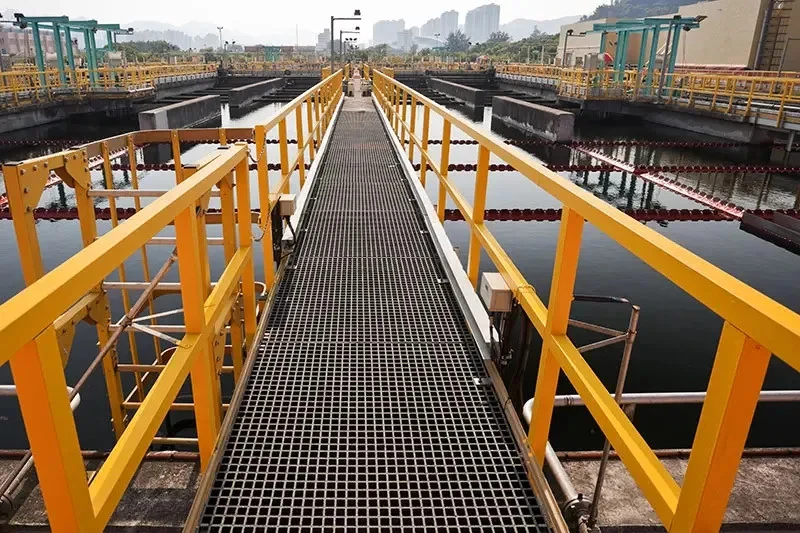
An access walkway above treatment basins. Photo: Dengtai Industry.
A practical checklist before you send the RFQ
Start with the intended use. Say whether the area is for pedestrians, whether people will move tools or equipment across it, and whether wheels are expected. If carts, trolleys, or vehicles may use the route, state that separately rather than treating it as ordinary foot traffic. Where wheel loading is relevant and known, provide the wheel diameter and width and the maximum load per wheel; if these details are not available, say so. Describe what lies below, especially anything affected by water or dropped objects.
Describe the environment and cleaning routine as specifically as you can. Note whether the installation is indoors or outdoors, what liquids or chemicals may contact it, how cleaning is performed, and whether sunlight or temperature exposure is relevant. Identify known exposures and flag uncertain ones. This helps the supplier discuss materials, resin options, and surfaces without implying a universal choice.
Provide the support arrangement and dimensions. A sketch or plan should show where the walkway or platform is supported, its overall layout, openings, and the dimensions that are available. Identify the clear span—the unsupported distance between supports—and distinguish it from the panel’s purchase length. Mark any load-bearing direction. Label width and span clearly. An old panel’s thickness, by itself, does not describe the support spacing or the conditions it must meet.
Next, decide what the walking surface needs to do. An open mesh allows water to pass through and can also allow small objects through. A covered top or closed panel changes that relationship and may affect drainage below. A covered surface should not be assumed to make a waterproof floor. State the surface need and ask how the proposal addresses it.
Mark every opening, notch, cut edge, and transition that the layout requires. These features can affect panel continuity and support, so show them and ask how the proposal accounts for them. Note handling constraints. Describe the fixing arrangement if it is already specified, or ask the supplier to identify the proposed fixing hardware. Fixings hold panels in position; they do not replace the supporting structure.
Finally, separate confirmed information from assumptions. Use “unknown” where a dimension, exposure, traffic type, or project requirement has not been established. Do not fill gaps with guessed loads or copied values simply to make the RFQ appear complete. Refer design questions to a qualified project reviewer.
Copyable RFQ input template
Complete known fields; mark unknowns rather than estimating.
- Intended use: ____________________
- Traffic (pedestrian, tools/equipment, and/or wheels): ____________________
- If wheels may be present — wheel diameter: ______; wheel width: ______; maximum load per wheel: ______; or unknown: ______
- What lies below: ____________________
- Environment and cleaning — indoors/outdoors: ______; liquids or chemicals: ______; cleaning method: ______; sunlight or temperature if relevant: ______
- Support sketch/plan: ______; clear span (unsupported distance between supports): ______; panel purchase length: ______
- Load-bearing direction, if applicable: ____________________
- Walking-surface need: ____________________
- Openings, notches, cut edges, transitions: ____________________
- Fixings (already specified or to be proposed): ____________________
- Handling constraints: ____________________
- Unknown items: ____________________
- Documents requested (product data and test documents for the stated application, span, exposure, and proposed configuration): ____________________
- If the project already names a standard, name: ____________________
Why “same thickness as the old steel (or old panel)” is not a complete specification
Thickness and material are only part of a panel’s description. A replacement with the same thickness may have a different construction, load-bearing direction, support arrangement, or surface. Similarly, a material label such as steel, aluminium, coated metal, or FRP/GRP does not state how the proposed panel is intended to work in the actual layout. The name FRP, GRP, or fiberglass identifies a broad material category; it does not automatically specify the resin, construction, or rating.
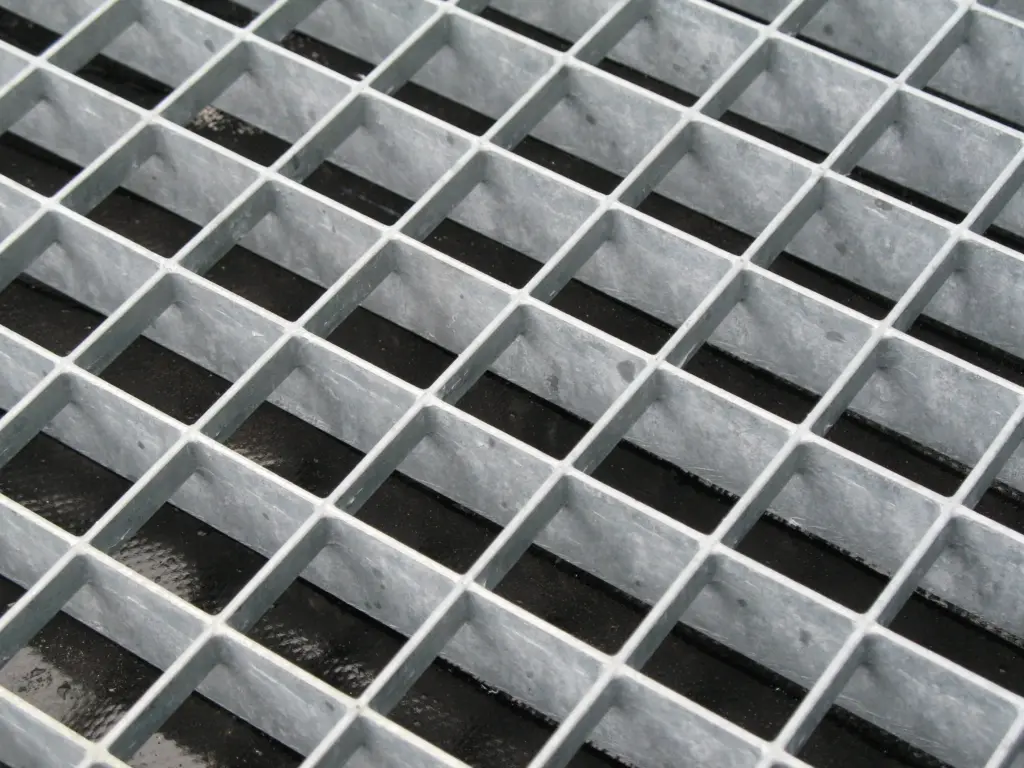
Galvanized steel bar grating, with bearing bars and cross bars visible. Photo: Belt777 (CC BY-SA 3.0). Source: Wikimedia Commons, Press grating.jpg (https://commons.wikimedia.org/wiki/File:Press_grating.jpg). License: CC BY-SA 3.0 (https://creativecommons.org/licenses/by-sa/3.0/).
The distinction between panel length and clear span matters when quotations are compared. McNICHOLS explains in Bar Grating Load Tables Explained that clear span is the unsupported distance between supports and distinguishes uniform loading from a concentrated load. The article also cautions that a load table assumes proper installation and support and is general guidance, not a substitute for project engineering analysis. That is a useful way to read a steel-grating table, not a universal rule or a rating for another product type. Strongwell’s Section 21 Project Worksheets / Grating Worksheet likewise distinguishes width from length or span and asks buyers to clarify custom dimensions. These points show why thickness cannot replace information about supports, use, and loading.
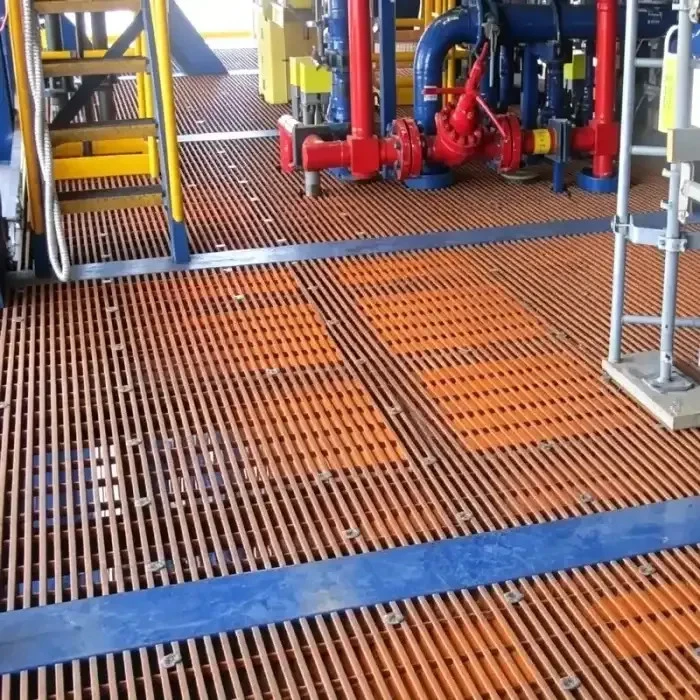
Grating panels around process equipment, with supporting members visible. Photo: Dengtai Industry.
When reviewing bids, check that each supplier has priced the same described layout and use. If an assumption differs, ask for it to be stated. A price comparison is meaningful only when the proposals refer to comparable conditions and identify any unresolved items.
| What item to compare | What the supplier should state | What to ask if it is missing |
|---|---|---|
| Layout and supports | Described layout and support arrangement | Which layout and supports does the quote assume? |
| Clear span and panel length | Unsupported distance between supports and purchase length, separately | Which dimension is clear span, and which is panel length? |
| Use and load type | Pedestrian use, tools/equipment, wheels or concentrated loading | What use and load type does this proposal cover? |
| Construction and walking surface | Construction and open, covered, or other stated surface | What construction and surface are included? |
| Environment or exposure | Indoor/outdoor and stated exposure assumptions | Which exposure and cleaning conditions were assumed? |
| Openings and cut edges | Treatment of shown openings, notches, cut edges, and transitions | Are the shown features included in this configuration? |
| Fixings and accessories | Whether included and what fixing hardware is proposed | Are these included, and what hardware is assumed? |
| Supporting documents | Documents for the stated application, span, exposure, and configuration | Which documents apply to this quoted configuration? |
| Quote exclusions | Items or work not included | What is excluded or expected from others? |
This is a comparison checklist, not a quotation. Ask: does the stated panel purchase length describe the clear span, or are they separate dimensions? Does the same material name or thickness also mean the same construction, surface, and support conditions? If a category name such as FRP/GRP/fiberglass is used, what specification does it describe? Are fixings or accessories included, what hardware is proposed, and what does the quote exclude? Ask each supplier to state its own scope; do not assume a uniform delivery term.
Compare like-for-like product types
A fiberglass-grating quotation should identify panel construction as well as walking surface. Molded and pultruded grating are different structural forms; open mesh and a covered top are different surface choices. Keep those decisions separate in the RFQ so a lower price does not conceal that two bids describe different products. If more explanation of what fiberglass grating is and its types and limits is useful, refer to that page. If the quotation does not make the distinction clear, ask the supplier to state the construction and surface type in plain terms.
Use the same discipline for every material being considered. Request the product description and supporting information for the specific configuration in the quote, then compare what each proposal says about supports, span, surface, openings, and fixings. No material name or surface description alone resolves whether the proposed assembly suits the project conditions.
Where this checklist stops, and what documents to ask for
This checklist helps prepare a purchasing request; it is not a design method. Loads, fire performance, electrical insulation, slip resistance, and allowable deflection must be assessed against project conditions and the applicable documentation by qualified people. Do not infer these properties from a general description, a material name, or an unrelated test result.
Ask each supplier for product data and test documents that correspond to the stated application, span, exposure, and proposed configuration. Ask suppliers to identify the product covered and explain applicable limits or assumptions. If the project already names a standard, include its name in the RFQ and request the corresponding documentation. Do not assume that a general certificate answers every project-specific question.
A complete RFQ will not settle every engineering issue. It should make the intended use and known site conditions visible, show the support and panel layout, identify surface and fixing needs, and call out missing information. That gives the project team a clear basis for review and makes it easier to see which questions must be resolved before a quotation can be accepted.






