
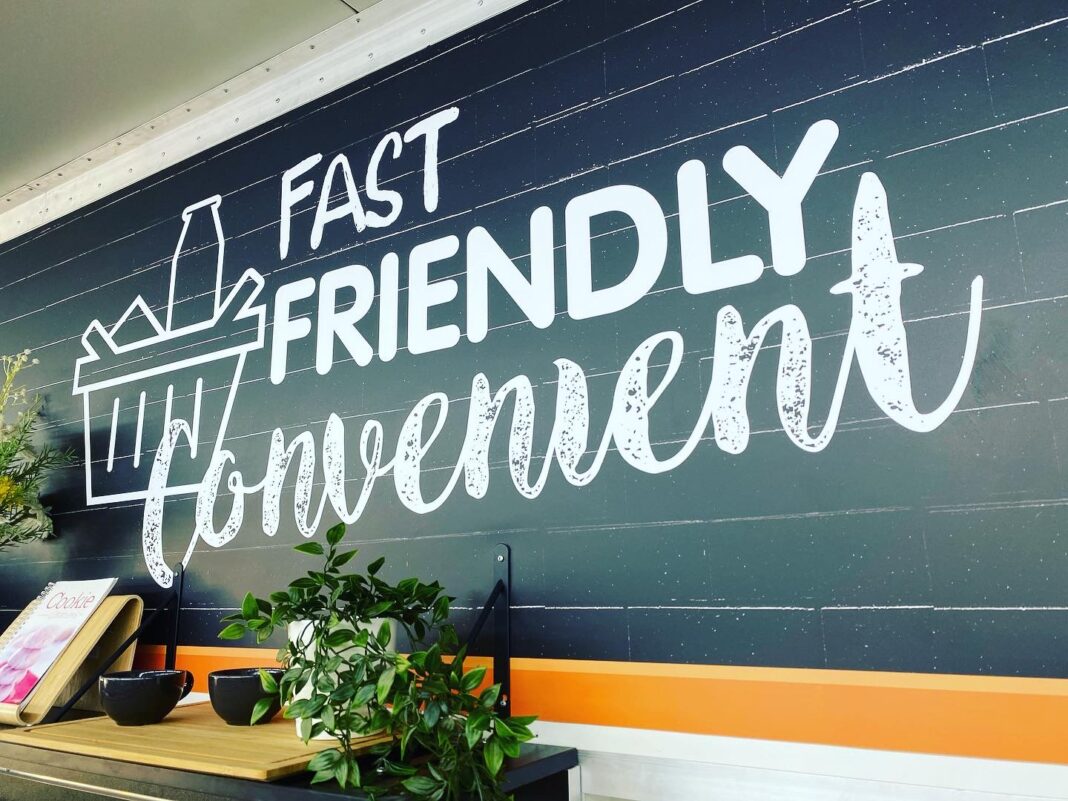
Before anyone reads your website or reviews, they see your shopfront. A clear, well-made sign tells people who you are, what you do and whether you’re worth stopping for, all in a couple of seconds.
A poor one, on the other hand, can make a great business look forgettable. Here’s how to get yours right.
What your sign needs to do
A good shopfront sign has three jobs:
- Be seen. It needs to stand out from the street, from a car or from across a shopping centre.
- Be understood. People should know what you do within a glance.
- Feel like you. It should reflect your brand and the kind of customer you want to attract.
If your sign does all three, it’s working as a 24-hour marketing tool.
Choosing the right type of sign
Different signs suit different premises and budgets. Common options include:
- Fascia signs, mounted above the entrance or across the front of the building
- High-level signs, which are larger and positioned to be seen from further away
- Projecting and hanging signs, visible to foot traffic walking along the street
- Window graphics, for opening hours, offers and branding on glass
- Indoor signage, such as reception signs, menu boards and wall graphics
- Directional and wayfinder signs, to help customers find parking, entrances and different areas
- Corflute and promotional signs, for short-term offers and events
- LED and illuminated signs, for visibility after dark
Many businesses use a combination of these. A strong main sign, supported by smaller ones, creates a consistent and professional look.
Design basics that make signs work
- Keep it simple. Your business name, logo and a short descriptor are usually enough.
- Use high contrast. Light on dark or dark on light remains legible in glare, rain and low light.
- Choose bold, clear fonts. Thin or ornate lettering often disappears from a distance.
- Size for the viewing distance, not the proof on your screen. Letters that look large on paper can be tiny from the street.
- Use your brand colours so the sign is consistent with your website, uniforms and vehicles.
- Leave breathing space. A crowded sign is hard to read and looks cheap.
Should your sign be illuminated?
If you trade in the evening, or want to be visible after dark, illumination makes a real difference. LED lighting is popular because it’s bright, efficient and long-lasting. Even for daytime businesses, lighting can improve visibility on overcast days, in covered arcades or in shaded areas.
Think about the whole customer journey
Signage isn’t just one board on the wall. Think about how customers find and move through your business:
- Can they spot you from the road?
- Is it clear where to park and where to enter?
- Do your opening hours and key messages appear on the door or window?
- Are indoor signs consistent with the outside?
Clear directional and wayfinder signage can also reduce frustration and make a business feel more professional.
Don’t forget your vehicles
If you drive a work van, ute or truck, it’s a moving billboard. Vehicle wraps and graphics extend your brand beyond your premises and can reach thousands of people every day. Consistent design across your shopfront and vehicles builds recognition quickly.
Get approvals and installation right
Some signs, especially large, high-level or illuminated ones, may need approval from your local council or landlord. Check requirements early, since approvals can affect timelines. Installation also matters: signs need to be secured safely and correctly, particularly at height and in coastal conditions.
Choosing a signage company
Look for a company that can look after the job from start to finish. Questions worth asking include:
- Do you handle design, fabrication and installation in-house?
- Will I see a design proof before anything is made?
- Do you offer free quotes?
- What materials and finishes do you recommend for my location?
- Can you help with a range of signs, so my branding stays consistent?
Using one team for the whole process means fewer handovers, fewer mistakes and a more cohesive result.
A local signage team
If you’re looking for Link Signs Sunshine Coast, the business is based in Bells Creek and works with clients across the Sunshine Coast, Brisbane and the Gold Coast. One in-house team handles consultation, design, fabrication and installation, covering business and shopfront signage, fascia and high-level signs, pylon signs, indoor and outdoor signage, LED and illuminated signs, wayfinder and directional signs, and commercial vehicle wraps. They offer free, no-obligation quotes.
A quick checklist before you order
- Decide where customers will see your sign from
- Choose a sign type that suits your premises
- Keep text short, bold and high contrast
- Consider lighting for after-dark visibility
- Check council and landlord requirements
- Ask for a design proof before production
- Get a quote that includes installation
Final thoughts
Good signage is one of the most cost-effective forms of advertising, because it works every hour of every day. Keep it clear, make sure it reflects your brand and have it installed properly, and your shopfront will start working harder for you






