Most homeowners want to believe a little patching will do the trick. And sometimes, it does. But concrete driveways have a lifespan, and when they start sending distress signals, ignoring them can cost you far more in the long run than a full replacement ever would.
Experienced concrete contractors have seen it all, from driveways with a few manageable cracks to surfaces that have completely given up the fight. The tricky part? Knowing which category yours falls into. Repairs are a smart short-term fix, but there comes a point where you’re pouring money into a surface that can’t hold it.
Here are seven clear signs that your concrete driveway has crossed that line.
1. Cracks Are Spreading Faster Than You Can Patch Them
A single crack isn’t a crisis. But when new cracks keep appearing—weeks after your last repair—it’s a sign the underlying structure is compromised. Surface-level patching doesn’t address what’s happening beneath, and the cycle of repair becomes endless.
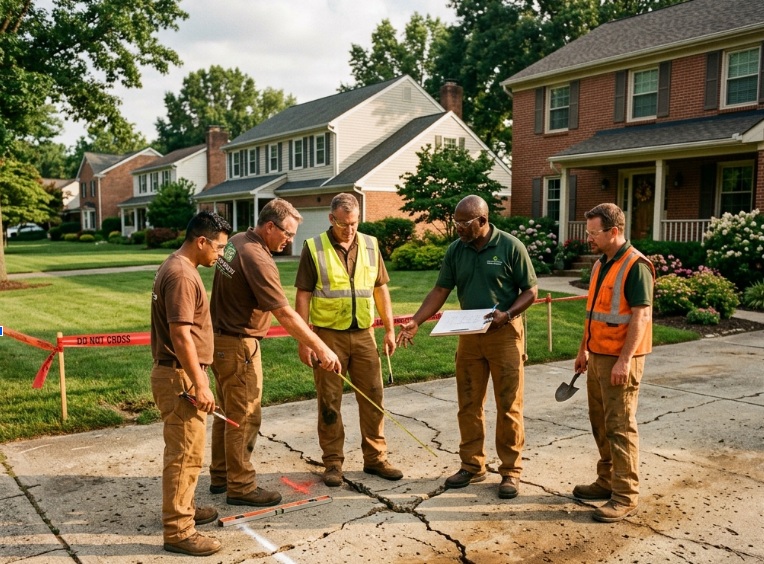
Wide cracks (anything over a quarter inch), branching patterns, or cracks that run the full length of the driveway are particularly telling. These aren’t cosmetic issues. They’re structural ones.
2. You’re Noticing Large Sunken or Raised Sections
Uneven concrete is more than an eyesore—it’s a safety hazard. Settled or heaved sections happen when the soil beneath your driveway shifts, erodes, or loses its ability to support the slab.
While mudjacking can sometimes lift a sunken section temporarily, the fix rarely lasts when the root cause is ongoing soil instability. If multiple sections of your driveway are uneven, replacement gives you the chance to address the base properly and start fresh with a stable, level surface.
3. The Surface Is Crumbling or Spalling Badly
Spalling—where the top layer of concrete flakes, chips, or pits—is common in older driveways. It’s caused by freeze-thaw cycles, moisture intrusion, or the use of deicing salts over many years.
Minor spalling can be resurfaced. Severe spalling, however, means the concrete has deteriorated throughout its depth, not just on the surface. At that stage, resurfacing is cosmetic at best. Concrete driveway replacement becomes the smarter, longer-lasting investment when spalling covers more than a third of the surface and continues to worsen after resurfacing attempts.
4. Drainage Problems Are Causing Pooling Water
A properly installed driveway channels water away from your home. When you start noticing puddles that sit for hours after rain—or worse, water creeping toward your foundation—something has gone wrong with the slope or the integrity of the slab.
Persistent pooling accelerates concrete deterioration and can cause serious damage to your home’s foundation over time. Drainage issues rooted in a failed or poorly graded slab can’t be fixed without tearing out and reinstalling the driveway with correct grading and drainage in mind.
5. The Driveway Is More Than 25–30 Years Old
Concrete driveways are built to last, but they’re not built to last forever. Most have a functional lifespan of 25 to 30 years under normal conditions. After that threshold, even a driveway that “looks okay” may have internal weaknesses that make repairs unreliable.
If your driveway is approaching or past that age and you’re already dealing with cracks, staining, or surface issues, the math shifts decisively toward replacement. Repairing aging concrete can buy you a year or two—replacement buys you decades.
6. Tree Roots or Ground Shifts Have Caused Severe Heaving
Trees add beauty to a property, but their roots can be brutal on concrete. When roots grow beneath a slab, they push sections upward unevenly, creating dramatic heaving that simply cannot be leveled without a full removal.
The same applies to significant ground shifts caused by poor compaction during original installation. No amount of patching corrects a driveway that was compromised from the ground up. Replacement—done with proper base preparation—eliminates the problem at its source.
7. Repair Costs Are Adding Up to More Than Replacement Would
This one is straightforward, but it’s often the sign homeowners overlook. If you’ve repaired your driveway twice in three years and you’re looking at another quote, add those numbers together.
Frequent repairs signal a driveway in systemic decline. A good contractor helps homeowners compare real costs, not just the price of today’s patch, but the cumulative cost of a driveway that keeps failing. In many cases, replacement is not only the smarter choice structurally, it’s the more economical one over a five-year horizon.
What Makes the Difference Is Who Does the Replacement
A new driveway is only as good as the team that installs it. Proper base preparation, correct concrete mix, appropriate thickness, and precise finishing all determine how long your new driveway holds up. Cutting corners at any stage shortens the lifespan significantly.
A skilled local concrete contractor brings the expertise and craftsmanship to every project to ensure your new driveway isn’t just a replacement, it’s an upgrade. Clean lines, proper drainage, durable finish, and a surface that handles decades of use without complaint.
Stop Repairing. Start Replacing.
If two or more of these signs sound familiar, your driveway is telling you something worth listening to. Continuing to repair a failing slab delays the inevitable while compounding the cost.
Reach out to a trusted local concrete contractor today for an honest assessment. A knowledgeable team will tell you exactly where your driveway stands, and if replacement is the right call, they’ll handle it from base to finish with the quality your property demands.