
Residential well water projects generate more callbacks than municipal water connections. The reason is almost always the same.
The system was specified against the symptom rather than the water chemistry.
A homeowner reports that the water smells like sulfur. A contractor installs a carbon filter. The smell improves slightly. Six months later the homeowner calls back because the iron staining on the fixtures never stopped and the media is already fouled.
A correct specification starts with knowing what is actually in the water.
Why Well Water Is Different
Municipal supply has a treatment plant upstream that normalizes the chemistry before it reaches the meter. Well water has no such buffer.
What comes out of a residential well reflects the local geology, the condition of the casing, surrounding land use, and seasonal variation in the water table. Two wells drilled a quarter mile apart on the same property can produce meaningfully different water.
Resources like Quality Water Lab’s guide to well water filtration systems give both contractor and client a useful shared reference before the specification conversation starts.
That shared baseline matters. A client who has done independent research arrives with realistic expectations. A client who has not done any research often arrives with a single symptom and no framework for understanding what treatment addresses it.
Matching the System to the Chemistry
The most common specification errors map to specific contaminant mismatches. These are the parameters that drive most residential well water treatment decisions.
| Contaminant | Threshold | Treatment | Common Mistake |
|---|---|---|---|
| Total coliform / E. coli | Any detection | UV treatment or chlorination | Carbon filter only |
| Iron (ferrous) | Above 0.3 mg/L | Oxidizing media or air injection | Standard carbon media |
| Hardness | Above 7 GPG | Water softener or conditioner | Carbon filter only |
| Nitrates | Above 10 mg/L | Reverse osmosis or ion exchange | No treatment specified |
| Sulfur / Hydrogen sulfide | Odor present | Oxidizing filter or aeration | Carbon filter only |
| Turbidity / Sediment | Visible or measurable | Sediment pre-filtration | No pre-filter installed |
| PFAS | Any detection | Reverse osmosis or carbon block | Standard carbon media |
Each parameter requires a specific treatment response. A system that performs well on one contaminant profile can perform poorly or not at all on another.
The Coliform Finding Most Contractors Miss
Water that runs clear with no noticeable odor can still test positive for coliform bacteria.
This is one of the more common findings on residential well panels and one of the more commonly missed because the water looks and smells fine. A homeowner who has never tested their water has no reason to suspect a problem.
Carbon filtration does not address microbial contamination. UV treatment is the appropriate response and it needs to be sequenced correctly — downstream of sediment and carbon filtration to protect the lamp from fouling.
Skipping the water test and specifying based on appearance alone is how coliform contamination stays in a system that just had filtration installed.
Sediment Pre-Filtration Is Not Optional
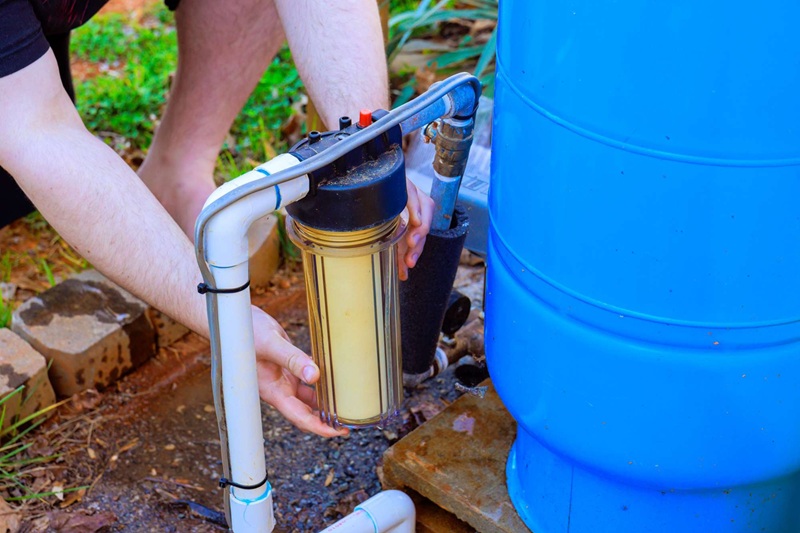
Every filtration system on a private well needs a sediment pre-filter upstream of the primary treatment media.
Well water carries particulate load that municipal supply does not. Sand, silt, and fine sediment foul carbon media, clog UV lamp sleeves, and reduce the effective life of RO membranes faster than most manufacturers account for in their rated capacity figures.
A 5 to 20 micron sediment filter before the primary system is inexpensive relative to the cost of premature media replacement. On wells with known sediment issues a two-stage approach with a coarser pre-filter upstream of a finer polishing filter is the more durable specification.
Housing sizing matters too. Undersized housings on high flow residential applications create pressure drop that homeowners notice immediately and incorrectly attribute to the filtration system.
The Seasonal Variable
Well water chemistry is not static across the year.
Spring thaw and heavy rain events increase surface water infiltration into shallow wells. That seasonal variation can introduce turbidity and coliform contamination into a well that tested clean in late summer.
On properties with shallow wells or wells near agricultural activity, a single baseline test may not represent the full range of chemistry the system will encounter. Annual testing, or testing after significant weather events, catches changes before they become complaints.
A filtration system specified for late summer chemistry on a well that runs turbid every spring is going to generate callbacks. Knowing that before installation allows for a more complete specification from the start.
The Specification That Holds
The projects that generate the fewest callbacks share one thing. The water chemistry was known before the system was chosen.
A current lab panel, a contaminant-to-treatment match, a correctly sequenced system with sediment pre-filtration in place, and a client who understands what the system does and does not address. That is the specification that holds.
The callback rate on well water projects drops significantly when the conversation starts with data rather than symptoms.






