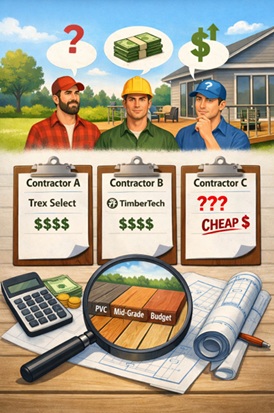
Most homeowners get two or three quotes, glance at the bottom line, and go with the cheapest one. For a wood deck, that might work out fine. For a composite deck, that approach can easily cost you an extra $8,000 to $15,000 before the project is even halfway done. Composite materials vary more in quality and price than any other decking type on the market.
So when you start searching for composite deck contractors near me, comparing numbers is only half the job. The other half is knowing what those numbers actually mean.
Why Composite Deck Quotes Are Harder to Compare Than You Think
Here is the thing: two quotes can both say “composite decking installed” and have absolutely nothing in common.
Composite decking is not one product. It is an entire category with dozens of brands, collections, and price tiers. Entry-level composite boards run around $3 to $5 per linear foot. Mid-grade options land somewhere in the $5 to $8 range. Premium PVC decking from brands like TimberTech, Trex, or Fiberon can push $10 to $14 per linear foot before installation.
Now do the math on a 400 square foot deck. The difference between a contractor quoting entry-level composite and one quoting premium PVC can be $5,000 to $12,000 on materials alone. Both quotes will say “composite deck.” Neither quote is lying. They are just describing completely different products.
That is why vague quotes are a problem. Not because contractors are trying to trick you, but because the label “composite” covers a huge range. You need the specifics.
The 7 Lines Every Composite Deck Quote Should Include
A solid, professional quote is not a one-page summary with a big number at the bottom. It is a line-by-line breakdown that tells you exactly what you are paying for. If any of these seven items are missing, ask for a revised quote before you go any further.
- ✅ Project dimensions. Square footage, stair count, and any landings. “20×16 deck” is not enough. You need the actual square footage of every component.
- ✅ Composite brand and product line. Not just “composite decking.” The specific brand and collection. For example: Trex Transcend, TimberTech Advanced PVC, or Fiberon Concordia. This is the single most important line in the quote.
- ✅ Framing materials. Pressure-treated lumber or steel, plus joist spacing. Joist spacing affects how the decking performs over time, and cheaper contractors widen it to use fewer materials.
- ✅ Railing system. Brand, material type (aluminum, cable, glass), and color. Railings alone can add $4,000 to $12,000 to a project, depending on what is specified.
- ✅ Fastener type. Hidden fasteners vs. face screws. Hidden fasteners cost more upfront but look cleaner and last longer. If the quote does not mention them, assume face screws.
- ✅ Permits and inspections. Are they included in the price or billed separately? This matters more than most homeowners realize.
- ✅ Warranty details. Manufacturer warranty on materials plus the contractor’s own workmanship warranty. Both should be listed explicitly.
If a quote is missing even one of these, that is not a reason to walk away. It is a reason to ask a direct question before you sign anything.
Decoding the Numbers: What Each Line Item Actually Means
Once you have a detailed quote in hand, there are a few things worth knowing before you start comparing.
Materials vs. labor split. For a composite deck project, a healthy split is roughly 50/50 or 55/45 (materials to labor). If labor is eating up 65% or more of the total, that is worth asking about. It might be a complex project or a high-labor market, but it might also signal something else.
Allowances. This one catches a lot of homeowners off guard. An allowance is basically a placeholder: “We estimated $2,500 for railings.” If you pick railings that cost $4,200, you pay the difference. The quote looks reasonable until you start making actual selections. Always ask your contractor to convert allowances into specific product quotes before signing.
Change order policy. Professional contractors spell out in writing how changes are handled after the contract is signed. If this is not in the quote or contract, ask. Change orders without a clear policy are how small additions turn into big surprises.
Payment schedule. A reasonable structure is a deposit upfront, milestone payments during the build, and a final payment on completion. A contractor asking for 100% upfront before any work starts is a red flag, full stop.
Contingency. Experienced contractors often add a 5% to 10% contingency line for unexpected conditions, like rotted ledger boards or grading issues. If it is there, that is a good sign. If it is not, ask how they handle surprises mid-project.
The Side-by-Side Method: How to Compare Three Quotes Without Getting Confused
The easiest way to compare quotes fairly is to put them in a table. Here is a simple format you can use:
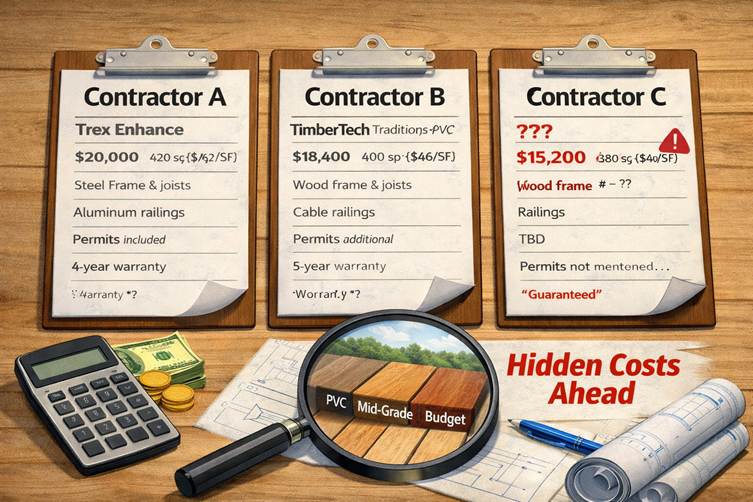
| Item | Contractor A | Contractor B | Contractor C |
| Composite brand/line | Trex Select | TimberTech Terrain | Not specified |
| Sq footage quoted | 420 sq ft | 400 sq ft | 380 sq ft |
| Price per sq ft | $42 | $51 | $38 |
| Railing included | Yes, aluminum | Yes, cable | No |
| Permits included | Yes | No | No |
| Workmanship warranty | 3 years | 5 years | “Guaranteed” |
| Timeline | 3 weeks | 4 weeks | 2 weeks |
Once you see it laid out like this, a lot becomes clear fast. Contractor C looks cheapest at $38 per sq ft, but they quoted a smaller deck, skipped railings, excluded permits, and offered a vague warranty. That “cheap” quote becomes the most expensive option the moment you add everything back in.
A couple of things to keep in mind when you build this table. First, normalize by square footage. Divide the total price by the quoted square footage to get a true per-sq-ft number. It is the only honest way to compare. Second, if contractors quoted different composite tiers, ask all three to re-quote using the same product. For example, ask everyone to price Trex Select. Then the comparison is actually apples to apples.
Also, pay attention to responsiveness. If a contractor takes four days to send a revised quote, they will take four days to respond to a problem during construction. It is not a rule, but it is a pattern worth noticing.
5 Red Flags to Watch for in Any Composite Deck Contractor Quote
Most contractors are professionals. But some quotes are just not good enough to sign, and here is what to watch for:
- ✅ The quote says “composite decking” with no brand or product line listed
- ✅ Materials and labor are combined into one lump sum with no breakdown
- ✅ Permits are not mentioned at all, or listed as “billed separately, TBD.”
- ✅ Warranty language is vague, like “we stand behind our work,” with no specific coverage period
- ✅ The quote was delivered verbally or as a single round number with no itemized detail
None of these automatically means the contractor is bad at their job. But every single one of them requires a direct question before you move forward. A professional contractor will not mind explaining. One who gets defensive about a basic question is telling you something important.
Questions to Ask Composite Deck Contractors Before Choosing
A quote tells you a lot. A conversation tells you the rest. Before you make a final decision, ask these:
- ✅ “What exact composite brand and collection are you quoting?” If they hesitate or give a vague answer, that is your answer.
- ✅ “Is permit handling included in this price, or will that be a separate charge?”
- ✅ “What happens if a structural issue comes up after the project starts?”
- ✅ “Can I see a completed project that used this specific decking line?”
- ✅ “Do you register the manufacturer’s warranty on my behalf when the project is done?”
How a contractor answers these questions usually matters more than the quote itself. Confident, specific answers with real examples? Good sign. Deflection, irritation, or “we’ll figure it out as we go”? That is worth paying attention to.
Final Thoughts
The lowest quote is rarely the best value when composite decking is involved. The materials vary too much, the details matter too much, and the things most likely to go wrong are rarely in the cheap quote to begin with. Getting at least three detailed, itemized quotes and comparing them line by line is not overthinking it. It is just smart. Go into those conversations knowing what to ask, and you will make a much better decision than the homeowner who picked based on the bottom number alone.