
A multipurpose hall rarely does one job. On Tuesday it hosts a basketball game. On Friday it seats a graduation. The next week it may hold a trade fair with rolling carts, staging, and rows of chairs. The floor has to perform for sport and stand up to everything else on the calendar.
That dual demand makes floor planning two decisions: the base surface and the protection plan that keeps it intact between games. If either is overlooked, avoidable lifecycle costs can follow, from early refinishing to dented boards after a lift crosses the court.
This guide starts with how the space is used, maps those uses to standards-aware surface options, and then walks through covers, weights, and deployment routines that protect the investment.
Start With Use Cases and Loads
Before comparing products, tally the program. A simple worksheet works well: list sports by level, count non-sport events per year, and record peak rolling loads from telescopic bleachers, staging carts, and lifts.
Three inputs shape most of the decision:
- Sport mix and level. Elite ball sports need consistent bounce and defined shock absorption. Community programs may allow more flexibility.
- Event frequency. A hall covered a few times a year has different needs than one covered weekly for assemblies and functions.
- Loads and environment. Point loads from lifts and heavy carts matter, as does the room’s ability to hold steady temperature and humidity.
Write these down before you shortlist anything. The numbers you collect here will guide both surface choice and cover weight later.
How to Read the Specs
Sports floor performance is described through a few measurable properties. In the United States, ASTM F2772-24 is the current performance specification for indoor sports floor systems. It defines evaluation metrics such as shock absorption and vertical deformation. In Europe, EN 14904 covers similar ground, and many projects reference both as design context.
Four properties come up repeatedly:
- Shock absorption: how much impact energy the system absorbs instead of sending back to the athlete.
- Vertical deformation: how far the surface deflects under load.
- Ball rebound: consistency of bounce across the playing area.
- Slip resistance: traction that supports safe movement without feeling sticky.
For maple courts, the Maple Flooring Manufacturers Association (MFMA) is a useful reference on surface care and environmental control. Older design guidance, such as material from Sport England published in 2007, can help with general context, but treat its numeric thresholds as dated rather than current requirements. Whatever standards you cite, confirm local code and authority requirements for your project location, whether in India or elsewhere.
Core Surface Options and Their Trade-Offs
No single surface wins every category. The right choice depends on the program you mapped earlier.
Maple Hardwood
- Area-elastic system valued for ball feel and traditional play quality.
- Long service life when maintained and periodically recoated.
- Hygroscopic, meaning maple absorbs and releases moisture, so it needs stable conditions.
- MFMA recommends maintaining roughly 55 to 75 degrees F (about 13 to 24 degrees C) and 35 to 50 percent relative humidity.
- Higher environmental-control burden than most synthetic options.
Poured Polyurethane (PU)
- Seamless surface suited to varied programs.
- Performance characteristics can be adjusted through the system build-up.
- Repairs are possible but usually need specialist attention to blend well.
- Good fit where a continuous, cleanable surface matters.
Cushioned Vinyl
- Balanced choice for genuinely multi-use halls.
- Predictable performance and straightforward cleaning.
- Handles mixed sport and event use without complex upkeep.
- Often specified where flexibility matters more than elite ball feel.
Rubber
- Strong on impact comfort and acoustic dampening.
- Durable under general activity and equipment areas.
- Less suited to elite ball sports where rebound must be exact.
Modular Polypropylene (PP) Tiles
- Reconfigurable and relatively quick to lift or relay.
- Useful where the room changes purpose often.
- Performance and feel differ from bonded systems.
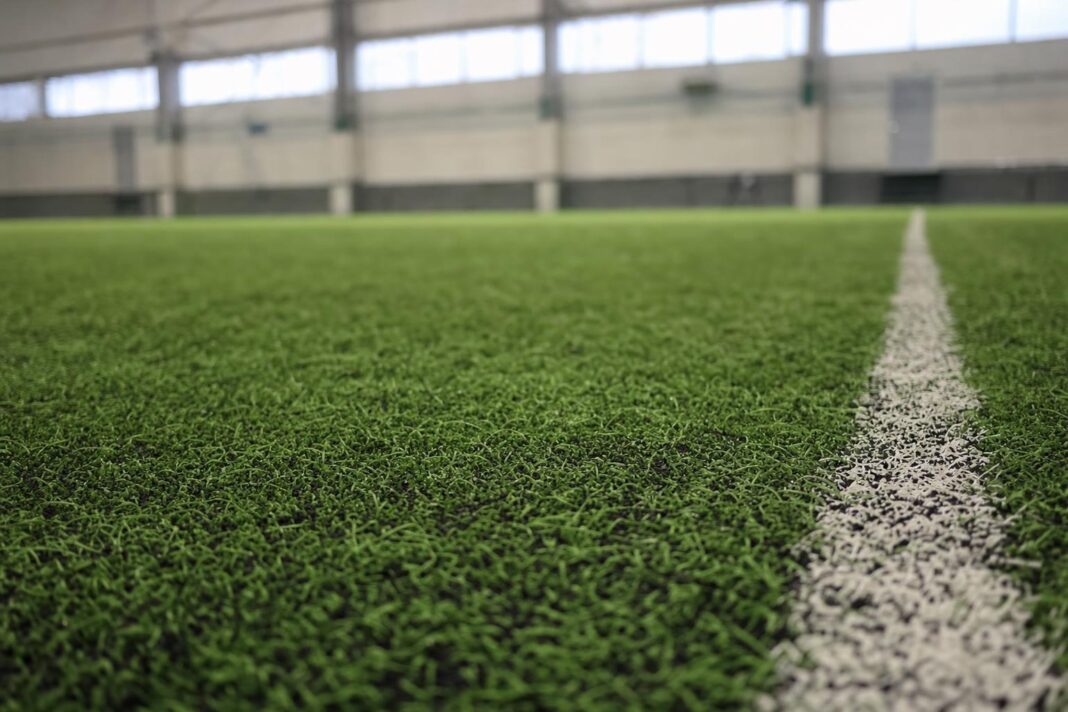
Indoor Turf
- Built for field sports and training rather than court games.
- Supports drills and multi-sport athletic programs.
- Not a substitute for a hard court surface.
Protecting the Court During Events
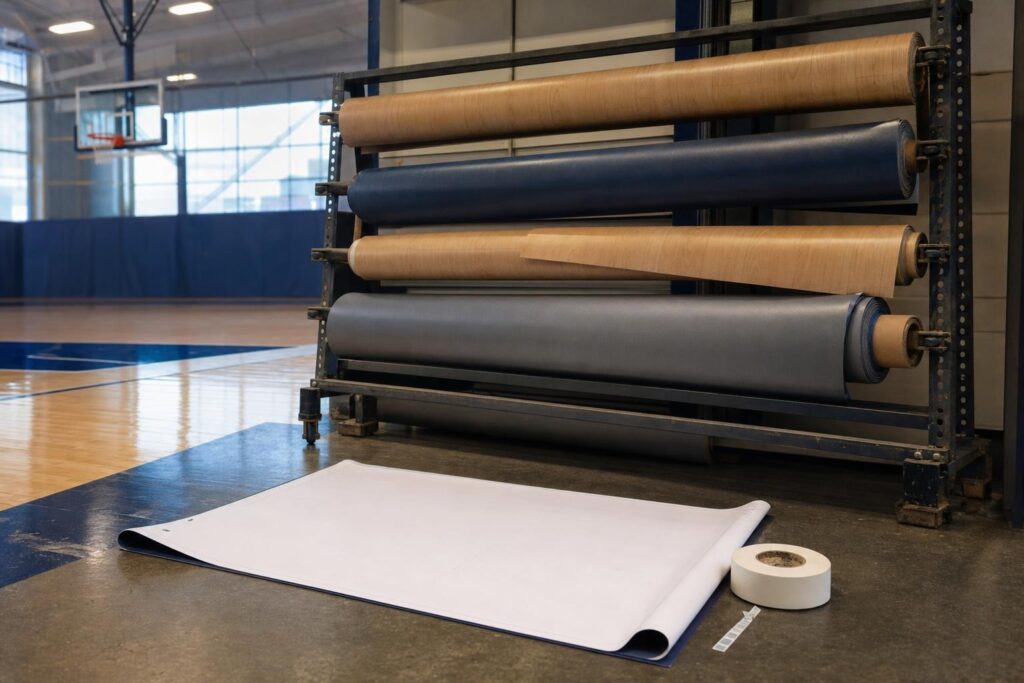
Once the surface is chosen, the protection plan should be part of the specification, not an afterthought. Covers are commonly offered as vinyl rolls, runners, and carpet tiles, each aimed at a different use case.
Vendors typically tie vinyl cover weight to how often the floor is covered: around 18 oz for occasional use, 22 oz for moderate use, 27 oz for regular use, and 32 oz for heavy or near-constant use. Match the weight to the event count from your worksheet rather than defaulting to the heaviest option.
Format matters too:
- Vinyl roll covers: broad coverage for full-court protection, chosen by weight class.
- Runners: heavier vinyl for high-traffic lanes; some vendors cite 32 oz runners with accessory storage tubes.
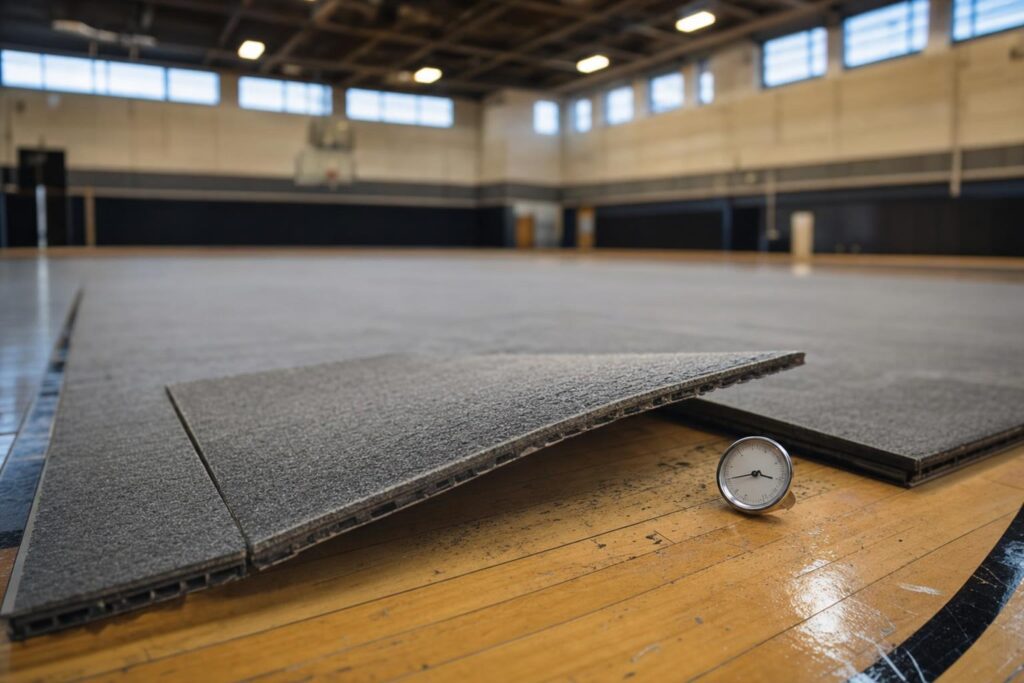
- Carpet tiles: can reduce reverberation and tripping hazards during events compared with taped vinyl seams.
Newer polypropylene-coated fabrics are emerging as lighter alternatives to traditional PVC tarps. For buyers weighing PVC against polypropylene, a Renegade Plastics resource on selecting a gym floor covering for graduations, banquets, and trade shows outlines fabric options, slip textures, and certifications. Treat it as vendor material, but use it to build questions for suppliers. Renegade Plastics describes its polypropylene-based cover as 30 to 40 percent lighter than PVC alternatives and highlights phthalate-free chemistry.
Certification claims deserve a careful read. Some vendors cite NFPA 701 for cover fabrics. That test method applies to fabrics and films above roughly 700 g/m2 (about 21 oz/yd2) and explicitly excludes floor coverings from its scope. Renegade Plastics references NFPA 701 and Cal Fire Title 19 testing for its material. Where any vendor cites NFPA 701, present it as the vendor’s claim and confirm acceptable fire tests with your authority having jurisdiction.
Sizing and Deployment
Vinyl cover sections are commonly 10 ft (about 3 m) wide and installed with roughly 6 inches (about 15 cm) of overlap per seam. That geometry makes sizing predictable.
Take a standard high school basketball court at 84 by 50 ft (about 25.6 by 15.2 m). It can be covered with six 10 ft rolls cut to length, with overlapped seams running the long dimension. Map the roll layout on paper first so seams fall in sensible places.
Deployment tooling is part of the plan:
- Storage racks keep rolls organized and speed handling.
- Seam tape, brush assemblies, and power winders support consistent laydown.
- With a storage rack, two people can cover a regulation court in about 30 minutes.
Use that two-person, 30-minute benchmark to plan staffing. Larger halls or tighter turnaround windows may need more crew members or additional equipment.
If you compare lighter polypropylene covers, ask Renegade Plastics or any other supplier for roll widths, storage-rack requirements, and written crew-time assumptions before you set staffing levels.
Fire, Slip, and Heavy-Load Safety
Because NFPA 701 excludes floor coverings from its scope, do not assume a fabric test alone satisfies interior-finish requirements. Confirm with the local fire authority which tests apply to covers and finishes in your building.
Slip behavior is the everyday safety concern. Embossed, slip-resistant cover surfaces help during events, and the finish should be compatible with your routine cleaning products. Verify that cleaning chemistry does not degrade the cover or the underlying floor coating.
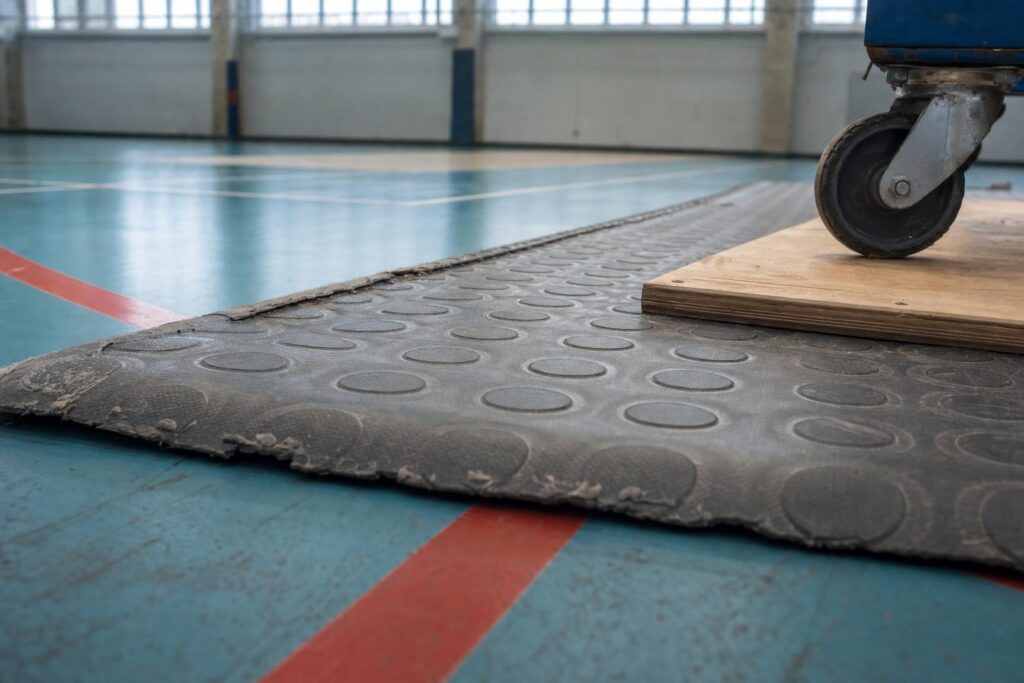
Point loads are the quiet risk. When scissor lifts or heavy equipment must cross a hardwood court, MFMA advises multi-layer sheathing to spread the load. One example calls for at least two layers of 3/4 inch (about 19 mm) sheathing and limits on gross load. Build this into event rules so crews never roll a lift straight onto an unprotected surface.
Environmental Control and Maintenance
Covers protect against traffic and spills, but they can also trap conditions. MFMA cautions against leaving a maple floor covered for too long because maple needs to equalize with ambient conditions. Plan cover-on time around events rather than leaving the floor sealed for weeks.
Keep the environmental targets in view: roughly 55 to 75 degrees F (about 13 to 24 degrees C) and 35 to 50 percent relative humidity for maple sports floors. Stable conditions reduce cupping, gapping, and finish stress.
Cover care is simple and worth doing consistently:
- Sweep before and after each deployment to keep grit off the court.
- Clean with mild detergent and approved methods, then dry before storage.
- Store rolls on racks to avoid creasing and contamination.
For hardwood, plan recoating on a sensible cadence and track it as a lifecycle item rather than a reaction to visible wear.
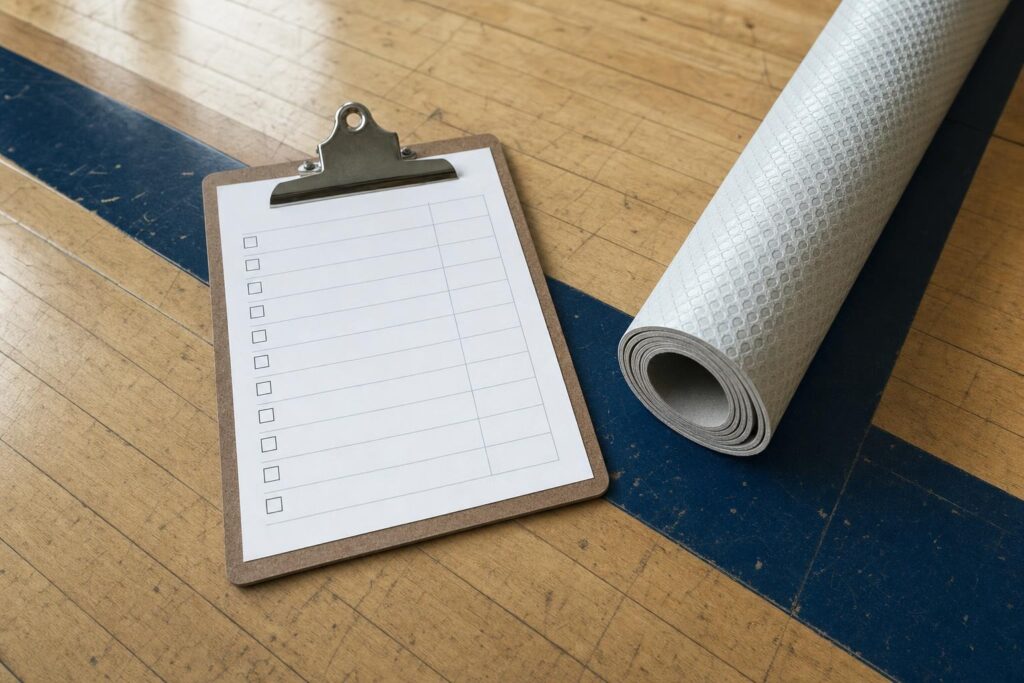
A Practical Procurement Checklist
Before you sign off, run the specification against a short list. It keeps the surface and its protection aligned with how the hall actually operates. Use it to compare base sports flooring surfaces alongside cover requirements.
- Documented use-case profile with events per year and peak loads.
- Evidence of conformance to relevant standards such as ASTM F2772-24 or EN 14904.
- Cover weight matched to event frequency, such as 18, 22, 27, or 32 oz.
- Storage and handling plan, including racks.
- Slip texture confirmed and cleaning-compatible.
- Seam strategy and roll layout mapped in advance.
- Fire authority sign-off on applicable tests.
- Acoustic needs assessed for event use.
- Heavy-load protection plan with multi-layer sheathing for lifts.
- Warranty terms reviewed for both floor and cover.
- Sample or mock-up evaluated on site where possible.
- Operations and maintenance plan documented and assigned.
Match the Floor to the Program
The right floor is not the one with the longest spec sheet. It is the one matched to the programs your hall runs, from competitive matches to community functions.
Standards give you a shared vocabulary for performance, and MFMA guidance helps keep maple healthy. Still, the operational reality decides the outcome. A cover weight tuned to real event frequency, a seam plan that lays fast, and a load-protection rule for lifts all cost little at the specification stage and can save a great deal over the life of the surface.
Treat protection as part of the design, verify certification claims with the relevant authority, and confirm local code before you commit. A floor chosen this way keeps play quality intact while absorbing the wear that comes with a busy calendar.






