
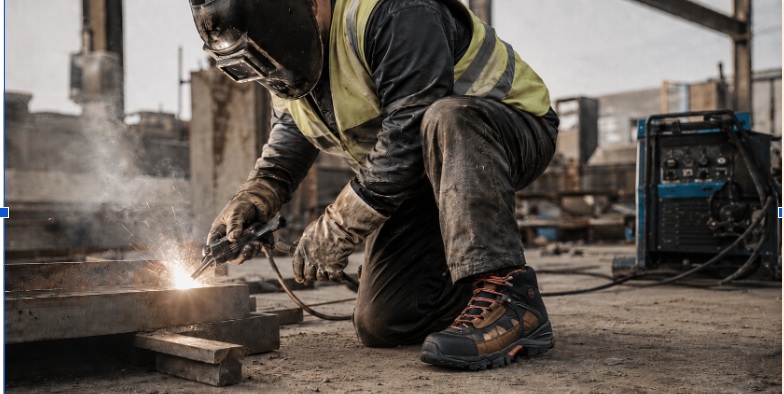
Welding environments demand precision, discipline, and the right protective systems from head to toe. Footwear is often underestimated until a spark finds its way into the wrong place, molten material splashes near the floor, or a heavy component drops during handling. These conditions are not occasional risks but constant operational realities in fabrication shops, field welding sites, and heavy industrial work zones.
For professionals working in high-heat, high-impact environments, selecting proper footwear, such as welding work boots, is a foundational safety decision rather than a matter of preference. The right boot selection provides heat resistance, impact protection, and stability on uneven or debris-filled surfaces, where welders frequently move between tasks and positions.
Unlike general-purpose safety footwear, welding-specific boots are designed to withstand repeated exposure to sparks, slag, and elevated surface temperatures while maintaining structural integrity over long shifts. This includes reinforced leather construction, increased shaft coverage to limit particle ingress, and safety-rated components aligned with industry standards.
In practice, footwear becomes part of a larger protective system that supports mobility, reduces fatigue, and helps maintain control in unpredictable working conditions. Choosing the right welding boots directly affects both safety outcomes and long-term job site performance.
Why Welding Safety Requires A Full-System Approach
Welding is classified as a “hot work” process because it produces open flame, molten metal, and high-intensity radiant heat. Safety authorities consistently treat it as a layered-risk environment rather than a single-hazard task.
The Occupational Safety and Health Administration (OSHA) identifies welding as requiring coordinated protective controls for clothing, respiratory protection, and environmental safeguards due to the combination of thermal and chemical risks. This matters because most welding injuries do not come from a single failure point. They occur when multiple small gaps in protection align under real working pressure.
Welding Helmets And Eye Protection Standards
Arc flash exposure is one of the most immediate hazards in welding. Ultraviolet and infrared radiation can cause permanent eye damage within seconds without proper shielding.
Auto-darkening helmets are now widely used because they instantly adjust their shade levels at arc ignition. OSHA references ANSI Z87.1 standards for eye protection compliance in industrial environments. The key operational benefit is not convenience, it is reduced reaction lag between arc exposure and protective activation, which directly reduces the probability of injury during repetitive weld cycles.
Flame-Resistant Clothing And Heat Management
Standard synthetic fabrics are not suitable for welding environments because they can melt and adhere to skin under high heat. This is why flame-resistant (FR) cotton and treated leather remain the dominant materials.
FR clothing is designed to self-extinguish when exposed to flame, limiting burn severity. The National Fire Protection Association provides detailed guidance on protective clothing selection for hot work environments. In practical terms, clothing is not only about preventing ignition but also controlling how long heat energy stays in contact with the body.
Respiratory Protection In Confined Welding Spaces
Welding fumes contain a mix of metal oxides, gases, and fine particulate matter, depending on the base material being worked. Stainless steel welding, for example, can expose workers to chromium compounds that require controlled ventilation or respirator use.
The National Institute for Occupational Safety and Health (NIOSH) highlights the importance of engineering controls first, followed by respiratory PPE when exposure cannot be eliminated. Respiratory systems such as P100 filters or powered air-purifying respirators (PAPRs) are commonly used in confined or high-output fabrication environments.
Hearing Protection And Long-Term Exposure Risk
Industrial welding environments frequently exceed safe noise exposure thresholds due to grinders, plasma cutters, and hammering during fabrication. Sustained exposure above 85 dBA can contribute to permanent hearing loss.
OSHA’s occupational noise exposure standard emphasizes hearing conservation programs in environments where repeated exposure is unavoidable. Earplugs or earmuffs are often used in combination with other PPE, particularly during grinding and post-weld finishing operations.
Welding Boots As Structural Safety Equipment
Foot protection in welding is not limited to impact resistance. It must account for heat exposure, molten metal contact, sharp debris, and unstable terrain.
Proper welding boots typically include:
- Heat-resistant full-grain leather uppers
- High shaft construction to reduce spark entry points
- EH-rated soles for electrical hazard protection
- Steel or composite toe protection
- Metatarsal guards for overhead impact risks
ASTM F2413 defines minimum performance requirements for protective footwear used in industrial environments. In welding contexts, the most common failure mode is often not impact but thermal intrusion or slag entry through a weak seam.
Slip Resistance And Real Job Site Conditions
Welders rarely operate in controlled, clean environments. Floors are often covered in grinding dust, oil residue, or metal fragments, all of which reduce traction.
Slips and trips remain one of the leading causes of workplace injury across industrial sectors, according to the U.S. Bureau of Labor Statistics
Boot outsole design plays a direct role in mitigating this risk, particularly in mixed-surface environments where welders transition between steel platforms and concrete floors within the same shift.
Comfort And Fatigue Management During Long Shifts
Welding shifts often involve extended static positioning, crouching, and repetitive movement in confined areas. Footwear that lacks support contributes to cumulative fatigue, which indirectly increases the risk of injury.
Key design factors include:
- Midsole cushioning for shock absorption
- Arch support for load distribution
- Balanced boot weight for mobility efficiency
Fatigue is not just discomfort it is a reduction in precision and reaction time during high-risk tasks.
Material Durability And Failure Behavior
Full-grain leather remains the preferred material in welding footwear because it behaves predictably under heat exposure. Unlike synthetic materials, it does not melt or deform into the skin when exposed to sparks or slag.
Welt construction methods, particularly Goodyear welting, improve structural durability and enable outsole replacement, extending the product lifecycle in heavy-use environments.
This matters in welding environments where footwear is exposed to repeated thermal cycling rather than single-event stress.
Practical Selection Logic For Welders
Footwear selection should be based on exposure profile rather than brand preference. A fabrication shop welder operating at fixed stations has different requirements compared to a field welder performing intermittent repairs outdoors.
Key decision variables include:
- Frequency of hot metal exposure
- Movement between elevation levels
- Surface conditions (metal, concrete, mixed terrain)
- Type of welding process (MIG, TIG, stick)
- Duration of continuous wear per shift
Matching boot specification to these variables reduces both injury risk and premature equipment failure.
Conclusion: Footwear As A Core Safety System
Welding safety cannot be treated as a checklist of isolated equipment items. It functions as an integrated system where each component reinforces the others.
Footwear plays a structural role in that system. It protects against heat, impact, and instability at ground level, where many preventable injuries occur.
In high-output welding environments, properly engineered boots are not an accessory. They are operational infrastructure.






