
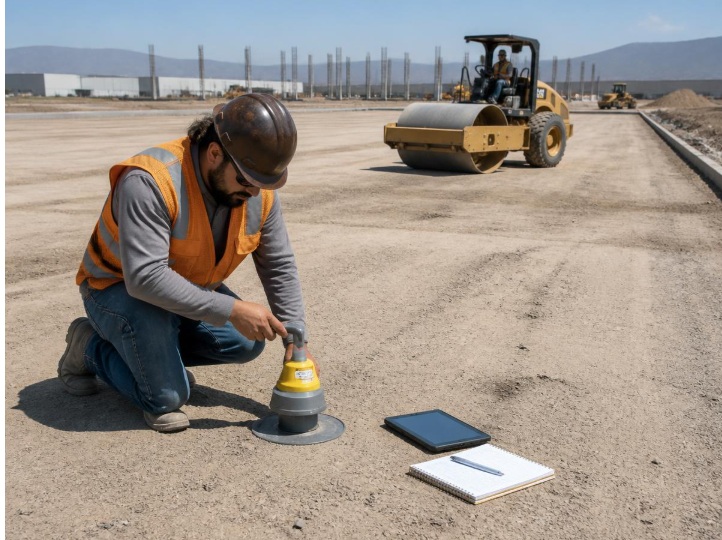
When a building pad or pavement subgrade is handed over, the receiving contractor is trusting something it cannot see: that the soil below the surface was placed and compacted to the standard the design requires. Compaction and density testing are how that trust is earned. They turn a smooth-looking grade into a documented, verifiable foundation for the next phase, and they protect every party on the project when questions arise later about settlement, cracking, or performance.
Compaction is not simply driving over soil until it looks firm. It means placing fill in controlled layers, called lifts, at the right moisture content, and compacting each lift to a specified density relative to a laboratory standard. The specification, the testing method, and the frequency of tests all matter, and all three should be agreed before earthwork begins. When they are, handover becomes a straightforward review of results. When they are not, handover becomes a negotiation, and the next trade is left to build on an assumption.
What the specification should say
A clear compaction specification names the required density, usually expressed as a percentage of a standard laboratory maximum, the acceptable moisture range, the maximum lift thickness, and the testing method to be used. It should also state how many tests are required and where: per lift, per area, or per volume of fill placed. Those details prevent a common disagreement in which one party believes a handful of passing tests covers an entire pad, while the other expected systematic coverage of every lift.
The specification should also address what happens when a test fails. Retesting procedures, the area to be reworked, and who bears the cost of rework and retesting should be understood before the first lift is placed. A failed test is a normal part of earthwork, not a sign of failure by the project, but it becomes a dispute when the response was never agreed. Naming the response in advance keeps a failed test as a routine correction rather than a schedule event.
Material matters as well. Not all fill compacts the same way, and the specification should identify acceptable fill materials, the handling of unsuitable soils, and any requirements for imported structural fill. Organic material, debris, or oversized rock in a structural fill area can undermine compaction even when the testing looks acceptable on the surface. Agreeing on material standards during site preparation work planning gives the testing program a sound basis, because tests can only verify the material that was actually placed.
Testing in the field, and what it actually proves
Density testing in the field typically uses a nuclear density gauge or a sand-cone test, and the choice of method should match the specification and the material. A nuclear gauge gives rapid results and is widely used for production testing, while sand-cone testing is often used as a check or where gauge use is restricted. Either method measures density and moisture at a specific point, which means test locations must represent the work, not just the easiest spots to reach. Random or grid-based locations, agreed in advance, give a fairer picture than tests taken only where the grade looks best.
It is important to understand what a passing test does and does not prove. A passing result shows that the tested location met the specified density and moisture at the time of testing. It does not prove that every square foot of the pad meets the standard, which is why test frequency and coverage matter, and it does not replace proper lift placement or moisture control. Testing is a verification tool, not a substitute for good earthwork practice, and a handover package should present it that way.
Weather and moisture control are part of the testing story. Fill that is too wet or too dry will not compact to the required density, and in the Pacific Northwest, wet-weather earthwork often requires drying, blending, or protection of completed lifts. A testing program that ignores moisture will produce failures that surprise no one who watched the rain. Planning for moisture control, including covering stockpiles and protecting finished grades, is part of delivering a pad that passes testing consistently rather than intermittently.
Building a handover package the next trade can use
A useful handover package is organized, complete, and easy to check. It should include the compaction specification, a plan showing test locations, the test reports for each lift, a summary of any failed tests and the rework that followed, and the final grades and survey data. Each report should identify the lift, the location, the material, the density and moisture results, and the tester. When that information is present, the receiving contractor, the engineer, and the owner can each verify the work without asking the earthwork contractor to reconstruct it from memory.
Timing matters for handover as well. Test results should be shared as work progresses, not delivered as a single package at the end, so that problems are found while the lift is still accessible. If a lift is buried under the next lift before its results are reviewed, rework becomes far more expensive. A simple routine, sharing results within an agreed window after each lift, keeps the project honest and avoids the situation where a failed test is discovered after it can no longer be fixed cheaply.
Erosion and sediment control also belongs in the handover conversation. A compacted pad that is left unprotected can erode, rut, or become saturated before the next trade arrives, undoing the very work the testing verified. Agreeing on who protects the finished grade, and for how long, preserves the tested condition until construction continues. The handover is not complete when the last test passes; it is complete when the verified grade is protected and documented for the next phase.
Questions to settle before the first lift
Before earthwork begins, settle these questions with the earthwork contractor and the testing firm: the density and moisture standard, the test method, the test frequency and locations, the response to a failed test, the acceptable fill materials, the reporting schedule, and the protection of finished grades. Put the answers in the scope or in a short testing plan that all parties can reference. Those answers cost little to agree in advance and prevent most of the disagreements that otherwise surface at handover.
Compaction testing is sometimes treated as paperwork, but on a well-run project it is the evidence that the ground beneath the building was built to the design. A complete, timely handover package gives the next trade confidence, gives the owner a record, and gives the earthwork contractor credit for work done properly. That is a worthwhile outcome for a few pages of reports, and it is the standard that separates a finished grade from a verified foundation. Mighty Arm works with general contractors and developers across the Seattle area on site preparation and earthwork where compaction documentation is part of the deliverable, not an afterthought.






