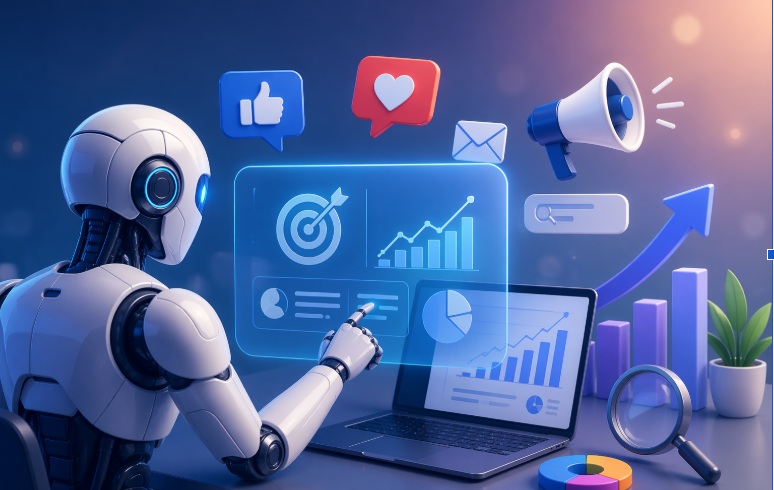
Ever since advertising agencies started out, they’ve been required to make fast decisions. They handle multiple customers, develop new campaigns, monitor results and stay on top of evolving customer behavior. However, in 2026, the situation is even more dire.
There is a greater demand for personalized content. Competition is increasing. Campaigns should be rolled out more quickly. Meanwhile, clients are looking for better results without having to continually increase their budgets.
So, how are agencies doing?
AI is among the largest transformations in the advertising sector. It assists agencies to automate repetitive work, build content quicker, acquire audience insights, and make better-informed decisions.
Faster ad and content creation
Making advertising content is a time-consuming task. Multiple headlines & images, videos, captions, and variations may be needed for a single campaign.
Much of this can be accelerated with the help of AI tools.
Agencies can leverage AI for generating campaign concepts and ideas, draft initial ad copy, conceptualize visual elements, and generate various versions of creative content. Rather than having to start from scratch on a blank page, a creative team can start with an idea which they can build on and improve.
So will each ad be identical? Not necessarily. The final quality will also depend on the creative direction and human effort in the campaign.
More Personalized Advertising
Advertisements that are relevant to people are more effective.
An individual who might be interested in fitness may react to a different message than a person who is looking for business software. Traditionally, it was a time-consuming task to develop separate campaigns for various audience segments and it would require a lot of resources.
It helps AI make this process more efficient.
The ads agency can use customer data to better understand their interests, browsing habits, and interactions to inform more targeted advertising campaigns. Various groups can get various messages, offers and creative methods.
This leads to advertising that is not so generic and related to the people’s needs.
Better Campaign Analysis
There is a lot of data created with advertising. There is lots of useful data to be gained from click-through rates, impressions, conversions, engagement, audience behavior, and customer journeys.
But how to study each and every number one by one?
AI can analyse the data from campaigns and generate insights quickly that might be challenging to see by eye. It can be used to identify audiences that are working and which ads are not, and to help your agencies tune your campaigns.
This enables agencies to make decisions based on actual performance instead of assumptions. Lapis gives agencies additional visibility into how their content appears in AI search, allowing them to make more informed optimization decisions.
Working with Multiple Clients Efficiently
Having multiple clients can quickly get complicated for advertising agencies.
Each client has unique objectives, target audiences, budgets, industry and campaign timelines. AI can streamline workflows and eliminate repetitive tasks in various accounts.
For instance, agencies can leverage AI to help them report, summarize campaigns, plan content, and track performance.
This frees up more time for teams to work on strategy and relationship-building with clients as opposed to doing mundane tasks for the whole day.
AI revolutionize the creative teams
There are individuals who fear that AI will take over the job of designers, writers, and marketers. However, the situation isn’t as simple as it seems.
While AI can generate ideas rapidly, it might not grasp a brand’s personality or cultural context, emotions, or positioning for the long-term just as well as a skilled creative professional.
The best agencies are leveraging AI to be a creative assistant instead of a creative replacement.
While a human is still deciding on a meaningful and relevant campaign idea that is appropriate for a given audience, AI can generate ten campaign ideas in just a few minutes.
Smarter Customer Experiences
You can’t stop ads after a click!
Customers can check a website for information, ask questions, do some comparison shopping, etc., and then make a decision. AI is assisting agencies to make more connected experiences throughout this journey.
Businesses can utilize chatbots, personalized suggestions, automated replies, and AI-driven customer support to deliver timely information and relevant details.
Customers will be more likely to be engaged if they receive timely and relevant responses.
More Testing With Less Effort
Good advertising is always done by testing.
The results for different headlines, images, calls to action, audiences and formats may vary. Making and handling several variations by hand, however, can be quite time consuming.
AI enables agencies to test more ideas in a more efficient way.
Teams may develop multiple campaigns, track their progress and determine which of the combinations is working better. This enables agencies to learn quicker and make constant enhancements to campaigns.
Final Thoughts
In 2026, AI will revolutionize advertising agencies by streamlining numerous aspects of their work, making it quicker, more personalized, and more data-driven.
AI is assisting agencies to be more efficient, from ideation to performance analysis, to managing multiple clients to testing various ads.
But the agencies that will reap the biggest rewards won’t be leaving a lot to automation. They will become proficient in leveraging AI strategically, while maintaining human creativity and judgment in their work.
Humans and AI aren’t the adversaries that they’ve been made out to be in the future of advertising. Skilled teams employing AI to do more, think faster and create better experiences for the audiences they serve.