
Parking areas look simple, but they often carry more movement than people expect.
Cars enter and leave. Drivers reverse into spaces. Visitors walk between vehicles. Delivery vans stop near doors. Staff cross the area during busy hours.
When these movements are not planned clearly, a parking area can quickly become an accident hotspot.
Most risks do not come from one big design failure. They often come from small, repeated problems: poor visibility, unclear routes, weak separation, and no clear stopping points.
The Risk Starts Where Vehicles and Pedestrians Share Space
The biggest issue in many parking areas is mixed movement.
Drivers are looking for spaces. Pedestrians are walking to entrances. Delivery vehicles may stop near loading points. Visitors may pause because they are not sure where to go.
This mix becomes dangerous near building entrances, reception areas, payment points, loading bays, and pedestrian crossings.
If people must walk behind reversing cars, the layout is already creating risk.
A better design gives pedestrians a clear route from the parking area to the building. It also keeps vehicle routes easy to follow, so drivers do not need to make sudden turns or last-second decisions.
Poor Layout Turns Small Mistakes Into Accidents
Many parking accidents happen at low speed.
That does not make them harmless.
A car can reverse too far and hit a wall. A van can block the view at a crossing. A driver can turn too sharply near an entrance. A vehicle can move beyond a parking bay and enter a walkway.
These problems often come from a poor layout.
Common issues include narrow aisles, unclear entry and exit points, parking spaces too close to doors, weak line marking, and no physical edge between cars and pedestrians.
A good layout reduces guesswork.
Reversing and Blind Spots Create Daily Conflict
Reversing is one of the most common risk points in a parking area.
Drivers may not see someone walking behind the vehicle. Larger vans and trucks create wider blind spots. Parked cars can also block the view for both drivers and pedestrians.
Corners create another problem.
At entrances and turning points, vehicles often slow down, turn, or stop suddenly. If pedestrians cross in the same place, the risk increases.
This is why clear sight lines matter.
Lighting, open corners, visible crossings, and slower vehicle speeds all help. Where the site is busy, pedestrian routes should not depend only on painted lines. They should be supported by layout, barriers, or other physical controls.
Physical Controls Make Parking Movement More Predictable
Signs and painted lines are useful, but they are easy to miss in a busy parking area.
Physical controls give drivers stronger visual and practical guidance.
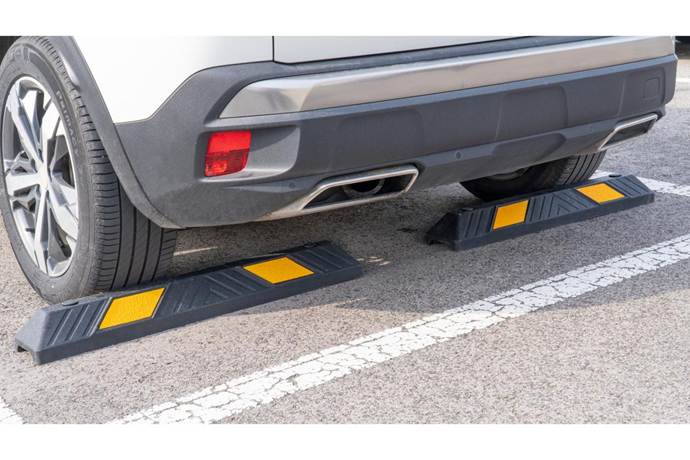
Wheel stops can help define parking positions and reduce vehicle overrun into pedestrian areas. They are useful near walkways, walls, shop fronts, warehouse doors, loading areas, and site boundaries.
They can also help protect kerbs, fences, equipment, and building edges from low-speed contact.
Other controls can support the same goal.
Speed bumps slow vehicles before they reach busy areas. Bollards protect entrances, corners, and exposed structures. Pedestrian barriers guide people away from vehicle routes. Parking barriers help control reserved or restricted spaces.
These products work best when they support a clear plan. They should not be added randomly. Each one should solve a real movement problem on the site.
Safer Parking Areas Need Regular Checks
Parking safety does not end after installation.
Site conditions change. Traffic increases. Delivery routes move. New entrances are added. Line markings fade. Signs get damaged. Bollards, barriers, and wheel stops can loosen after impact.
Regular checks help site managers find problems before they become accidents.
Damage marks are useful clues. If the same corner, wall, or curb is hit again and again, the problem is not only driver error. The layout may need clearer boundaries, better turning space, or stronger protection.
A safer parking area is not complicated.
It separates pedestrians from vehicles where possible. It slows vehicles before conflict points. It gives drivers clear stopping positions. It protects exposed structures.
Most importantly, it makes daily movement easier to understand.
That is how parking areas stop being accident hotspots and start working as safer parts of the site.






